dailynewsnblog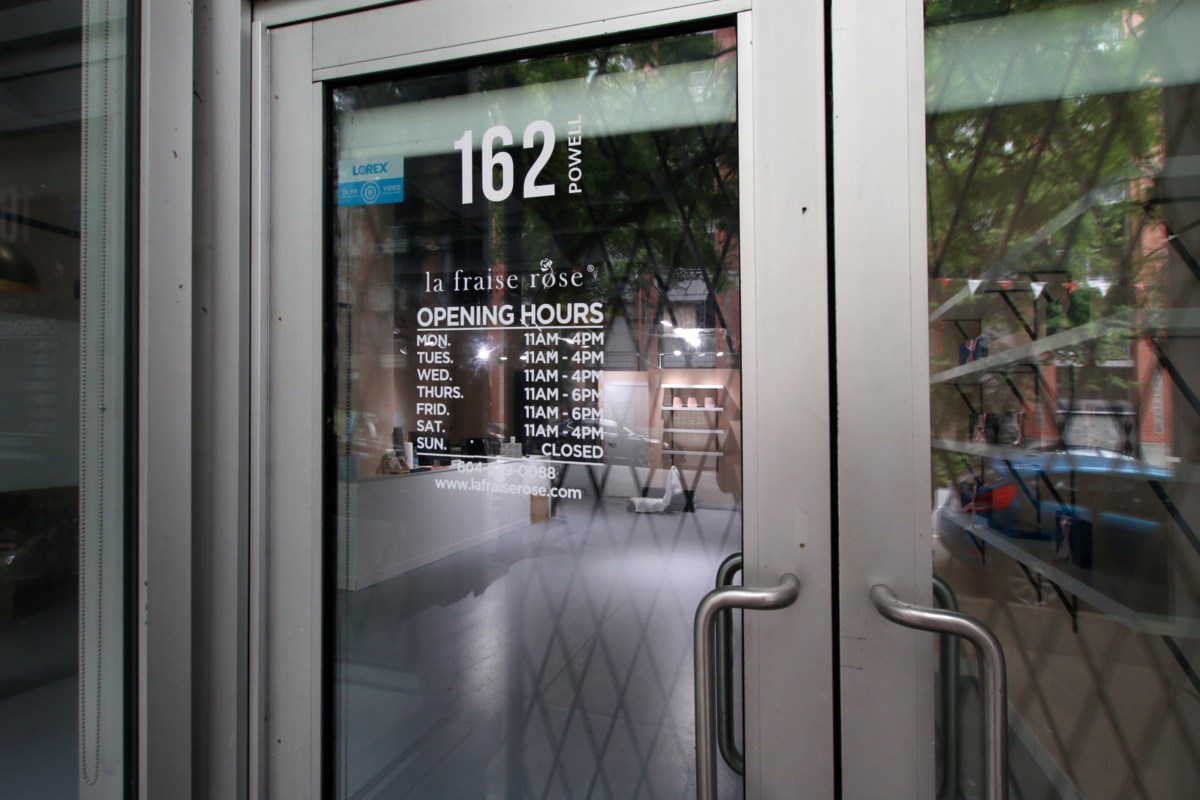
CanaCap accused of using ‘instant funding agreements’ as a guise to charge interest rates up to 25 times the legal limit
A Vancouver chocolate and flower company has launched a class action lawsuit against several corporate lenders, alleging they conspired to trap distressed small businesses with criminal interest rates.
Filed May 29 in B.C. Supreme Court, La Fraise Rose alleges a network of companies under the CanaCap brand provided several “instant funding agreements” intentionally designed to circumvent the law.
The Vancouver company claims it received less than $39,000 but had over $73,000 debited from its account—paying back nearly double what it borrowed at interest rates that allegedly spiked to 25 times the legal limit.
None of the claims have been tested in court.
Business in Vancouver reached an individual at CanaCap who identified himself as Adam.
“We’re not interested in talking to you,” he said over the phone.
CanaCap did not respond to an email seeking comment.
Instant funding allegedly used as ‘guise’ to charge illegal interest
Founded in 2021, the owner of La Fraise Rose began selling gift boxes of chocolate-dipped strawberries as a side hustle. As the business grew, it began selling floral arrangements for special events and opened a location at the CF Richmond Centre shopping mall.
The company opened another location off Vancouver’s Cambie Street in 2022 before moving to a larger location in Gastown.
In 2023, financial pressure was mounting. That’s when the company turned to the internet and in a Google search discovered the company CanaCap.
“At that time, CanaCap represented that it offered financing solutions for businesses in need of funding,” states the petition.
The companies offered what are described in the court challenge as “instant funding agreements” to distressed businesses.
The agreements were marketed as loans that could get approved within an hour and paid out the same day. Drafted by the lenders, terms of the agreements were presented to the class members as “non-negotiable,” according to the petition.
In exchange for instant cash, the class members agreed to a one-year term that automatically renews every year. Borrowers could terminate the agreement but only if they didn’t still owe money and only if they did so in writing 90 days before renewal, the petition states.
Between September 2023 and March 2026, La Fraise Rose entered into seven instant funding agreements, each one giving the company “immediate funds” to operate its business.
The Vancouver company claims that the instant funding agreements were used as a “guise” to debit funds from it and other class members’ bank accounts in a way that was “oppressive, arbitrary, and unlawful.”
As a result, the chocolate and flower company claims the lenders were “unjustly enriched.”
Business in Vancouver contacted the company’s founder, but she declined to be interviewed.
Interest rates spiked 25 times legal limit, claims suit
Over the three-year period, the petition claims CanaCap debited more than $73,000 from the La Fraise Rose’s bank account. That allegedly amounts to more than 190 per cent of the less than $39,000 the company borrowed.
Canada’s Criminal Code caps legal interest rates based on the size of the loan. Lenders are prohibited from charging more than 35 per cent annual interest on loans up to $10,000. For mid-sized loans between $10,001 and $500,000, the legal limit rises to 48 per cent. Any loan over $500,000 is completely uncapped.
The effective rate of interest on La Fraise Rose’s seven instant funding agreements “routinely” exceeded those legal limits, according to the petition. In some cases, the company claims the annual rate rose above 1,200 per cent—about 25 times what’s allowed for medium-sized loans.

The class action describes CanaCap’s business loan operation as a network of corporate entities spanning multiple jurisdictions.
According to the class action, all three men are alleged to have been the “directing minds” behind the criminal acts allegedly perpetrated by their companies.
According to the lawsuit, Evan Marmott, Adam Benaroch and Noah Benaroch created several companies named as defendants in the petition: CanaCap, Cana Cap Services, Capital Lynk, and Forward Funding.
The class action alleges the companies—all registered as either federal and provincial corporations in Quebec and Ontario—were organized to function as an “integrated business pursuing common purposes and objectives.”
Adam Benaroch is listed in the petition as director and shareholder of CanaCap and Cana Cap Services, and director and majority shareholder of Capital Lynk. Noah Benaroch is claimed to be the director and majority shareholder of Forward Funding. Both allegedly reside in Côte Saint-Luc, Que.
Marmott, meanwhile, is named as the CEO of CanaCap and director of Cana Cap Services. The petition says he is a resident of New York City.
A U.S. model replicated in Canada?
This isn’t the first time the lenders have faced legal scrutiny.
In 2021, a Montana judge ordered Marmott’s U.S. operation, CapCall, to pay over $2.7 million in penalties, returned payments and legal fees over a scheme found to have masked high-interest loans.
The ruling centred around a group of 16 restaurants spanning Idaho, Montana and Washington state.
In 2007, the restaurants encountered financial pressures as the Great Recession set in. Eventually, they sought outside financing from CapCall.
CapCall provided immediate cash, and in exchange, was to receive a portion of the restaurants’ future earnings—an agreement known as “merchant cash advances,” according to the decision.
Between October 2014 and September 2015, the restaurants and CapCall consummated 18 transactions. The cash advance scheme was later determined to be a guise that masked high-interest loans.
The future earnings promised to CapCall were found to have breached Montana’s maximum 15 per cent interest rate, in some cases, allegedly climbing as high as 175 per cent per year, according to the ruling.
Ultimately, the judge in the case ordered CapCall to pay a more than $1.2 million penalty for predatory lending, return over $1.1 million in unfair pre-bankruptcy payments and cover over $420,000 in legal fees.
Meanwhile, as CapCall began litigating the Montana case, it appears Marmott moved to expand into other jurisdictions. In an interview posted to the Broker Fair NYC website in 2018, the CEO said he was looking to expand into the Canadian marketplace.
“We took what we do in the U.S. and we kind of replicated it in Canada,” he is quoted saying.
Naomi Novak, a lawyer representing La Fraise Rose, said the Montana decision offers a window into how the company operates.
“We’re aware of the case,” she said.
Scope of litigation still not clear
It’s not clear how many Canadian class members could be eligible to join the proposed lawsuit.
The petition has been filed on behalf of everyone in Canada (other than the defendants) who entered into an “instant funding agreement” seeking an advanced amount of up to $500,000.
According to CanaCap’s website, the company has provided over $550 million to more than 50,000 customers since 2006.
CanaCap has launched and, in some cases, has been the subject of dozens of lawsuits across B.C. and Ontario. They include claims against a shuttered daycare in Nanaimo, a pharmacy wholesale supplier in northern B.C., and contractors spanning Kelowna to North Vancouver.
La Fraise Rose is seeking an order certifying the class action and a declaration that the defendants charged “unlawful” fees in breach of Canada’s Criminal Code.
The petition also calls for a range of damages, including for the alleged conspiracy and as punishment for the defendants’ “deliberate” and “high-handed” actions.
BIV’s free newsletters cover daily business, real estate, B.C. politics and more. Sign up here for B.C.’s most important business news delivered directly to your inbox.