dailynewsnblog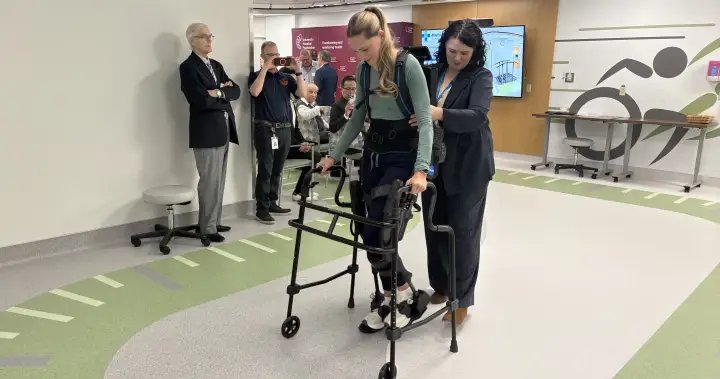
A new $2.7-million facility at the University of Alberta Hospital is hoping to provide rehabilitation to inpatient neurology patients as soon as possible after an injury or stroke.

The new Neurology Rehabilitation Centre, located on the fifth floor of the hospital, is outfitted with more space and state of the art technology, like an Ekso, a wearable robotic exoskeleton that enables patients with lower-extremity weakness to stand and walk and a Zero-G, a robotic track system that provides dynamic body-weight support, preventing falls while allowing patients to practice movements safely.
“Prior to this neuro-rehabilitation innovation centre, we still had the same amazing therapists, but they did not have the space or the equipment to really optimize the treatments,” said Dr. Chester Ho, Medical co-lead for Neurosciences Care Alberta and professor and spinal cord injury research chair at the University of Alberta.
Dr. Ho brought the idea of the new facility to the University of Alberta Hospital foundation after doing several studies on the impact of early rehabilitation intervention on neurology patients.
“We basically want to take advantage of what we call neuroplasticity, which is the ability of the brain and spinal cord to be flexible and to recover as much as possible,” he said.
“With early rehabilitation we’re able to fully take advantage of neuroplasticity to get people to recover sooner and better, and that translates to a better recovery but also better quality of life.”

Get weekly health news
Receive the latest medical news and health information delivered to you every Sunday.
Patients like William Stephenson are showing why early intervention is so important. He suffered a spinal cord injury after he crashed his plane near Wetaskiwin.
“Shortly after takeoff, I had an engine stall and slammed into the ground,” Stephenson said. “When I woke up, I couldn’t feel my lefts. I was pretty much done for I figured.
“No one thought I was going to be able to walk again.”
After a few weeks of surgeries and recovering, he started taking part in Dr. Ho’s study looking into the impacts of early rehabilitation on spinal cord patients.
“They put an electro stimulus from my brain to my toe,” he said. “That’s the first I felt anything, it was instant. Boom! Just like that!
“I was freaking out, like I was telling the doctor, ‘Did you see that? Did you?’”
Stephenson walked into the opening of the neuro rehabilitation facility and is excited about how his involvement in the study will help others.
“It’s undoubtedly going to help a whole lot of people,” he said. “It changed my life.”
The University Hospital Foundation said the majority of the$2.7-million came from its yearly Festival of Trees fundraiser.
“I think the public system really does their best to support what is needed in the system, but this is about innovation,” Dr. Jodi Abbott, president and CEO of the University Hospital Foundation, said.
“Over time, an innovation becomes a standard of care. So, it’s a really critical thing that we’ve done.”
The centre is designed to treat patients with complex neurological conditions, using specialized equipment. It includes a modern neurorehabilitation gymnasium and an electrophysiology research suite.
Patients are now able to use the facility, and staff are hoping to get more patients into the facility in the future.
“This is why we’re here, and this is what we do, and we love what we do,” Dr. Ho said.
For more information, visit GiveToUHF.ca.

© 2026 Global News, a division of Corus Entertainment Inc.