dailynewsnblog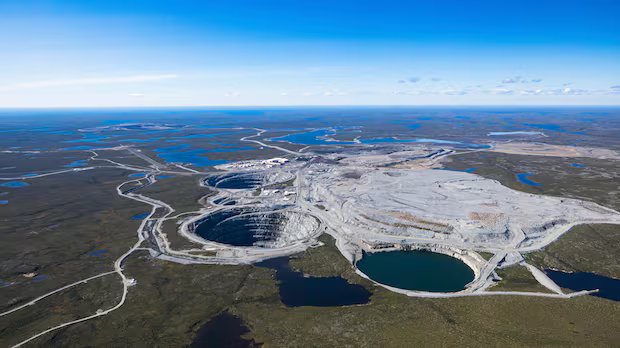

Listen to this article
Estimated 4 minutes
The audio version of this article is generated by AI-based technology. Mispronunciations can occur. We are working with our partners to continually review and improve the results.
The cost of site reclamation at the Ekati diamond mine, and the fate of hundreds of workers, are still unclear after the N.W.T. announced the mine would start the transition to closure years before expected.
Ekati Diamond Mine had been slated to close in 2029, but entered into receivership Tuesday after its parent company could not secure a buyer. Arctic Canadian Diamond Company filed for creditor protection in May.
Receiver PricewaterhouseCoopers Inc. is slated to oversee the site’s wind down. The receiver, along with experts, are assessing how many staff will remain on site and how much reclamation will cost.
In a news conference Wednesday, the deputy minister of the Department of Environment and Climate Change (ECC), Robert Jenkins, said that an “appropriately-sized workforce” will remain on site through the transition to closure, though they haven’t yet determined exactly how many that workforce includes.
Ekati currently employs about 360 people, according to the government.
Nicole Beauchamp, an assistant deputy minister with the Department of Education, Culture and Employment, said the territory can support the affected workers with skills development, job searches or income support.
“This has been a difficult week for a lot of people and I think we have to acknowledge that,” said John MacDonald with the Department of Executive and Indigenous Affairs, at Wednesday’s news conference.
He said the territorial government will look for ways to provide additional support for affected workers as the receiver does its work.
No final closure plan in place
The territory holds just under $327 million in reclamation security to ensure the site is properly closed and cleaned-up. That money goes to work such as pulling down buildings, earth work and monitoring.
Jenkins said they believe that security will cover those costs but the receiver, along with experts, will reassess. He said their goal is to stay within that $327 million security.
“We do have a good level in confidence in the amount,” Jenkins said.
The territory doesn’t have a final closure and reclamation plan in place but does have an interim closure and reclamation plan based on the previous closure date of 2029.
“There’s some good work that’s been done for the interim plan that we can use going forward but it is unfortunate that we don’t have a final plan in place,” Jenkins said.
The interim plan notes the importance of ensuring contaminated soils don’t present a risk to human or wildlife health, traditional knowledge is included in the closure plan, and that the site can be reclaimed for wildlife and, in particular, caribou movement.
Mining, oil and gas has accounted for nearly a quarter of the territory’s GDP, according to the N.W.T.’s recent budget. Diavik Diamond Mine ceased operations earlier this year, after operating in the Northwest Territories for more than 25 years. The Gahcho Kué diamond mine is also struggling, announcing in February that it would pause an expansion project and that it was in workforce reduction discussions.
As it looks to other sources of income for the N.W.T., MacDonald said the government is “very interested” in proposed defence investments in the territory, and other federal major projects still awaiting approval.
The territory has also been touting its access to critical minerals.
In a written statement, Caitlin Cleveland, minister of industry, tourism and investment, acknowledged the need for the N.W.T.’s economy to diversify.
“The diamond industry helped build the modern Northwest Territories, but this moment also reinforces why our future cannot depend on one mine, one commodity or one sector,” the statement reads.
“We need a broader and more resilient economy, supported by strong Indigenous partnerships, responsible resource development, critical infrastructure and good northern jobs.”