dailynewsnblog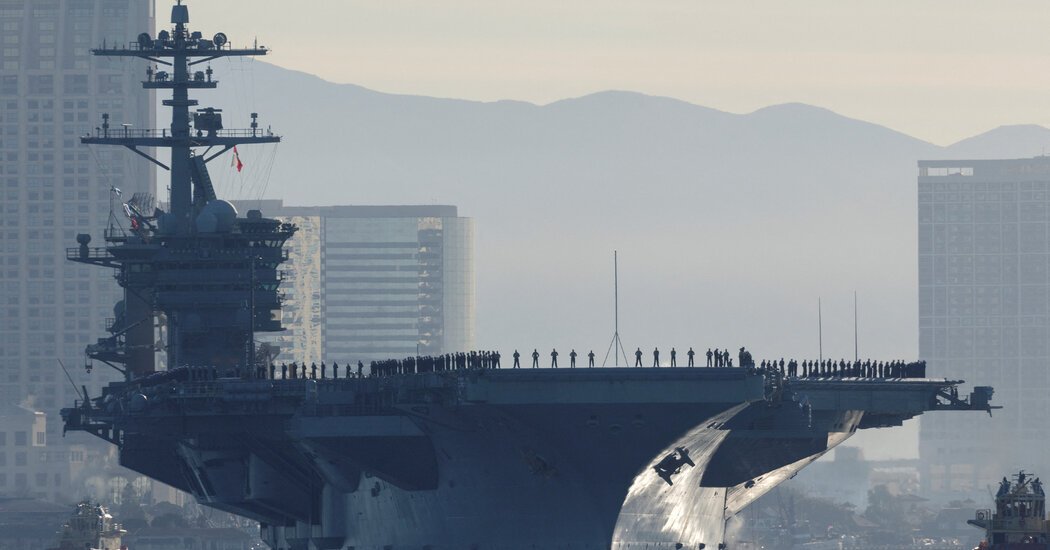
On the first full day of the reimposed blockade on Iranian ports, the U.S. military said that American warships had “redirected” two vessels attempting to cross the boundary of the restricted area.
“The U.S. military remains vigilant and prepared to ensure full compliance,” U.S. Central Command said of the operation in a social media post.
But beyond that, Central Command, which directs military operations in the Middle East, has said little about the renewed blockade.
Successfully enforcing such a blockade takes a massive commitment of warships and aircraft to identify, track, warn and potentially seize vessels attempting to cross whatever red lines have been drawn on a chart.
When President Trump ordered a blockade of Iranian ports along the Persian Gulf and the Gulf of Oman in mid-April, that line was drawn from Ras al Hadd, on the eastern tip of Oman, to Iran’s border with Pakistan, roughly 215 miles northeast.
In June, the signing of a memorandum of understanding between the United States and Iran lifted that blockade. Merchant ships resumed transit in and out of Iranian ports, and in July the price of oil — which had risen sharply since the war began on Feb. 28 — began trending downward.
Last week, frustrated with his lack of progress in drawing the war with Iran to a close, Mr. Trump declared the cease-fire over and ordered new rounds of airstrikes in response to Iran’s attacks on merchant vessels transiting the Strait of Hormuz.
On Monday, Mr. Trump ordered the blockade reinstated. It went into effect at 4 p.m. Eastern on Tuesday. Higher gas prices soon followed.
By definition, a naval blockade is an act of war.
The Navy has deployed a large number of warships in the region since hostilities with Iran began. During the previous blockade, those ships — mainly destroyers — stayed in the Gulf of Oman about 400 miles from the Strait of Hormuz.
According to the U.S. Naval Institute, as of Monday that presence is anchored by two aircraft carrier strike groups in the Northern Arabian Sea — the U.S.S. Abraham Lincoln, accompanied by two destroyers, and U.S.S. George H.W. Bush, which has three destroyer escorts.
Each of the carriers has four squadrons of fighter aircraft embarked.
To project power ashore, the Navy’s amphibious assault ship U.S.S. Boxer is deployed to the region with the 11th Marine Expeditionary Unit embarked, accompanied by two additional amphibious ships capable of landing Marines ashore.
Seven more destroyers and one cruiser are also in the Arabian Sea, according to the Naval Institute.
During the initial naval blockade of Iran, which lasted from April 13 to June 18, Central Command said in a statement that its forces had “redirected” more than 140 vessels that complied with the blockade and disabled nine ships it said had tried to get past the assembled warships.
U.S. forces have used deadly force to disable those ships, and in some cases have launched Hellfire antitank missiles from aircraft at merchant ships that Central Command says were trying to run the blockade.
An American attack on the tanker Settebello on June 9 killed three crew members who were Indian nationals, leading to a diplomatic protest from the government in New Delhi.