dailynewsnblog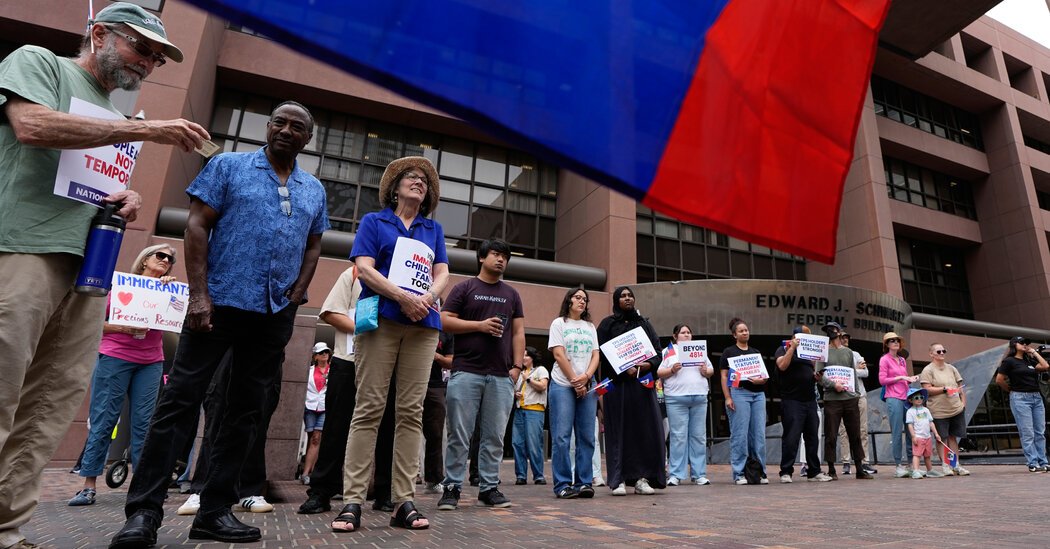
The Homeland Security Department told employers on Friday that they must let go in coming weeks the hundreds of thousands of foreign workers who have been allowed to live in the United States through a humanitarian program the Trump administration has sought to dismantle.
The work permits of Haitians with Temporary Protected Status will expire on July 24. Such permits will also lapse on July 17 for those from Ethiopia, Myanmar, Somalia, South Sudan, Syria and Yemen, according to notices issued for each affected country by U.S. Citizenship and Immigration Services, which oversees the legal immigration system.
The guidance comes on the heels of the Supreme Court’s decision last month upholding the Trump administration’s authority to end protections for T.P.S. holders from Haiti and Syria. Once the terminations take effect, the recipients become vulnerable to deportation. More than 330,000 Haitians and 6,100 Syrians have been living in the country under the program, a designation granted by the U.S. government when it determines that crisis conditions in a country, such as a natural disaster or civil unrest, make it unsafe for its citizens to return.
The five other countries collectively have about 20,000 T.P.S. holders, according to the National Immigration Forum, an advocacy group.
U.S. Citizenship and Immigration Services had been extending work authorization in short increments. The agency had previously set the expiration date for July 1 and then extended it last week to July 10 for all the countries. On Friday, it did so again.
But some employers had already terminated workers by the time they were notified of the extension. Other employers had kept such workers on the payroll, with the understanding that the Supreme Court’s ruling would probably not take effect for about 30 days.
Jacob Monty, legal counsel for the American Business Immigration Coalition, said that many employers were confused by the shifting dates and had feared they could face penalties for employing people who were now ineligible to work in the United States.
“We still have rule of law, and T.P.S. has still not been terminated,” he said in an interview.
“U.S.C.I.S. could have clarified the issue,” he said. “Many employers were uncertain, leading them to unnecessarily terminate the workers early.”
Thousands of T.P.S. recipients from Haiti work in the health care sector and as caregivers to older Americans. The program has also allowed thousands of beneficiaries to work in the manufacturing, construction and transportation industries.
In addition to immigrants from Haiti and Syria, the countries at the center of the Supreme Court case, the administration had already announced its intent to end Temporary Protected Status for workers from the other five countries. Lawsuits in federal court had prevented the terminations, but the Supreme Court ruling created a precedent that is expected to lead the lower courts to allow them to go ahead.
The government notices to employers cite the Supreme Court decision, saying that the federal courts were expected to “align” with the high court’s ruling in favor of the administration.
The Department of Homeland Security did not immediately respond to a request for comment.
Lawyers for Haitians and Syrians argued that the T.P.S. terminations had been politically motivated, preordained and rooted in racial animus. But the majority in the 6-to-3 decision, split along ideological lines, found that the homeland security secretary had the authority to end the program.
While the government recently extended Temporary Protected Status for those from Lebanon, the Supreme Court decision likely will embolden it to end the status for additional countries. For example, it is widely expected to let El Salvador’s protection, which covers about 200,000 people, lapse in early September. During Mr. Trump’s first term, courts blocked the termination.
The program has been in place since 1990. But the Trump administration has long described it as a de facto permanent immigration scheme because many people have had the status for years as previous administrations repeatedly extended the protections.
Immigrant advocates have denounced the Trump administration’s efforts to terminate T.P.S. programs, underscoring that conditions in several of the countries remain deeply unstable. South Sudan, Somalia and Yemen have been grappling with armed conflict, failing infrastructure and fallout from severe cuts in international aid.