dailynewsnblog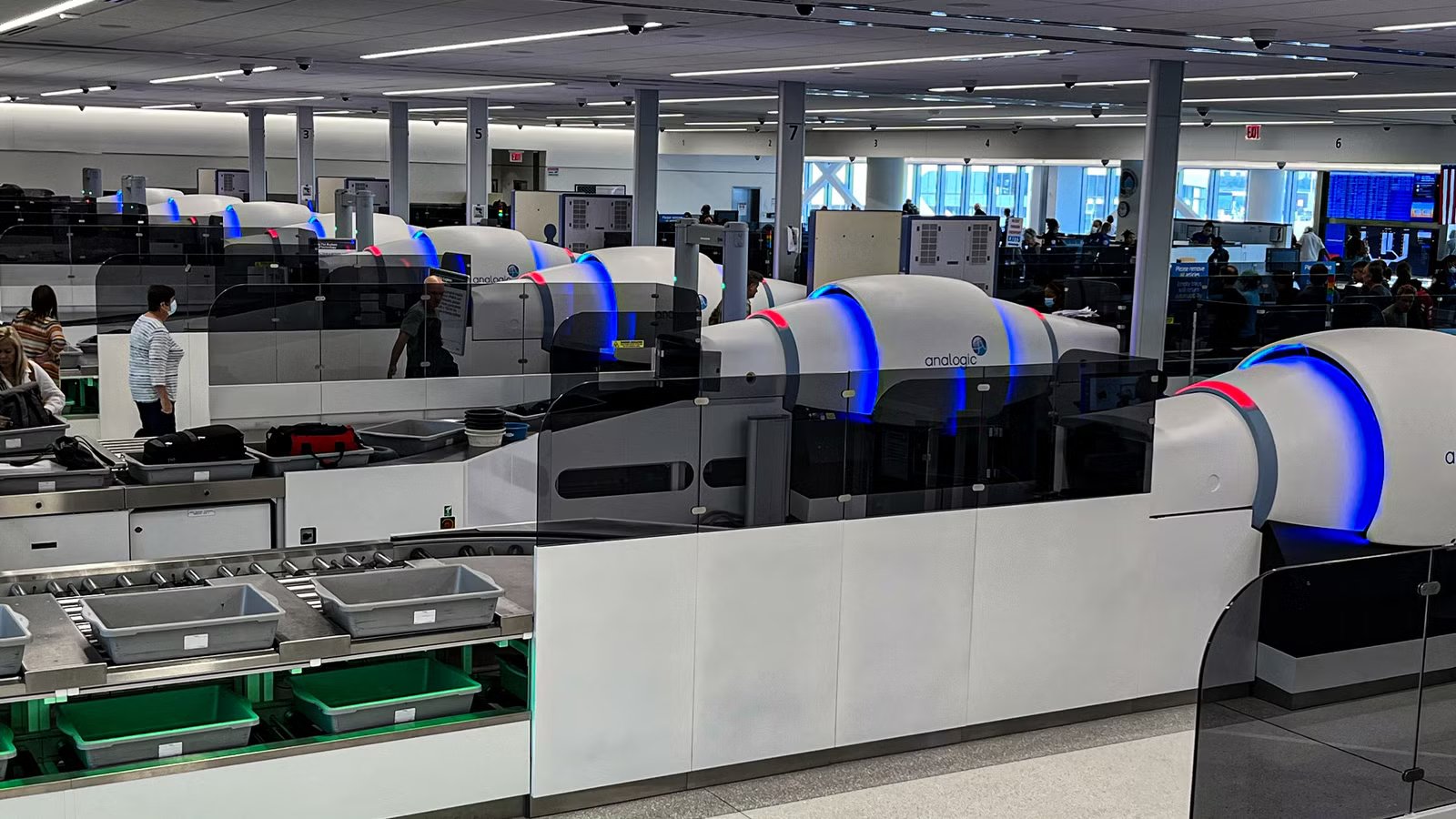
The Transportation Security Administration (TSA) has installed 1,162 computed tomography scanners across 296 US airports as of early July 2026, part of a rollout funded by a $781.2 million contract awarded in 2022. The machines produce 3D images that let officers rotate and examine a bag’s contents from any angle, run automated threat detection algorithms capable of identifying liquid explosives, and allow passengers to leave laptops and 3-1-1 liquids inside their bags. The technology is a substantial improvement over the flat 2D X-ray units it replaces.
It also has a smaller tunnel. CT openings measure approximately 24.5 inches wide by 16.5 inches high (62.2 x 41.9 cm) against approximately 25.2 by 16.9 inches (64 x 42.9 cm) on the older machines. TSA has acknowledged that “not all larger carry-on bags will fit into the units” and recommends checking large carry-ons with the airline.
The Tunnel Is Smaller Than The Machine It Replaced

The tunnel opening on TSA’s computed tomography checkpoint scanners measures approximately 24.5 inches wide by 16.5 inches high (62.2 x 41.9 cm). The 2D X-ray units the CT machines are replacing have openings of approximately 25.2 inches by 16.9 inches (64 x 42.9 cm). The difference is between 0.4 and 0.7 inches (1.0 to 1.8 cm) per side. On paper, the reduction is negligible. At a checkpoint with a line of passengers behind you and a boarding time approaching, it is the difference between your bag clearing the machine and a TSA officer telling you to walk back to the airline counter.
TSA confirmed the difference to Simple Flying but noted it does not apply across the entire deployed fleet. “Some models (Base) of the 3D CT scanners do have a slightly smaller opening compared to older equipment,” the agency said. “This design is necessary to accommodate the advanced imaging technology and ensure optimal performance.” That distinction explains why a bag can clear security at one airport and be rejected at another, or even at a different lane in the same checkpoint.
The standard domestic carry-on allowance across US airlines remains 22 by 14 by 9 inches (56 x 36 x 23 cm), a figure that includes wheels and handles. A bag built to those exact dimensions still fits through the CT tunnel with room to spare. The problem is that most carry-on bags are not empty rectangles. A soft-sided bag packed to capacity bulges beyond its nominal dimensions. Expandable suitcases with the zipper undone add two inches to their depth. Exterior pockets stuffed with jackets, shoes, or water bottles push the profile outward. Protruding telescopic handles and wheel housings on some models exceed the manufacturer’s stated measurements.
TSA has acknowledged the issue directly. In a July 2026 press release announcing CT installation at Juneau International Airport (JNU), the agency stated that “CT units have a slightly smaller entry tunnel, and not all larger carry-on bags will fit into the units,” and recommended that “large carry-on items be checked with the airline.”
What The CT Scanner Does That The Old X-Ray Could Not

The trade-off for the narrower tunnel is a substantial improvement in what TSA officers can see inside a bag. The 2D X-ray units produce a flat, single-angle image that requires the operator to interpret overlapping shapes and densities from one perspective. Dense items obscure what sits behind them. A laptop lying flat across the width of a bag blocks the view of everything beneath it, which is why passengers were required to remove electronics and liquids before screening. Computed tomography captures multiple X-ray images as the bag passes through the tunnel and reconstructs them into a three-dimensional model that the operator can rotate, zoom, and examine from any angle.
The 3D reconstruction enables automated threat detection that the 2D units could not perform reliably. CT algorithms analyze the density and composition of items inside the bag and flag materials matching known explosive signatures, including liquid explosives that were nearly impossible to identify on a flat X-ray image. Peter Duffy, TSA’s Federal Security Director for Alaska, described the capability in the agency’s July 2026 statement: “CT technology utilizes advanced algorithms to identify explosives, including liquid explosives and other threat items.” The detection improvement is what justified the $781.2 million contract TSA awarded for the technology in 2022.
The passenger benefit is that laptops, tablets, and 3-1-1 compliant liquids can stay inside the bag. Removing electronics and liquids was the single largest source of divestiture time at the checkpoint, requiring passengers to unpack at the belt, repack after screening, and creating a chokepoint that slowed the entire lane. CT lanes eliminate that step. According to Airport Technology, the smaller tunnel geometry reflects a design compromise to fit CT units into busy checkpoint lanes while preserving throughput and detection performance. TSA chose better detection and faster divestiture over half an inch of tunnel clearance.
Why All Bags Now Have To Go In Bins

The second operational change at CT lanes is that every carry-on item must be placed in a bin. At older X-ray checkpoints, passengers could send a roller bag directly down the conveyor belt without a bin, using bins only for loose items like jackets, shoes, laptops, and liquids. CT scanners require everything to go in a bin, including hard-sided roller suitcases, backpacks, duffel bags, and briefcases. TSA’s Juneau press release specified the requirement: “With the new CT scanners, all carry-on items, including roller-bags, need to be placed into a bin for screening instead of being placed directly on the conveyor belt.”
TSA has not published a detailed technical explanation for the bin requirement. What is clear from the agency’s guidance is that the requirement applies universally at CT lanes, regardless of the bag type or size. A hard-sided roller suitcase that would have gone directly onto the belt at an older checkpoint now requires a bin. The bin presents the item to the scanner in a consistent position and provides a uniform surface, which is relevant to how the imaging system processes what passes through the tunnel.
The change has practical effects on checkpoint flow. More bins per passenger means more bins in circulation, more bins accumulating at the collection end of the belt, and more staff time spent returning empty bins to the divestiture area. The requirement also adds a step at the front of the line. For passengers with multiple carry-on items, the bin count per person increases accordingly, and at a busy checkpoint the bin supply can become a constraint on how quickly the lane moves.
What Happens When A Bag Does Not Fit

When a bag does not fit through the CT tunnel, the TSA officer’s options are limited. The agency has no authority to check a bag on a passenger’s behalf and no mechanism to transfer it to the airline from the checkpoint. The passenger is directed back out of the secure area to the airline’s check-in counter or baggage drop, where the bag must be checked as hold luggage. That means exiting security, walking back through the terminal, joining the check-in queue, paying whatever checked-bag fee applies to the fare, and then returning through the security line a second time.
The financial and timing consequences depend on the fare and the airline. A passenger on a Basic Economy ticket without a checked bag allowance pays the full checked-bag fee, which ranges from $35 to $45 for the first bag on most US carriers when purchased at the airport. A passenger arriving close to departure may find the check-in cutoff has already passed, which at most airlines is 45 minutes before a domestic departure and 60 minutes for international flights. If the cutoff has passed, the bag cannot be checked, and the passenger cannot travel with it. TSA’s published recommendation is to avoid the situation entirely: “TSA recommends that large carry-on items be checked with the airline.”
TSA told Simple Flying that officers can help before a bag reaches the scanner. “If you have a bulky item, musical instrument, or specialized medical equipment that you suspect will not fit, please inform a TSA officer before placing it on the belt so they can assist you with alternative screening,” the agency said in a statement. TSA also noted that officers “are available to assist travelers with larger items or special needs to help ensure a smooth screening process.” Reporting from Cincinnati/Northern Kentucky International Airport (CVG) and other airports indicates that passengers whose bags are rejected at the tunnel are being sent back to the ticket counter, which is why flagging an oversized item in advance is the better option. The practical guidance for travelers is to measure the bag after packing rather than relying on the dimensions printed on the manufacturer’s tag.
Why Photographers Are The Other Group Affected

The other group affected by the CT rollout is photographers who shoot film. CT scanners expose items in the tunnel to higher X-ray levels than the 2D units they replace. A TSA spokesperson confirmed to Nexstar that undeveloped film sent through a CT scanner can be fogged or destroyed, including film already loaded inside a camera. Polaroid and instant film are equally vulnerable. The damage is not always visible until the film is developed, at which point the images are unrecoverable.
The older X-ray machines were widely considered safe for film at lower ISO speeds, and photographers carrying standard 100, 200, or 400 ISO stock routinely sent it through checkpoint scanners without noticeable degradation. CT eliminates that margin. TSA recommends that photographers place film and cameras containing undeveloped film in carry-on bags and request a hand inspection at the checkpoint rather than sending them through the scanner.
Passengers have the right to request hand inspection of undeveloped film under TSA policy. The process requires the photographer to remove the film from their bag before it enters the scanner, present it separately to the officer, and wait while the film is visually examined and swabbed for explosive residue. The inspection adds time at the checkpoint and works best when the photographer arrives early, has the film organized in a clear container, and explains the request before placing anything on the belt. Photographers who travel frequently with film have reported inconsistent experiences with how readily officers accommodate hand inspection requests, which is a training and staffing question rather than a policy one.