dailynewsnblog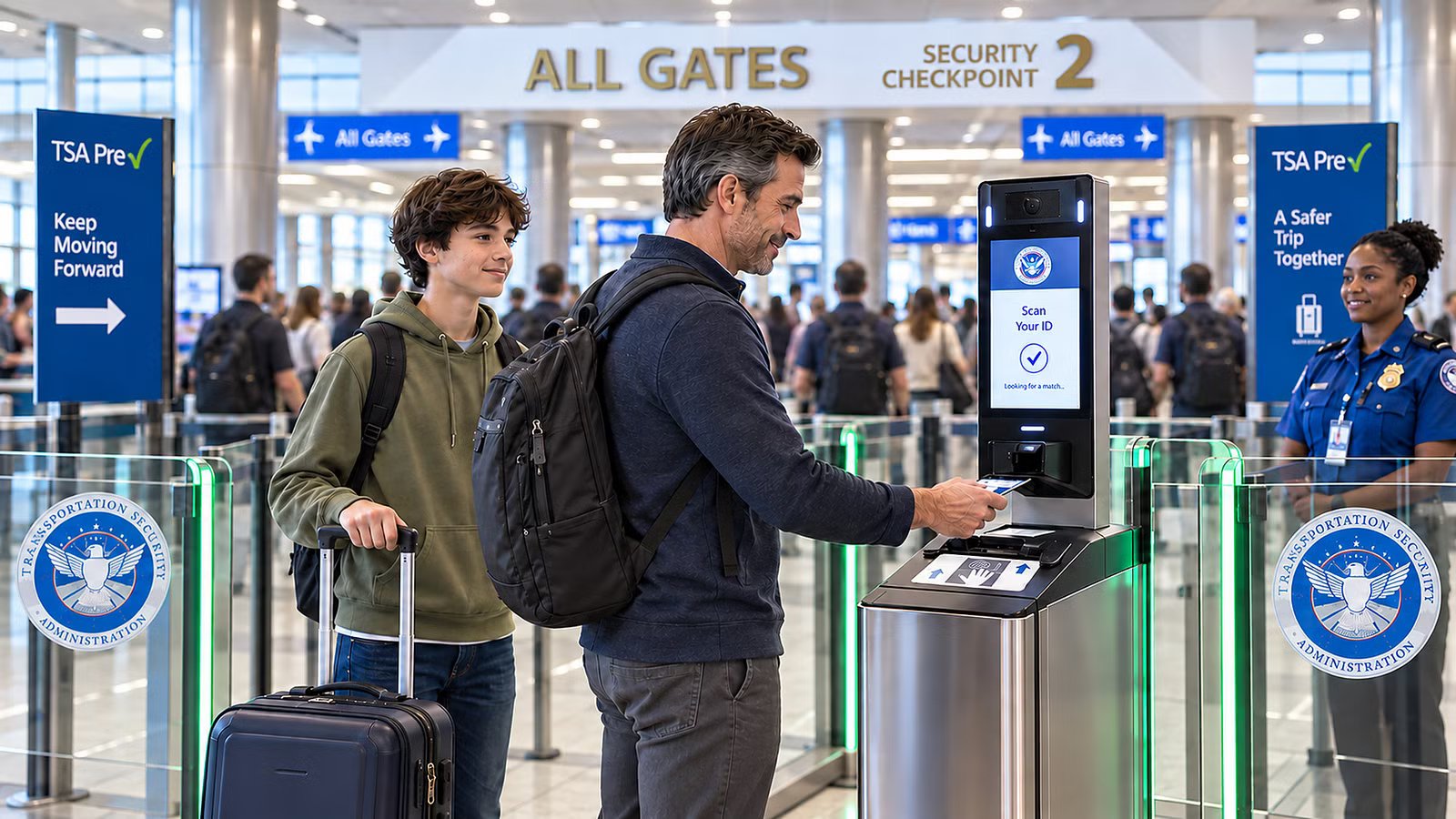
One of the most familiar rituals at a US airport security checkpoint — drinking, dumping or surrendering a bottle of water before reaching the X-ray belt — could soon begin to disappear. The Transportation Security Administration (TSA) is reportedly considering allowing some TSA PreCheck members to take full water bottles through security at selected airports. However, the existing 3-1-1 liquids rule, which limits carry-on liquids to containers of 3.4 ounces (100ml), remains in force nationwide for now.
Crucially, this would not initially amount to the wholesale death of the 20-year-old liquids rule. Senior administration officials told CBS News that the proposed exception would be limited to PreCheck passengers using airports equipped with newer Computed Tomography (CT) scanners and automated detection capabilities that can distinguish water from other liquids. Officials did not identify the airports that would participate first, while acknowledging TSA does not yet have enough suitable equipment — or funding — for a nationwide rollout.
TSA Could Let PreCheck Passengers Keep Their Water

ABC News reported earlier today that allowing PreCheck members to bring water through security is being considered as part of a broader introduction of next-generation PreCheck lanes. Those checkpoints incorporate facial-comparison technology alongside new 3D baggage and body scanners, and ABC said the broader programs could take around a year to roll out. CBS’s reporting puts an important boundary around that: TSA is considering water only, rather than scrapping restrictions covering every larger bottle of shampoo, lotion, gel or other liquid.
The idea has been building for more than a year. Former Homeland Security Secretary Kristi Noem questioned the liquids restriction publicly in July 2025, just after TSA ended the routine requirement for passengers to remove their shoes. Noem added that liquid size could be the agency’s next major change, but also cautioned that an announcement was not imminent.
Any PreCheck-only exemption would already cover a huge pool of travelers. TSA announced more than two years ago that PreCheck had surpassed 20 million active members, and it has continued to add members at a rate of approximately three million new enrollments a year. Former TSA Administrator David Pekoske said that the program has grown dramatically as it continues spreading across US airports, and especially as biometric Touchless ID has increasingly allowed eligible passengers to verify themselves without presenting physical identification.
“TSA PreCheck continues to be one of our most innovative risk-based security solutions, as evidenced in the fast-growing membership of the program.”
What TSA’s New eGates Actually Change

TSA’s new checkpoints are actually a combination of new technologies that are being stitched together. And for clarity, it is not the eGates that will determine whether a bottle contains water, as their job is to verify the passenger. It is the CT scanners and associated detection software that examine what is inside the carry-on bag. TSA describes CT as “the next generation of carry-on screening technology”, producing three-dimensional images that officers can manipulate to identify potentially dangerous items while allowing more belongings to remain packed.
Stage | Technology | What It Does | Passenger Benefit |
|---|---|---|---|
Identity | AutoCAT/eGate | Checks ID, screening and travel status; can use facial matching | Avoids conventional officer ID check |
Digital identity | PreCheck Touchless ID | Matches passenger’s face with identity data already on file | ID/boarding pass may stay put |
Carry-on screening | CT/CPSS | Generates a manipulable 3D view of bag contents | Electronics and other items can often remain packed |
Detection | Automated algorithms | Analyzes CT imagery for prohibited materials/threats | Fewer manual interventions as capability improves |
Passenger screening | Advanced body scanners | Searches for concealed items on the passenger | More automated screening |
Lane operation | Automated screening systems | Handles bins, bag diversion and screening flow | Faster, more consistent processing |
TSA’s eGate rollout is nevertheless a good guide to where its checkpoint-of-the-future strategy is heading.  Charlotte Douglas International Airport (CLT) began testing eight eGates at Checkpoint 2 this summer; TSA has also trialed the technology at
  Los Angeles International Airport (LAX) and
  Ronald Reagan Washington National Airport (DCA), while
  Newark Liberty International Airport (EWR) introduced eGates for eligible United PreCheck Touchless ID users in Terminal C this month.
DCA is particularly interesting as a possible airport to watch. All 23 lanes installed as part of its major checkpoint redevelopment were designed for advanced credential authentication and CT screening, while LAX has been testing CT carry-on scanners since 2018. Meanwhile, Las Vegas’  Harry Reid International Airport (LAS) has gone even further, operating TSA’s Innovation Checkpoint, where PreCheck passengers have tested self-service screening systems combining facial identification, automated bag handling and advanced scanners. However, none of these airports has been confirmed as an initial water-bottle location.
The 100ml Rule Will Die Slowly, Not Suddenly

Today’s restrictions on liquids date back to the August 2006 transatlantic liquid-bomb plot, in which conspirators planned to conceal explosive components inside drinks bottles on flights from the UK to North America. The US reacted by imposing the now-familiar 3.4-ounce/100ml limit. However, CT screening now increasingly offers TSA a way to replace that blanket restriction with a much more detailed examination of what a container actually holds. But the problem is that technology is not installed uniformly.
The UK’s moves to scrap the 100ml liquids rule actually offers an unusually good preview of what US passengers could potentially face. Several of the larger airports, such as  London Heathrow Airport (LHR) and
  London Gatwick Airport (LGW) now permit containers as large as two liters (approximately 68 ounces) following CT upgrades. However, others, such as Manchester Airport (MAN) and London Luton Airport (LTN) still enforce the 100ml policy despite also having newer scanners. Britain’s government therefore specifically warns passengers to check the rules at every airport on their itinerary, including their return journey.
A similarly uneven US rollout could be even more confusing because permission might eventually depend not simply on the airport, but on membership, airline, terminal, checkpoint and equipment. At Newark, for example, the new eGates are currently limited to eligible  United Airlines passengers in Terminal C who have PreCheck and have opted into Touchless ID; passengers and their bags still undergo normal physical screening after identity verification. For years, therefore, a traveler might be able to carry a bottle through security on the outbound journey but have to dump it before flying home.
That makes the likely demise of TSA’s water-bottle ban less of an overnight repeal than the beginning of a gradual technological transition. TSA now has scanners sophisticated enough to contemplate treating a trusted traveler’s bottle of water differently from an unknown liquid, but it does not yet have that capability everywhere. The 3-1-1 rule may finally be starting to disappear — just don’t assume that because a full bottle made it through security on one trip, it will make it through the next.