dailynewsnblog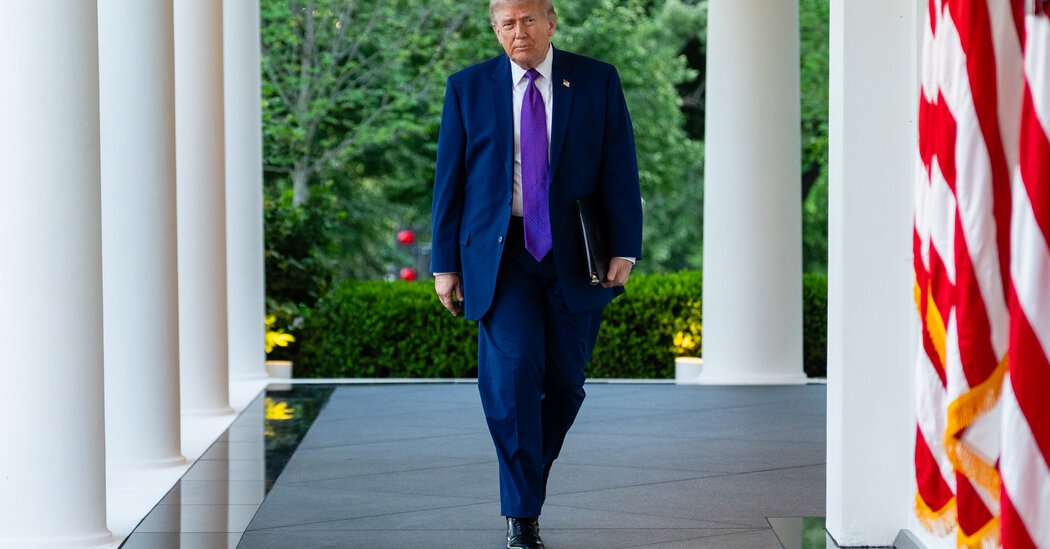
President Trump has never been a fuzzy, feel-your-pain kind of politician.
That came through in an especially striking way yesterday, when he answered a question about whether he was motivated by the financial situation of Americans to make a deal to end the war with Iran.
“Not even a little bit,” he replied, as my colleague Erica Green reported. (You can watch the video here.)
“I don’t think about Americans’ financial situation,” Trump added. “I don’t think about anybody. I think about one thing: We cannot let Iran have a nuclear weapon. That’s all.”
It was a response that flouted fundamental rules of American politics — that voters are motivated above all by economic concerns, that they want to support politicians who “care about people like me” — and it was a risky one, given Trump’s dire political standing:
His disapproval rating is consistently hovering around 60 percent or worse
A new CNN poll found that 77 percent of Americans — including a majority of Republicans — thought his policies had increased the cost of living in their own community
Inflation rose a startling 3.8 percent in April, the fastest rate since May 2023, sending a flashing warning about how the war in the Middle East is raising prices for Americans
Republican pushback to the conflict is growing in Congress
And Trump has not exactly given the impression that he is single-mindedly focused on bringing down the cost of living. He spent one recent night unleashing a barrage of Truth Social posts about various grievances and topics, including conspiracy theories about Barack Obama and Hillary Clinton.
“President Trump was re-elected for four reasons,” Whit Ayres, a veteran Republican pollster, told me. “To improve the economy, to bring down inflation, to control illegal immigration and to get away from woke culture. Anything that works against any of those four goals is not helpful.”
Republicans have had some good news, however, on the redistricting front. Two favorable court rulings for them have spurred a rapid escalation of Republican-led redrawing of maps across the South.
Trump, for his part, has arrived in Beijing for a two-day summit with China’s leader, Xi Jinping. Several primaries unfolding this month will test his influence, and the popularity of his policies, in his party. And of course, November is a long time from now.
“The longer-term forces are obviously not promising, with increasing inflation and declining job approval on the part of the president,” Ayres said. “There’s some short-term forces, particularly the mid-decade redistricting, which might work in their favor on the House side. So we’ll see which one dominates.”
But, he noted, “there’s no question that there’s a strong relationship between the president’s job approval and his party’s performance in the House.”