dailynewsnblog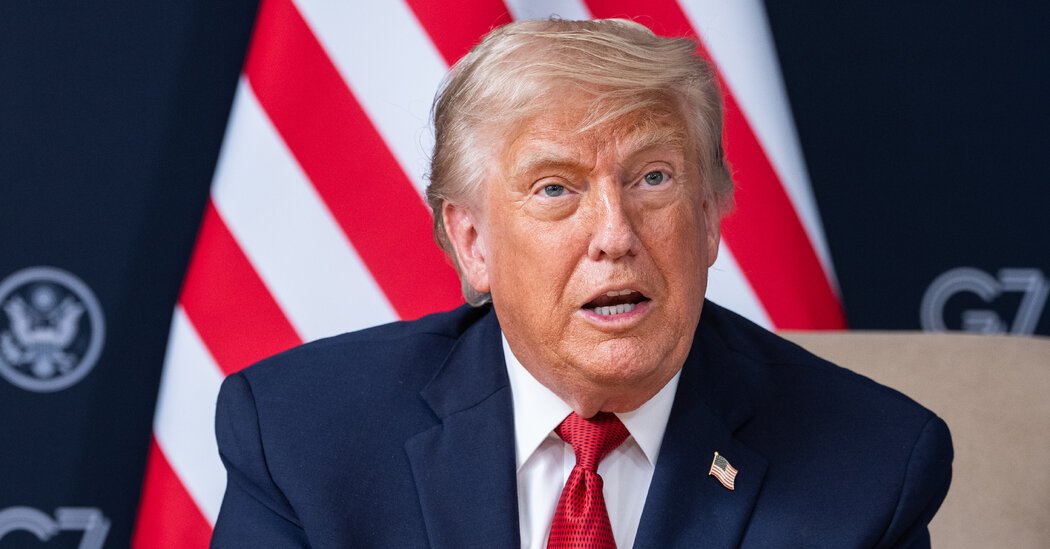
President Trump’s agreement with Iran opened new fissures in his party on Wednesday, with Republicans on Capitol Hill and beyond questioning whether his administration had secured adequate concessions from Iranian leaders after months of a costly and unpopular war.
After the Trump administration released the text of the arrangement on Wednesday, some Senate Republicans reacted with fierce criticism, skepticism and alarm. Prominent members of the G.O.P.’s old guard from outside Congress also sounded dubious notes. And even some of president’s allies in the conservative news media voiced concern.
“Reagan is rolling over in his grave,” Senator Bill Cassidy, a Louisiana Republican who lost in a primary last month after Mr. Trump targeted him for defeat, wrote on social media. He said that Iran’s nuclear ambitions “were not curbed” and that the country had learned that it could leverage the Strait of Hormuz, the oil shipping corridor that has been closed during the war and is set to reopen under the deal, to extract concessions.
The war, Mr. Cassidy said, was “the worst foreign policy blunder in decades.”
The reactions underscore a challenge Mr. Trump faces five months ahead of the midterm elections, as he works to free Republicans from the political albatross of the war while navigating varying views about it within his own party. While Mr. Trump has won praise for the deal from some Republican allies, consolidating support in a party with competing factions is proving to be a difficult task.
At the start of the conflict, Mr. Trump angered some “America First” isolationists within the Make America Great Again movement who felt he was breaking his promise of starting “no new wars.” Now, as he tries to bring an end to the fighting, he is facing pushback from more traditional conservatives who wonder if he has struck a deal that will ultimately be better than the one President Barack Obama reached with Iran a decade ago. (Mr. Trump pulled the United States out of that framework in 2018.)
The preliminary agreement would lift sanctions on Iran and release billions of dollars in frozen Iranian assets. It would push talks about Iran’s nuclear program into a 60-day negotiation period that could be extended by “mutual consent.” And it states that the United States and its regional partners would develop a $300 billion reconstruction plan for Iran. Some Republicans have said they were nervous about the prospect of such a fund; Mr. Trump on Wednesday insisted that the United States would not invest in it.
“Is it giving $300 billion to the Iranian ayatollah?” Senator Ted Cruz, Republican of Texas, asked on his podcast. “I hope not. I pray not,” he said, even as he praised Mr. Trump’s decision to take the United States to war, saying the president had “utterly destroyed the Iranian military.”
Some of the most vocal criticism came from Republicans who have been pushed to the margins of the party by Mr. Trump. Senator Thom Tillis, a North Carolina Republican who is retiring, said there was “a lot of work to be done to convince me that we’re on the right path.”
Former Representative Marjorie Taylor Greene, a Georgia Republican who was once one of Mr. Trump’s most vocal supporters but has since broken with him, criticized the president in a video on social media for what she called a “totally unnecessary” war.
“This, apparently, is what winning looks like,” Ms. Greene said, sarcastically.
Nikki Haley, who served as U.N. ambassador in Mr. Trump’s first administration and lost to him in the 2024 Republican presidential race, wrote on social media that “Hitting Iran’s nuclear and missile sites was the right move.”
But she added: “It’s a huge mistake to pay to rebuild the threat we just destroyed.”
Pushback has also shown up in other settings.
On Wednesday morning, the front page of The New York Post offered a critical view of the administration. “Trump devastated Iran, now he hits them with a … LOVEBOMB,” the right-leaning tabloid’s front page blared, above an image of a burning American flag and text saying that Mr. Trump’s deal showered Iran’s leaders with “cash — and no sanctions.”
Mark Levin, who hosts a Fox News program, said he found “much to be concerned about” in the agreement and wanted to see it amended.
Mr. Trump attacked critics of the deal on Wednesday, calling them “stupid and bad people,” and declared that he had the support of the international community. He said carrying on the war would have “satisfied a group of 10 percent of the people,” but would have “been the wrong thing to do.”
“There are some people, some writers, that I thought were friends of mine, but I don’t want them as friends anymore,” the president said of his critics as he addressed reporters at the Group of 7 summit in France.
Mr. Trump has shifted his objectives for the war with Iran over time, and some critics appeared to be holding him to the goals he set in launching strikes on Iran in late February, including changing its regime, eliminating Iran as a global threat and stopping its nuclear program.
At the same time, many Republicans were eager to move on from the conflict before what could be a challenging election for their party. Republican operatives say their party’s performance in November will depend heavily on whether energy prices fall in the coming months.
“The lower the gas prices are in November, the better Republicans will do,” said Corry Bliss, a Republican strategist.
The price of a gallon of gasoline is up nearly a dollar over last year’s, according to the AAA motor club. And energy prices overall are up 23.5 percent from a year earlier, according to the Consumer Price Index.
Democrats have invested in advertisements pinning higher costs at the pump on the conflict. Republican lawmakers in swing districts had said for weeks that they were eager to see a swift end to the war.
Some Republicans on Capitol Hill have hailed the deal as a significant achievement. Senator Tim Scott, the South Carolina Republican who leads the Senate Republicans’ campaign arm, said on social media earlier this week that Mr. Trump had secured a “major victory for American security and global stability.”
Senator John Cornyn, a Texas Republican who recently lost a primary to a Trump-backed rival, took a more measured position, saying the president “should be congratulated for degrading their capability of waging war against the West and Israel.”
“I think it’s just an intermission in the continuing conflict that’s been going on since 1979, and I wish we would, basically, incapacitate them, but that hasn’t been possible,” he told reporters on Wednesday.
Senator Lindsey Graham, a Republican from South Carolina who had long pushed for the United States to strike Iran, was initially skeptical about the deal when Mr. Trump announced it on Sunday without disclosing details.
“I am somewhat concerned that Iran’s view of the agreement seems different than what the American negotiating team is claiming,” Mr. Graham said Sunday on social media.
On Wednesday, he expressed some degree of optimism.
“Whether or not the United States can reach an acceptable, verifiable deal with Iran regarding its nuclear program and other issues is yet to be determined,” he wrote on social media, “but I see little downside to trying.”
Tyler Pager and Catie Edmondson contributed reporting.