dailynewsnblog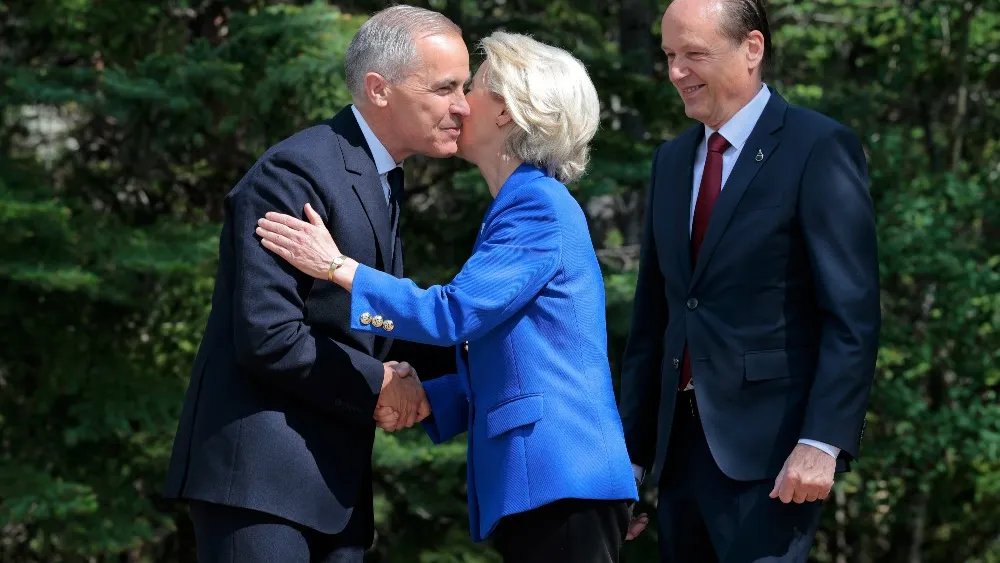
Canadian Prime Minister Mark Carney delivered a speech to the European Parliament on Thursday in Strasbourg, France praising the longstanding trade and economic partnership and cultural synergies that define the Europe-Canada relationship.
One day earlier, as a part of her annual State of the European Union speech, European Commission President Ursula von der Leyen made a novel and unprecedented proposal—that Canada should become the EU’s first ever associate member. The yet undefined role would, she said, link the North American nation to the biggest trade bloc in the world.
The overture came after months of tension between Canada and the United States, the country’s biggest export market and closest neighbor. Ties between the nations have been fraying for months, culminating over the summer in a breakdown in talks to renew the U.S.-Mexico Canada Agreement and the subsequent levying of bilateral tariffs on more than $20 billion in products, including textiles and apparel, imported into the respective markets.
This protracted and painful uncoupling began in earnest around President Donald Trump’s reelection. Since then, Canadian leaders like Carney and former Prime Minister Justin Trudeau have sought to forge new trade relationships and deepen existing ones.
With this convoluted landscape as a backdrop, Carney responded to von der Leyen’s offer this week. He thanked the EU for working with Canada to establish “one of the world’s most successful trade agreements” last June, and said Canada “welcomes” the trade bloc’s “ambition” to bring Canada in as an associate member.
“I will tell polling shows that an overwhelming majority of Canadians support much closer ties with Europe,” he said. “An alliance for the future is a unique, positive approach that we will define together, building on our common strengths and based on shared values.”
Carney stopped short of accepting von der Leyen’s proposal, however, offering a somewhat nebulous alternative: that “Canada and Europe should secure our strategic autonomy through deep co-operation in the full range of strategic capabilities,” including critical minerals, defense, AI, energy security, space exploration and trade.
The lack of a full-throated and resounding acceptance of the offer perhaps points to a lingering desire to avoid rankling President Donald Trump. Still, the leader pulled no punches when it came to the U.S., though he declined to mention it by name.
“Today, our societies are shaken by new storms: the upheavals linked to climate change, the erosion of democratic norms and the weaponization of trade. The multilateral institutions we relied on have been weakened,” Carney said.
“Sovereignty and openness are now difficult to reconcile. Economic integration is now used as a weapon, and tariffs as a means of leverage. Financial mechanisms are used for coercion. Supply chains constitute points of vulnerability to be exploited,” he lamented.
Trump called the EU’s proposal to embrace Canada as an honorary member of the bloc “laughable,” telling reporters, “No, I don’t see that [happening].”
“If they do that, if I think it’s a hostile act, I will put very serious tariffs or stop trading with Europe on many things,” he threatened. “If Europe does that …with a good intention, that’s fine. If it’s a bad intention, we’ll put very heavy tariffs.”
Carney was characteristically diplomatic in his response to the threat, but he was also firm in conveying that Canada has no intention of taking direction on trade policy.
“This alliance is a positive process; that’s my response to the American president. A stronger, more resilient, more sovereign Canada will be a more effective partner with the United States,” Carney told the media after his Thursday speech.
“Canadians are united that nobody is going to tell us what language we speak, no one is going to dictate our culture or with whom we can strike agreements internationally,” he added.