dailynewsnblog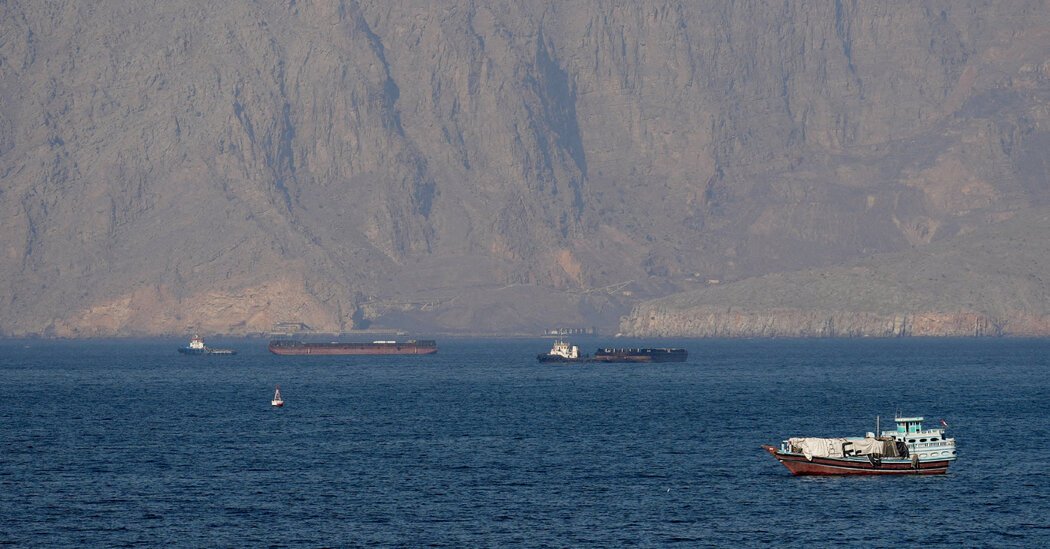
One day after proposing a fee for ships transiting the Strait of Hormuz, President Trump on Tuesday said the United States would instead guarantee safe passage to vessels from Persian Gulf states that agree to invest in the United States.
It’s not clear how Mr. Trump’s plans would play out, and the president’s latest comments left questions unanswered.
But the flip-flop shows how far the debate over the strait, the vital waterway in the Middle East, has strayed from longstanding practices in the shipping industry and underscores the level of unpredictability that businesses working in the region are facing as the conflict between the United States and Iran lurches back to war.
“The fact that things are changing all the time, itself, means that it’s hard to make a decision to normalize trade,” said Lasse Kristoffersen, the chief executive of Wallenius Wilhelmsen, a car shipping and logistics company based in Norway.
Jakob Larsen, the chief safety and security officer at BIMCO, the world’s largest shipping association, said that Mr. Trump’s plan raises the risk that other countries will try to monetize the international waterway that they border.
“That is, of course, really, really problematic from a shipowner’s perspective and for shipping in general,” Mr. Larsen said. “It will only drive up the cost of transportation across the globe, and that will eventually hit the end customer and create inflationary pressure.” Ultimately, when leaders make comments that undermine international conventions, the conventions become weaker, he said.
The changing plans and at times contradictory approaches show how Mr. Trump has struggled to confront Iran, which has repeatedly demonstrated its ability to endure attacks and exert its own control of the strait, using drones and missiles to strike ships. The result has been a drawn-out conflict that’s roiled the global economy and sent oil prices soaring.
On Tuesday, a day after saying he would charge 20 percent fees to ships in exchange for U.S. military protection when using the waterway, Mr. Trump said he would scrap his proposed fees if Gulf countries invested in the United States.
“Based on highly productive conversations with Middle East leadership, I have decided to replace the 20% United States Reimbursement Fee with Trade and Investment Deals that the various Gulf States will be making into the United States,” he said on social media. “Those Investments will be MASSIVE but, at the same time, extraordinarily good for them, and their future.”
Mr. Trump’s post did not say which countries he was referring to or whether countries outside the Persian Gulf that use the strait, including allies like Japan and South Korea, would also be asked to make U.S. investments.
His remarks came weeks after his administration, in response to Iran threatening to impose tolls in the strait, said such levies were unacceptable.
The International Maritime Organization, a United Nations agency that regulates global shipping, said Tuesday that it was aware of Mr. Trump’s announcement about seeking trade and investment deals in exchange for safe passage through the strait and was awaiting more details.
“We have always been consistent on our stance on fees — I.M.O. stands firmly against charging fees for passage through straits used for international navigation,” said Natasha Brown, a spokeswoman for the agency, in a statement on Tuesday. “There is no legal basis through which to introduce mandatory tolls simply to transit through a strait.”
Shipping is the cheapest way to move goods, and more than 80 percent of world trade is transported by ship. While neither the United States nor Iran has ratified the United Nations Convention on the Law of the Sea, the treaty that calls for shipping through international waterways to be free, they have generally followed its norms for decades.
Before the war, the Strait of Hormuz was an international shipping route that vessels sailed through without charge. But since the start of the war, Iranian officials have repeatedly said they intend to monetize the strait.
Iran immediately seized on Mr. Trump’s comments as confirmation that governments that offer security for vessels have the right to charge. “POTUS is absolutely right. Whoever provides secure and safe passage of commercial vessels through the Strait of Hormuz should be compensated for this service,” Iran’s foreign minister, Abbas Araghchi, said on social media on Monday. “20% is of course too much. We will be fair.”
Iran fired on three vessels moving through the strait overnight. Two seafarers were killed and 14 were injured, including four seriously, according to the International Maritime Organization.
Traffic in the strait slowed nearly to a halt on Monday, as Iran and the United States exchanged strikes for a third straight day, and the fragile truce between the countries appeared to collapse. Only 10 vessels passed through the strait on Monday, the lowest level in a month — a fraction of the more than 130 vessels a day that would pass through the strait before the war, according to Kpler, a maritime data company.
Iran is unlikely to back down in response to U.S. pressure, according to Eurasia Group, the geopolitical risk consultancy. The firm predicted that Iran would continue to attack ships to pressure Oman and the other Gulf states to agree to give Iran permanent influence in the strait.
Mr. Kristoffersen said that any limitation on freedom of navigation would be against the rules that had governed international shipping for decades.
“Any breach of this principle, of course, could make others tempted to try to do the same,” he said. “And that is why we hold that principle so high.” Mr. Kristoffersen, whose company had one vessel stranded in the Persian Gulf that exited in early July, said he would not be sending vessels into the gulf until there was no longer a risk that vessels would be attacked. “If the intention is still there, military protection is not sufficient for us.”
Peter Eavis contributed reporting from New York.