dailynewsnblog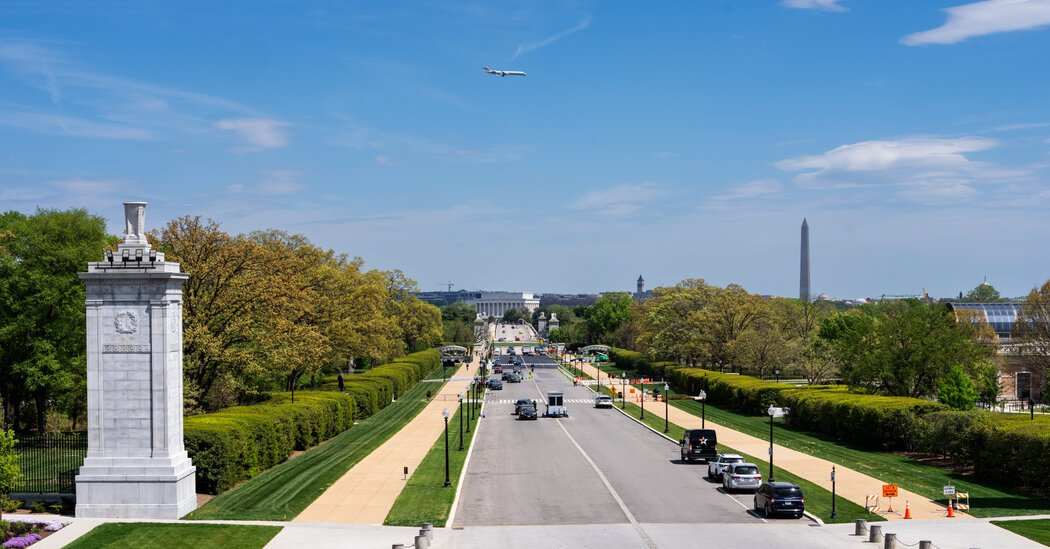
The Federal Aviation Administration said the Trump administration’s plans to construct a 259-foot tall arch less than a mile from Washington’s Ronald Reagan National Airport would likely not pose risks to aviation safety.
But evaluators recommended that red, blinking obstruction lights similar to the ones atop the Washington Monument be added to the design — a common measure for large structures that go up near airports.
“The hypothetical building, at the filed heights listed above, would have no significant adverse effect on airspace” or navigation procedures into and around the airport, evaluators wrote in a feasibility study released Friday.
The F.A.A. must still complete a formal evaluation of the project before it can move forward, and it must be approved by a regional planning commission. But the feasibility study released Friday suggests the F.A.A. will determine that the arch is not a hazard, helping to clear bureaucratic hurdles to construction.
The arch, which President Trump has dubbed the “triumphal arch,” is a key part of his efforts to reshape the appearance of the nation’s capital city, which also include a new White House ballroom and a renovated reflecting pool on the National Mall.
Aviation experts have been divided over whether the arch would complicate the ability of aircraft to maneuver in and out of Reagan National Airport. The crowded airspace became a target of safety efforts last year after a commercial jet and an Army Black Hawk helicopter collided in midair, killing 67.
A New York Times analysis this week showed that the top of the arch would jut into an area that is supposed to ideally remain clear for flights. Objects that break into that area require particular scrutiny from the F.A.A. to determine whether they can be safely built.
The F.A.A.’s study noted that the arch “has been identified as an obstruction,” meaning the structure “would require it to be lit with red obstruction lights.”
The initial F.A.A. study said the arch would not affect air traffic or require a change in flight procedures, as long as obstruction lights were attached.
While projects higher than 200 feet tall are required to undergo a formal evaluation process to determine whether they pose a hazard to flights, feasibility studies like the one released on Friday are voluntary on the part of the builder, and their recommendations are not binding.
The report notes that the results of the feasibility study do not “constitute a determination of no hazard to air navigation from the FAA,” and that “a full aeronautical study will be required for the actual design of the building prior to its construction.”