dailynewsnblog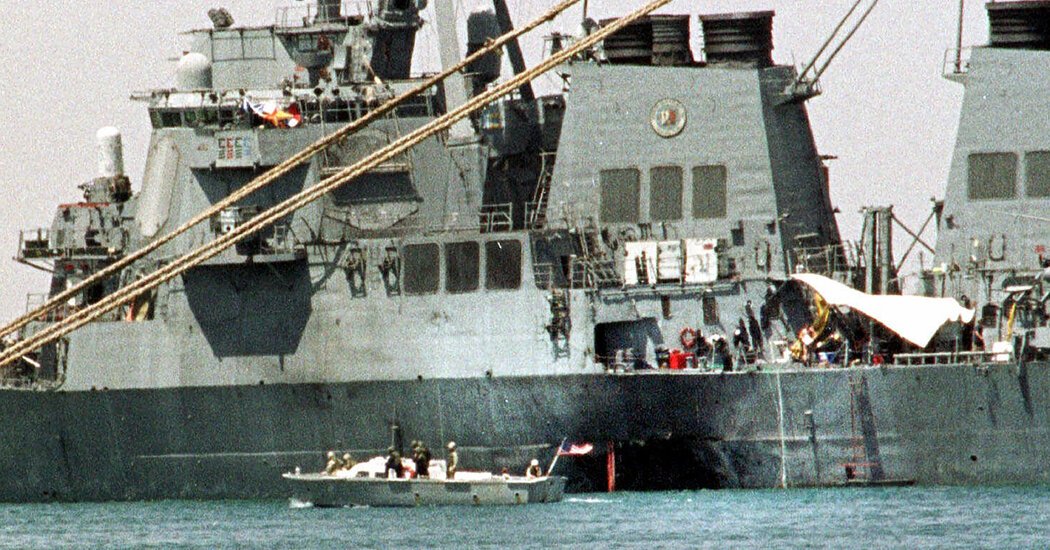
The trial in the bombing of the USS Cole has been indefinitely delayed, a new setback in a quarter-century-old case that has been shadowed by the C.I.A.’s use of torture.
The military trial at the U.S. naval station in Guantánamo Bay, Cuba, was scheduled to start on June 1. But Col. Matthew Fitzgerald, the judge overseeing the case, announced the decision to postpone it last month without giving a specific reason.
He said the postponement would involve “months, not weeks.”
The suicide bombing of the U.S. Navy destroyer on Oct. 12, 2000, killed 17 U.S. sailors and wounded dozens of others during a refueling stop in Yemen.
A Saudi prisoner, Abd-al Rahim al-Nashiri, is accused of orchestrating the attack, which was seen as a precursor of the Sept. 11 terrorist attacks.
Military judges in the Cole case have set and then abandoned about 10 proposed trial dates since Mr. Nashiri was first arraigned in 2011, nine years after he was captured.
The Secretive World of Guantánamo Bay
-
U.S.S. Cole: The Army judge in the bombing case ordered the prosecution to do its “due diligence” in providing defense lawyers with any evidence the U.S. government might have “regarding Iran’s role” in the attack off Yemen 25 years ago. President Trump has said Iran was “probably involved.”
-
Torture Ruling: A government lawyer appealed to a Pentagon review court to overturn a torture ruling in the Sept. 11 case that disqualified the use of the confessions of a man accused of conspiring in the hijacking plot that killed nearly 3,000 people.
-
Cuban Deportees: The long, circuitous journey of dozens of Cuban men who were designated for deportation from the United States last year but instead taken to a prison at the U.S. base at Guantánamo Bay ended when they were repatriated to Cuba.
-
Guantánamo Prison Enters 25th Year: The prison has outlasted the war in Afghanistan, has employed tens of thousands of temporary troops and holds six men charged but not yet tried in death penalty cases.
-
A Curious Collaboration: An unlikely collection of portraits has given the public its only glimpse inside the U.S. military prison at Guantánamo Bay.
The case had been on track to hold the first death-penalty trial in the court that was created by George W. Bush after the Sept. 11 attacks in a U.S. government effort to seek the executions of suspects blamed for Al Qaeda attacks.
Lawyers in court have cited several potential reasons for the judge’s delaying the start of trial.
Prosecutors are still working with the C.I.A. and other intelligence agencies to declassify evidence for the public and defendant to see, rather than hold secret sessions of the trial. If the agencies refuse, the judge will need to decide how to proceed.
Some of the proposed evidence involves the agency’s torture of prisoners in the early 2000s. Mr. Nashiri, one of the first prisoners who was held in a C.I.A. black site, was waterboarded, sleep deprived, kept nude and threatened with a drill and handgun in his early agency interrogations.
Some Navy shipmates who survived the Cole attack and the relatives of those who were killed that day have died waiting for the trial to begin. Survivors of the attack and relatives of the victims have been traveling to the base since the arraignment in 2011 to watch pretrial proceedings with the hope that they would lead to a full trial.
Defense lawyers for the defendant have proposed a delay until Jan. 11, 2027, which would avoid the court’s traditional closure for the Christmas holiday. There is only one courtroom at the base’s court complex, Camp Justice, with a jury box large enough for a capital trial.
The June 1 date would have averted a conflict with the long-running case against four men who are accused of conspiring in the attacks of Sept. 11, 2001. Prosecutors had proposed the same Jan. 11, 2027, start date.
The new judge in that case, Lt. Col. Michael Schrama, has not ruled on that request.
Mr. Nashiri’s lead lawyer, Allison Miller, announced in court last month that she was still seeking to resolve the case with a plea agreement. Steve Feinberg, the deputy defense secretary, had previously rejected a plea offer, but Ms. Miller said that a court staff member was clarifying which portions of the offer were obstacles to his approving the deal.
Some logistical questions remain unresolved, including how and where the Pentagon would assemble the pool of more than 300 U.S. military officers for the 12-member jury panel and alternatives.
Defense lawyers only recently received approval for mental health experts to examine Mr. Nashiri in order to testify on his behalf. The lawyers also want to go to Saudi Arabia to interview potential witnesses but have recently been unable to go there because of travel restrictions on Pentagon employees caused by the Iran war.
Separately, the White House has not been able to provide any underlying intelligence for recent claims by President Trump that Iran had a role in the Cole bombing. Defense lawyers wanted the information as they seek to blame others for the bombing.
Prosecutors notified the defense team that “the White House has no responsive information” supporting the president’s assertion, Ms. Miller said in court.