dailynewsnblog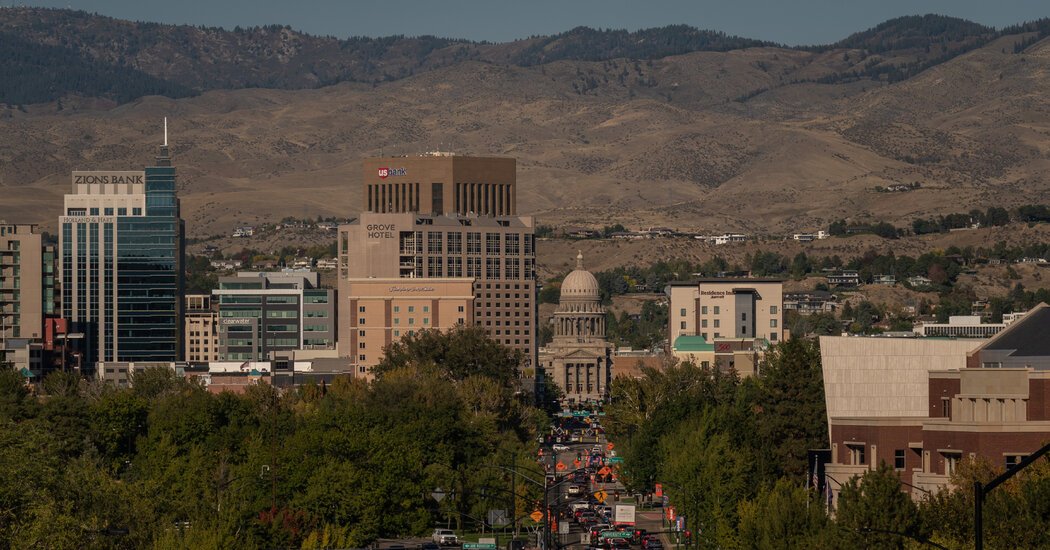
Six transgender Idaho residents asked a federal judge on Thursday to strike down a new state law that makes it a crime for people to use the bathrooms in public buildings and private businesses that do not match their sex at birth.
Violating the law would be a misdemeanor punishable by up to one year in prison. A second offense within five years would be a felony, carrying up to a five-year prison sentence. Lawyers with the American Civil Liberties Union and Lambda Legal filed the suit in federal court in Boise, where several of the plaintiffs live.
After learning that Idaho lawmakers had approved the legislation last month, Diego Fable, 37, a transgender Boise resident, asked his employer if he could keep his job should he move to Colorado. Mr. Fable, who has a full beard and has been using bathrooms designated for men since he transitioned six years ago, said the law made everyday life outside his own home seem impossible.
“Do I comply and use the women’s restroom and risk drama?” Mr. Fable said. “Do I drive all the way home” to a toilet, he asked, “and then come back?”
“How do I navigate going skiing or going birding out in the park?” he continued. “How do I navigate playing Dungeons and Dragons for six hours? The safest route feels really isolating, which is to just stay home.’’
Before the passage of the new law, 21 states, including Idaho, already restricted transgender people from accessing bathrooms that align with their gender identity in public schools and, in many cases, government-owned buildings and public places like parks or airports, according to a database maintained by the Movement Advancement Project, a research organization that tracks state-level legislation on L.G.B.T.Q. issues.
Idaho’s new law is seen as the most restrictive in the nation. In addition to publicly-owned properties, it applies to privately-owned settings such as restaurants, retail stores, business offices, or game stores that host Dungeons and Dragons tournaments. Unlike other state laws that apply only to multi-user restrooms, Idaho’s law covers even single-user bathrooms designated for male or female occupants. Idaho is also the only state where violations could lead to a felony charge.
The law passed both chambers of the Republican-dominated Idaho Legislature largely along party lines. Its supporters said the ban was necessary to protect the privacy, safety and dignity of women and girls, as well as for consistency in the way the state defines who falls into the categories “men” and “women.”
“This bill protects Idaho’s cultural decency,” said Senator Josh Kohl, a Republican from Twin Falls.
But in an interview, plaintiffs in the suit spoke of the complexity of compliance. Zoey Wagner, 30, a transgender woman who uses female-designated bathrooms, said she feared harassment should she use one designated for men. Amelia Milette, 50, who is transgender and was born and raised in Idaho, said her job requires her to visit a range of offices on different days. The new law would require her to plan a route somehow that would include gender-neutral bathrooms. Mr. Fable’s employer told him that to work out of state he would need to be reclassified as a contractor, which will affect his health insurance and other employee benefits.
In the complaint, lawyers for the plaintiffs argued that the law fails the constitutional requirement that the state have a rational basis to enact it. They cite the testimony of the Idaho Fraternal Order of Police that existing Idaho laws, such as criminal trespass statutes, already addresse inappropriate or disruptive behavior in restrooms.
“Transgender people are being targeted in the state of Idaho,’’ said Barbara Schwabauer, senior staff attorney for the A.C.L.U.’s L.G.B.T.Q. and H.I.V. Rights Project. “That is the only explanation for a law that has this vast of a penalty and sweeps this broadly.’’
The plaintiffs claim that the law violates their guarantee of equal protection and their due process right to avoid disclosing private information. Because of its penalties, they argue, the law needs to clear a high bar for clarity, and that the language that allows access to single-user facilities if an individual is in “dire need” or if theyare the only ones “reasonably available” render the law unconstitutionally vague.
The law is set to go into effect on July 1. The plaintiffs have requested a temporary injunction to stop the state from enforcing it while the case is being decided. They are not challenging the portion of the law that covers locker rooms and showers. Last year, the U.S. Court of Appeals for the Ninth Circuit ruled that Idaho could bar transgender students from using locker rooms and changing areas that aligned with their gender identity, citing the state’s interest in not exposing students to “the unclothed bodies of students of the opposite sex.”
But the appeals court has not ruled on the challenge to the bathroom portion of that law. Challenges to laws regulating the use of bathrooms by transgender people in Kansas, South Carolina and Oklahoma are also making their way through the courts.
Seamus Hughes and Anna Griffin contributed reporting.