dailynewsnblog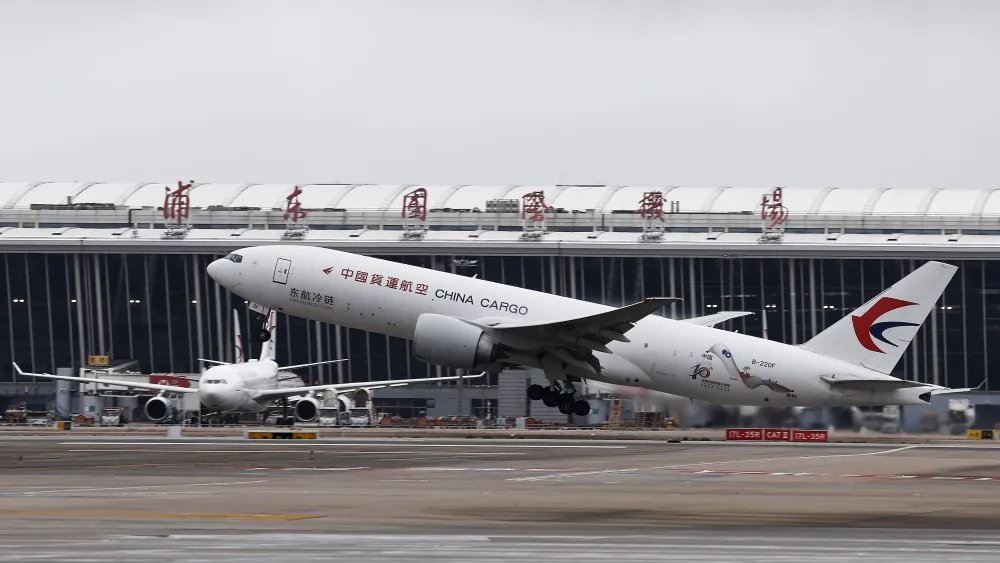
Air cargo demand increased by 8.5 percent in June, marking the third month in a row growth has accelerated with North American carriers serving as the strongest contributor to growth, according to the International Air Transport Association (IATA).
Similar to May, when trans-Pacific air cargo demand accelerated nearly 20 percent amid weaker year-ago volumes, June’s strongest growth came from the Asia-North America trade lane. The route recorded 14.7 percent year-over-year growth in cargo tonne-kilometers (CTKs), which measure the transport of one metric ton of cargo over a distance of one kilometer.
Shipments across the Pacific Ocean grew for the fifth positive month, propelled by AI-related cargo movement and semiconductor demand.
The route has seen a strong bounce back from last year, when the U.S. drastically shifted its trade policy in a way that heavily targeted Chinese goods via high tariffs and the end of the duty-free de minimis provision. UPS indicated in a Tuesday earnings call that the China-to-U.S. route returned to year-over-year growth starting in May, with the company saying there is momentum on the trade lane into the second half of the year.
North American carriers posted the fastest total-market growth pace at 13.1 percent year over year and added more than 700 million CTKs, generating almost 38 percent of the industry increase. Asia Pacific carriers advanced by 7.9 percent, contributing 670 million CTKs and 34 percent of the industry increase.
A partial restoration of Middle Eastern operations contributed to the advance, even though regional security conditions have not fully stabilized, IATA said.
“Demand growth outpaced capacity at the global level and in all regions except Latin America and the Caribbean,” said Willie Walsh, IATA’s director general in a statement. “Demand also grew faster than global trade, supported by high-value technology products, and urgent shipments. While this all gives strong reasons for optimism in the second half of 2026, risks remain—continuing hostilities in the Middle East and a renewed focus on tariffs by the U.S. among them.”
Airlines added lift at a substantially slower pace than traffic, preserving a relatively tight operating environment. Against the CTK expansion of 8.5 percent, industry-wide available cargo tonne-kilometers (ACTKs) rose by 4.4 percent annually.
Jet fuel skyrockets in July, followed by August surcharge hikes
Average global jet fuel prices have spiked more than 37 percent since the last week of June, as peace talks between the U.S. and Iran broke a two-month downtrend in fuel costs.
According to the Jet Fuel Price Index, compiled by S&P Global Platts, the average global price in the week ending July 24 was $160.06 per barrel, up from $116.63 per barrel as of the week ending June 26.
On a weekly basis, average prices jumped 7.1 percent.
Data from Freightos indicates that escalating fuel prices have not directly correlated with air freight rates yet. As of Wednesday, the benchmarking platform’s air index said China-to-North America rates decreased 2 percent to $5.76 per kilogram from the week prior. China-to-Northern Europe rates of $3.84 per kilogram were down 10 percent weekly.
But a top air carrier out of the market recently raised fuel surcharges, suggesting the fuel price hikes will come home to roost.
Last Friday, Hong Kong-based Cathay Pacific announced it would expand on the fee effective Saturday, acknowledging the increasing jet fuel prices in recent weeks.
Surcharges for flights from China to North America, Europe, Middle East, Africa and the southwest Pacific will increase from $123.70 to $174.60, the airline said.
The surcharge hike was the carrier’s first since April, and the fuel surcharge is still below the peak level in that same month.
This follows “multiple reductions to the fuel surcharges since May,” the carrier said, “demonstrating the effectiveness of the mechanism in capturing jet fuel price movements in downward as well as upward directions.”
Cathay Pacific says it will continue to review and revise the fuel surcharges every two weeks.
Asian carriers including Japan’s All Nippon Airways and Japan Airlines and Taiwan’s EVA Air are also hiking surcharges, with EVA increasing the fees 20 percent on Saturday to $1.29 per kilogram on long-haul flights to North America, South America, Europe and Africa.