dailynewsnblog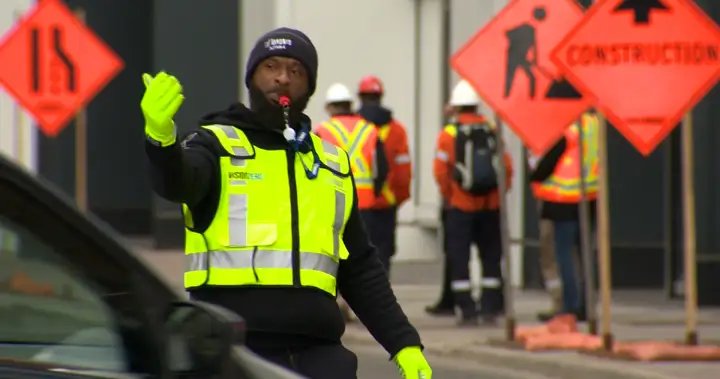
There are times when nothing beats the personal touch.

That’s a lesson Toronto is still taking on board when it comes to managing its grinding gridlock, deploying more than 100 high-viz-clad men and women to snarled intersections across the city.
The city’s traffic agent program has been growing for years and appears to be yielding results that traffic lights and cameras haven’t.
“There’s lots of tools in the toolbox,” Mike Barnet, Toronto’s director of enforcement and street management, told Global News.
“Traffic agents have a time and a place for them to be at. We see a big benefit of them in special events where we’ve got lots of people, sometimes people who are not familiar with some of the rules. We talk about King Street, some of the special rules on King Street.”
The goal of the agents, unlike police officers or red light cameras, is to educate drivers and keep intersections moving, rather than hand out tickets to those breaking the rules.
Over the past year, Toronto has increased the number of traffic agents it has on the books.

Get breaking National news
Get breaking Canada news delivered to your inbox as it happens so you won’t miss a trending story.
At the beginning of 2025, Toronto had just 20 active traffic agents, predominantly deployed to King Street and the Gardiner Expressway’s on-ramps.
Fast forward to July last year, when the number had grown to 55. By the beginning of 2026, Toronto hit 100 active traffic agents. The city is currently recruiting an extra 27, to take the total to 127 by roughly the end of the year.
The recruitment has allowed Toronto to start deploying its traffic agents across the city.
Where once they were concentrated on key north-south snarl points in the downtown, the Gardiner Expressway or charged with keeping the King streetcar moving, traffic agents are now fanning out across the city.
“When we had a smaller workforce, we obviously had to focus on a much more concentrated area,” Barnet added. “(Expanding) gave us the ability to really move them into more areas across the city rather than … just in that downtown core.”
The launch of the Finch West and Eglinton Crosstown LRTs both benefited from traffic agents, who are also being used for major events like Toronto FC matches and moving as far north as College Street and University Avenue during rush hour.
“The traffic agents there are less for enforcement and really more to provide positive reassurance,” he explained. “When we’ve got them out in the intersections, they become really an expert in how to move traffic because they’re there every day.”
Toronto saw its first major successes with traffic agents on King Street, where drivers were regularly violating rules designed to move a key streetcar route faster.
A study released by the city in early 2024 showed traffic agents were essentially the difference between vehicles following or flouting the rules.
Without traffic agents in place, streetcars crawled along, taking between 45 and 65 minutes to drive the length of King Street, according to the city.
But when traffic agents were introduced, the travel time dropped as much as 74 per cent, to between 17 and 21 minutes.
Barnet said the success of the program meant it would also be relied on during the upcoming FIFA 2026 World Cup.
“Now, we have over 100 and so we’re able to meet more demand,” he added. “Certainly, FIFA is going to place a large demand for us later this summer.”
© 2026 Global News, a division of Corus Entertainment Inc.