dailynewsnblog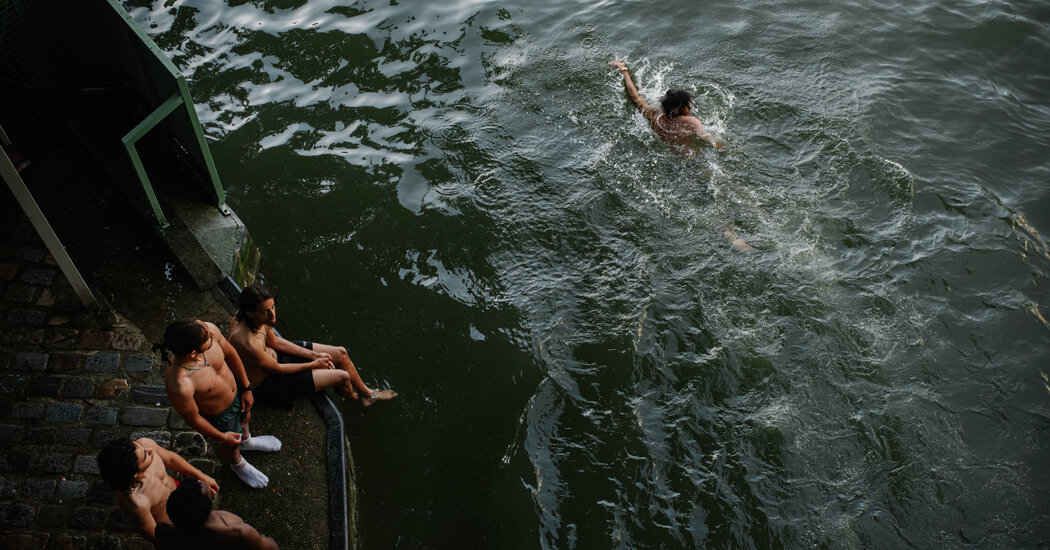
Perched on the cobblestone bank of the Canal Saint-Martin in Paris, watching his children whoop and shout as they splashed in the murky water, Stéphane Guillaume looked like a rare Parisian who’d beaten the heat. But in the new normal of scorching-hot Paris summers, he said, any victory would be fleeting.
“It’s going to get worse every year,” said Mr. Guillaume, a 44-year-old computer engineer. “It’s very worrying because we’re already at the limit of what’s bearable.”
With temperatures across France soaring to the highest levels ever recorded in June — more than 40 degrees Celsius, or 104 degrees Fahrenheit — thousands of people are turning to extreme measures: jumping into canals, rivers and other waterways for relief. It can be a deadly choice. Forty people have drowned in heat wave-related accidents between June 18 and June 23, according to the French government.
Many in France still recall the summer of 2003, when nearly 15,000 people in the country, most of them older, died in a freak heat wave. That prompted recurring debates about how to weatherproof French society. The Ecologists, a green party, is proposing paid time off for those most exposed to climate disruptions, while decades of cultural resistance to air conditioning seems finally to be on the wane.
Yet the mismatch between tropical heat and northern European infrastructure remains stark. In Paris, the Louvre Museum and the Eiffel Tower announced they would close early on several days this week. Near Toulouse, in southwest France, the authorities shut down a nuclear plant because the water temperature in the River Garonne, used to cool its reactor, was dangerously hot.
While swimming in the Canal Saint-Martin is off limits, except for a short stretch that is roped off and patrolled by lifeguards, locals and visitors are taking matters into their own hands. Whether it is leaping off its cast-iron bridges or cavorting with brightly colored floats, they have turned much of this three-mile waterway into an urban oasis.
Mr. Guillaume said he didn’t worry about safety. He kept a close eye on his children, and he said city officials regularly tested water quality in the canal, which once supplied Paris with grain, loaded on barges. Police cars rolled past, their officers doing nothing to stop the crowds from swimming or jumping.
“The kids are happy,” said Mr. Guillaume, referring to the daily visits with his family since the heat enveloped Paris last weekend. “They stay at home, and in the evening, they go to the canal. It’s like a holiday.”
Still, he said he had a disquieting sense that the prolonged nature of this heat wave — the second of the summer, and it’s not yet July — dramatized the untenable nature of climate change. School, hospitals, and houses in France are not equipped for long stretches of extreme heat, a reality that has become vividly clear this week, as the country wilts under a persistent, unforgiving sun.
On Tuesday, Prime Minister Sébastien Lecornu convened a second meeting of the government’s “inter-ministerial crisis task force on the heat wave.” Speaking to reporters beforehand, he stated the obvious: France was in the grip of a heat wave of “exceptional intensity,” adding that “all local and national temperature records are being broken every day and every night.”
“The real issue that should concern us is the duration of the crisis and this event,” Mr. Lecornu said. He noted that under the most dire of three forecasts by Météo France, the National Weather Service, the heat wave could persist for weeks and “carry us through much of July.” The other two forecasts call for temperatures to return to more normal levels within a few days or a week.
The prime minister said he welcomed proposals to make France more resilient in the face of extreme heat. Paris has already done some things to cool its streets, including planting trees and installing water spray stations. Other ideas, like making buildings more habitable in extreme heat, will take time, meaning they will bring scant relief to people sweltering today.
Given those limitations, it appeared that Paris has opted for a laissez-faire approach with the crowds at Canal Saint-Martin. City officials announced they extended the opening of the canal for swimming until July 4, and also installed a shower for bathers to use after they get out of the water.
For all the French insouciance, there were reminders that Canal Saint-Martin is an industrial waterway, not a neighborhood pool. On Tuesday evening, children were playing with a shopping cart, still dripping with algae, that had been dredged from the bottom. They said that bicycles were another common discovery.
A French comedian, Hugues Lavigne, posted a playful YouTube video of himself going for a swim in the canal. After dunking his head briefly underwater, he resurfaced and promptly appeared to vomit on the cobblestone bank. “That is so good!” he exclaimed, before turning around and going in for more.
Some Parisians contend that swimming in the canal is better than suffering at home. Victoria Cog, 47, an elementary schoolteacher, noted that the temperature in her house was 32 degrees Celsius, or 90 degrees Fahrenheit, and even hotter in her classroom. Such heat is a risk, given that she said she suffered from a chronic cardiovascular disease and has two children, aged nine and 13.
“If I faint alone at home with my kids, who is going to call emergency services?” Ms. Cog said. “At least here we can all watch each other,” she said, gesturing to the zone of the canal, which has five lifeguards. “It’s very well supervised, there’s no current, and there’s plenty of space in the water.”
To some visitors, the Canal Saint-Martin is Paris’s newest tourist attraction. Friends from Durham University in northern England, who play in a jazz band, had found their way to the canal to cool off between gigs. Now they were waiting in a line of people, mostly young men, to leap off one of the bridges.
“I heard about this place from a friend who is a pompier,” said Bena Bird, 22, using the French term for firefighter.
Mr. Bird said his friends researched the water quality online and were satisfied they would not get sick if they kept their mouths closed when they were underwater. One of his friends, Ella Eastwood, 21, said, “You kind of assume there is sewage running through a river in the middle of a major city.” (Swimming is forbidden when it rains, and there is a risk of sewage overflow.)
Still, Ms. Eastwood said, “London doesn’t have anything like this.” With that, she clambered over the stone railing and leaped into the water with a yelp.