dailynewsnblog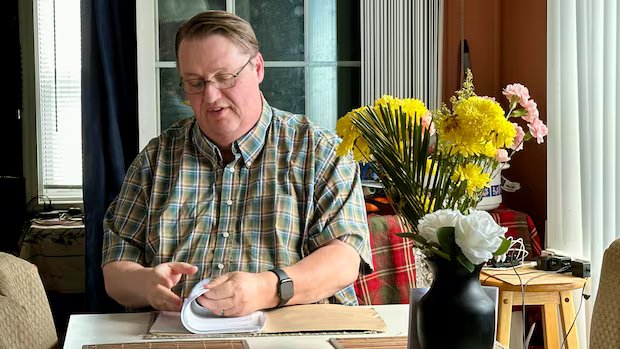
Timothy Clark felt a growing sense of duty. To say something, to protect others. So he popped some coins into a school payphone and dialed the number for the Roman Catholic Archbishop of Halifax.
It was 1984 and he was 14 years old.
A member of the archdiocese office staff answered, he says. He told her he wanted to talk about a priest who had touched him inappropriately. She took his home phone number and said someone would reach out. No one, he says, ever called.
“They basically just ignored me,” Clark, now 55, said in a recent interview at his home in Wileville, N.S.
For nearly four decades, he kept the sexual abuse he suffered as a young teen close to him. So it was with some trepidation that, in 2023, he decided to make a claim as part of the settlement of a class-action lawsuit involving abuse by priests in what’s now called the Roman Catholic Archdiocese of Halifax-Yarmouth.
But a path he thought would help him shed his secret and find acknowledgment has been tinged by regret. It’s been nearly three years since he was approved for $60,000 in compensation, but he’s still not seen a penny of the $10 million that was set aside.
Clark is among more than 60 victims of clergy abuse whose claims have been formally accepted but who have not yet been paid, as the class-action post-settlement process has stretched on.
‘It drags on’
What has particularly bothered Clark, he said, is what he views as a lack of communication. When he sought answers, he said he was shuffled between employees of the company hired to administer the claims process and lawyers for the class-action members.
“The more I went through it and the less information I got, the more helpless it was,” he said. “It was almost like, this isn’t what I had envisioned when I started this process. So it kind of just, it drags on, and it goes on, and you don’t get information.”
Class-action lawsuits involving institutional abuse can make headlines when they are launched, and bring a hoped-for sense of justice when they are settled. But the aftermath, when public attention has waned, is also crucial.
One frustrated claimant in the clergy-abuse case wrote directly to the Nova Scotia Supreme Court in December, indicating he’d been told his payment had been delayed but he had “not received assistance, guidance, or a clear explanation for the repeated extensions.”
The letter prompted a court hearing in January where lawyers for the class members and for the archdiocese updated Justice Christa Brothers, who had approved the settlement agreement in November 2022.

John McKiggan, a Halifax lawyer who helped launch the class action, noted in an interview that the settlement put aside a fixed pot of money. This means payments can only be made when all cases are fully assessed, as the number of approved claimants will determine how much each receives.
McKiggan said the primary reason for the delays was the “large number” of cases where the archdiocese sought interviews with claimants, although he noted it had the right to pursue that avenue.
Some claimants were reluctant to submit themselves to questioning related to the sexual abuse they faced, he said. Organizing interviews, in some cases, took time.
‘Complex and emotional’
However, Melanie Comstock, a lawyer for the archdiocese, said the right to question claimants has been used “sparingly,” and fewer than a third have been asked to do a “clarifying interview.” The archdiocese, she said, has sought to be trauma-informed.
She said the most common reasons for an interview include: the filled-out claim form was short on details; the priest accused of abuse had no known history of complaints or prior claims; or the time frame alleged by the claimant did not match where the priest was posted.
The archdiocese, she said, felt an obligation, both to the church and the remaining claimants, to test the evidence in certain cases, as approving compensation for an “improper claim” would cut the amount paid out to the rest.
“It is unfortunate that some of the claimants are feeling frustrated as we work through the court-approved process,” Comstock said in an email.
“Sexual abuse cases are complex and emotional for those impacted so it is understandable that they would like to see the process concluded.”
The archdiocese has challenged just seven of the 78 claims that were processed, Comstock said. Four are scheduled to be adjudicated in the coming months by a third-party lawyer, she said, while the adjudicator has already dismissed claims of abuse in the three other cases.
She also noted a large number of claims were received toward the end of 2023, as the one-year deadline for submissions neared. They were reviewed first by an administrator, and the last of the claims weren’t delivered to the archdiocese until the fall of 2024, she said.

Asked about the criticism that communication with some claimants has been poor, McKiggan said his firm has sent out updates when there is a change, and has been in touch with the court. He also asserted his firm tries to reply to phone inquiries within 48 hours.
“There’s no question that there’s a sense of frustration out there, which I share. No question about it, because we expected this to be finished,” he said.
Under the settlement, $3.2 million of the $10 million was to go to McKiggan’s firm and a Toronto firm that also worked on the file on behalf of class members. McKiggan confirmed the firms have received their money.
The amount was approved by Brothers, the judge in the case, in 2022. She noted the “significant contribution of professional time and disbursements” by lawyers for the plaintiffs. The lawyers also assumed a financial risk, given they would have seen nothing if the class action failed.
“Without counsel willing to take on these cases, meritorious claims like these could languish and vulnerable people in our society would not have an opportunity to obtain access to justice,” Brothers wrote in her decision.
‘Justice and healing’
In 2022, the current Archbishop of Halifax-Yarmouth, Brian Dunn, said settling the class action was “necessary to provide an opportunity for justice and healing for all victims.” In a recent email, he acknowledged “it certainly has been a lengthy process waiting for the compensation to be paid.”
The class action covers victims who were abused between 1954 and 2020. Claimants will likely receive anywhere from $30,000 to $350,000. Some will be paid lower amounts and others higher, depending on the nature of the abuse and the harm suffered.
It was many years later that Clark learned Rev. Robert Joseph McDougall, the priest who had abused him at a church event and following choir practices, had also targeted other boys, some of whose cases were eventually prosecuted. In 1999, the priest was sentenced to house arrest.
Clark said he had long harboured the guilty feeling that he could have done more to stop the abuse, or that he’d been old enough at the time to speak out about it, or that he should have avoided it in the first place.
Three years ago, he spotted a notice about the class-action settlement on a bulletin board. When he later filled out the form, including dates, locations and descriptions of the abuse, he said he felt the guilt lift.
“My wife didn’t even know until after I’d made the claim,” he said. “I never told her ’cause I felt it was a burden. She had a good childhood. She wouldn’t understand — that’s what I felt. But she was supportive in the end.”
MORE TOP STORIES