dailynewsnblog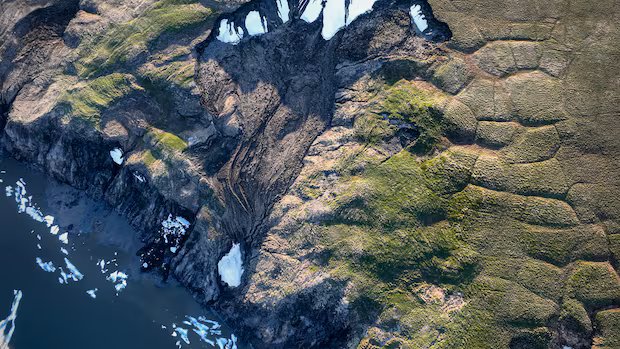
Thawing permafrost on a small island off the Yukon’s north coast is shedding light on how climate change could dramatically affect the Arctic landscape in years to come.
On Herschel Island-Qikiqtaruk, an island five kilometres off Yukon’s north coast, rapid changes to the landscape are driven largely by thawing permafrost which creates slumps, says Isla Myers-Smith, a professor at the University of British Columbia.
“You get this sort of bite out of the ground that grows successively bigger and bigger each year as more of that ice is exposed,” Myers-Smith said.
In ice-rich areas, like Herschel Island-Qikiqtaruk, a cliff typically forms at the back of the slumps and recedes over time, she said.
Myers-Smith says the impacts of these slumps are wide-ranging. Permafrost stores carbon, and slumps often release carbon into the water and the atmosphere, contributing to further warming. Slumps also disturb soil and strip the landscape of vegetation, altering plant communities and affecting people and wildlife.
She and her research team are working with park rangers on the island to monitor and study how permafrost slumps are changing the landscape, and in particular, its vegetation. The team will be returning to the island to continue this work in June.
Since 2015, she and her team have been capturing drone footage of permafrost slumps and coastal erosion.

A study published last month in the journal Nature Climate Change looked at permafrost slumps across the Arctic using satellite imagery and found that in low-Arctic areas vegetation recolonized within a decade, but in high-Arctic sites, where the growing season is shorter, vegetation took more than 30 years to recover.
The study includes imagery from a site on Herschel Island-Qikiqtaruk, where it took an estimated 25 years for vegetation to recolonize after a slump.
Myers-Smith says that satellite data is important for understanding how permafrost slump disturbances affect the Arctic as a whole, but only so much can be gleaned from satellite imagery.
“It takes a lot longer for the same plants that were there before the disturbance formed to come back in,” she said. “So it could be hundreds of years, it could even be thousands of years in some of these systems. So the full recovery time is actually a lot longer than the satellites can detect.”

On-the-ground research and observations shows how permafrost slumps change over time and what type of vegetation is recolonizing the area, and can provide early signs of a slump re-activating again after it stabilizes.
This research and the work of local park rangers is critical not only for understanding climate change and thawing permafrost on Herschel Island-Qikiqtaruk, but the future impacts of climate change across the Arctic, she said.
“Having a place that’s kind of at the forefront of change helps us understand change more broadly.”
‘You have to witness it yourself’
In early August 2023, long-time park ranger and Inuvialuit elder, Richard Gordon, heard a loud rumble during one of his visits to the island. It was the sound of hundreds of landslides that ripped tundra apart and sent it crumbling into nearby valleys and into the ocean.
Gordon was the senior park ranger for Herschel Island-Qikiqtaruk Territorial Park for 25 years before he retired this year.
Over the years, he and other park rangers monitored permafrost slumps and watched them become larger over time. But that summer, a heat wave left the landscape permanently altered.
Temperatures on Herschel Island-Qikiqtaruk soared to five degrees warmer than typical maximum summer temperatures, according to Myers-Smith. Over the course of two weeks, permafrost thawed deep in the soil, triggering landslides across the island.
“I [could] hear the ground just making noise like moaning,” Gordon recalled. “I was glad to witness that … [it] really brought some of the words from the elders when they say you got to respect the land … because the land is very powerful.”

Now, Myers-Smith says some of those landslides have continued to grow and are now permafrost slumps.
“And that has implications for the carbon cycle, for wildlife, for people,” she said.
Gordon says these changes have forced the Inuvialuit to adapt their subsistence harvesting in the area. He says people used to hunt caribou on the island, but in recent years, he hasn’t seen caribou on the island.
Erosion caused by thawing permafrost has also increased sediment in the water, and is affecting the timing of the Dolly Varden run, he said. Now, Inuvialuit are harvesting whitefish and inconnu instead.
Gordon says studying how the island is changing will help Inuvialuit adapt, and witnessing the changes first-hand is the best way to document climate change on the island and across the Arctic.
“You have to witness it yourself,” he said. “Once you see it, you wonder … how fast [climate change] is moving in the circumpolar region.”
“It’s the last frontier where we have permafrost and … we’re losing it each and every year, and it changes the whole landscape.”