dailynewsnblog
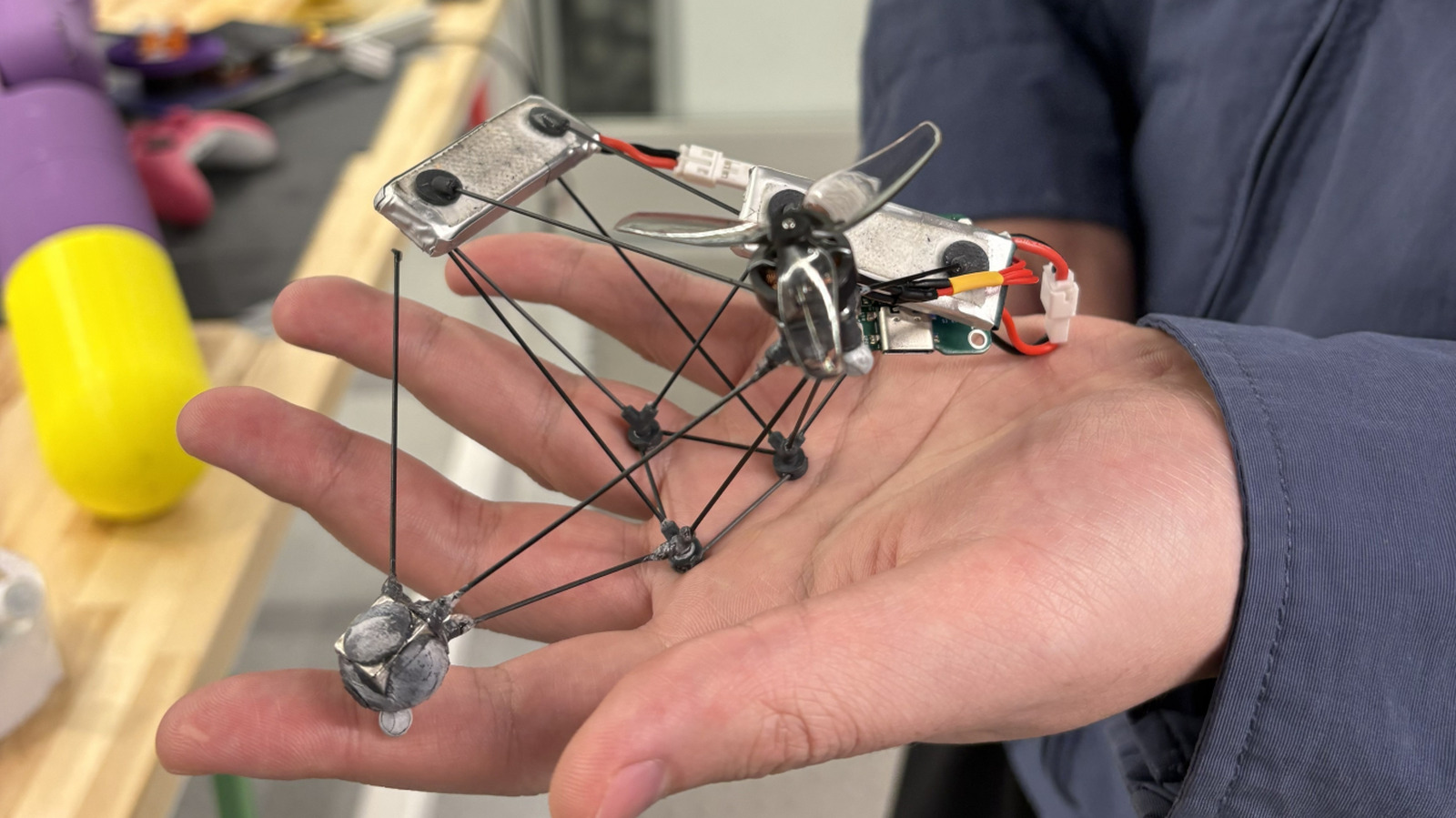
Researchers at Northwestern announced that they may have cracked the drone-invisibility-code. Dubbed the Phantom Twist by its creators, the drone exploits faults in human vision to become nearly invisible to the naked eye. Rotating up to 25 times per second, it achieves the same optical illusion as propellers, spinning so fast that the human eye cannot follow it. Unlike its fanned counterparts, however, the drone lacks stand-still components that root it in your vision. Instead, the drone’s propeller and body spin in opposite directions, According to its creators, the Phantom Twist is roughly 10 times less visible than your standard quadcopter and may be the closest we’ve come to realizing visually invisible aircraft.
Of course, this doesn’t mean that the aircraft has achieved full invisibility, instead achieving what the research release calls “a ghostly smudge that seamlessly blends into the background.” Perhaps the best way to visualize it is to think of the Predator films, in which a faint outline can be seen. Thankfully, you won’t need to coat yourself in mud and go on an Arnold Schwarzenegger-style rampage to find this crafty drone, as the Phantom Twist still has several stealth limitations. For one thing, the UAV makes an audible whirring sound as it spins through the air, tipping any unsuspecting observer off to its movements. Moreover, its engineers admit that its wires and support rods are still somewhat visible, further limiting this model’s functional “invisibility.”
The UAV was debuted at Sydney, Australia’s Robotics: Science and Systems conference, where its designers delivered a talk titled Computational Design of a Low-Visibility UAV Using Human-Aligned Perceptual Metric. Interested readers can dive deeper into the team’s feat of engineering through the paper that accompanied the talk on the conference’s website. The project, partly funded by the National Science Foundation, was conducted by members of Northwestern’s McCormick School of Engineering’s Center for Robotics and Biosystems.
Designing an invisible drone
Scientists have worked for years to accomplish invisible flights. For Northwestern’s McCormick team, the pursuit started with a computational model that generated 20,000 drone designs. From there, the researchers used artificial intelligence to sift through and rearrange the models, optimizing its components to reduce visibility in flight. Once they narrowed their choices down, researchers simulated the drone’s flight over a series of landscapes, using a perception model to mimic human vision and gauge visibility. After further refining the 500 least-visible options, the team was finally ready to put their designs to a physical eye test. According to Michael Rubenstein, an associate professor of computer science and mechanical engineering who headed Northwestern’s project, “The design process was fully automated. Then, when we were confident that a drone met all our criteria, we built it.”
The result was a drone that manipulates human perception. As Rubenstein put it in the study’s press release, “Most efforts to hide drones focus on making them look like their surroundings. Instead, we asked whether we could design the drone itself around the way humans perceive motion.” To do so, the design places its propeller, wires, circuit board, batteries, and counterweights at different heights, ensuring plenty of empty space between components. During flight, the propeller spins counter to the rest of the drone, ensuring that none of its parts’ rotations are synchronized, thus preventing our eyes from fastening onto any set points.
Emma Alexander, an assistant professor who specializes in computer vision and coauthored the study, further explained that the design takes advantage of the time our eyes take to process visual signals. Comparing it to exposure time in cameras, Alexander noted that “when an object spins quickly, we perceive it as blurring out and losing distinct features. Because this new drone is almost entirely transparent, its few opaque components are visually averaged with the background for an overall appearance of a slight haze.”
An invisible future?
Projecting the fate of the Phantom Twist’s leap in drone stealth is difficult. For now, the team at Northwestern will look to update its designs, with Rubenstein confirming that they would continue working toward functional invisibility by incorporating transparent materials and quieter propulsion systems.
The researchers have posited that the drone could apply to a host of civilian uses. For instance, researchers believe that invisible drones could be used to survey wildlife. For instance, current quadcopters are often too noisy and visually distinctive to effectively survey undisturbed wildlife preserves in detail. The researchers point out that their foreign presence can disrupt the behavior of their subjects, such as nesting birds, effectively ruining the credibility scientific observations. The same can be said for inspecting infrastructure, where observers need to be able to observe functions in real time without disrupting operations.
Of course, it will be difficult for observers not to draw the obvious link between this leap in drone stealth and its potential military and surveillance applications. As it stands, global militaries are engaged in a death sprint towards fully automated drone warfare, as leaps in artificial intelligence and robotics transform quadcopters from a tool for asymmetric warfare into the defining weapon in conflicts ranging from Ukraine and Iran to Sudan and Gaza. The proliferation of cheap, advanced attack drones has revolutionized modern conflicts, reducing costs, expanding the scope of battlefields, increasing civilian death tolls and, ultimately, prolonging conflicts.
All told, the drone market is defined by its accelerated development timelines. Because drones are extremely cheap, in some cases costing millions of dollars less than the missiles launched to destroy them, manufacturers can quickly test, manufacture and deploy emerging technologies with previously unimaginable speed. In Ukraine, for instance, observers have seen technological learning cycles reduced from years to weeks. The real question, therefore, may not be whether invisible military drones are on the horizon, but how and when global arsenals begin incorporating them into their development pipelines. Unfortunately, the answer likely depends more on questions of scale and feasibility than any moral scruple. Hopefully, the civilian impact of the researcher’s study can stand up to those it will potentially render on the battlefield.