dailynewsnblog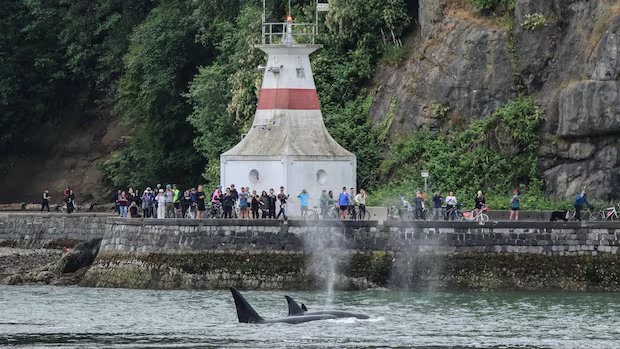

Listen to this article
Estimated 5 minutes
The audio version of this article is generated by AI-based technology. Mispronunciations can occur. We are working with our partners to continually review and improve the results.
More whales are appearing in the waters around Vancouver thanks to seasonal movement, food availability, and decades of conservation work, researchers say.
A new study says West Coast transient killer whales, also known as Bigg’s killer whales, are now being seen in the inside waters of Vancouver Island for about 250 days a year on average.
The study, published in Marine Mammal Science, found that about 70 per cent of the coastal population of the transient killer whales regularly use the Salish Sea, an inland sea that spans the waters between Campbell River, B.C., and Olympia, Wash.
“It’s probably the most critical piece of habitat for killer whales on the entire coast,” said Andrew Trites, director of the Marine Mammal Research Unit at the University of British Columbia.

“Probably the most important food stop or the most important grocery store for them in all of North America.”
Transient killer whales are different from the endangered southern resident killer whales, which mainly feed on fish like salmon. Bigg’s killer whales hunt marine mammals such as seals, sea lions and porpoises.
Trites said the rise in Bigg’s killer whale sightings is tied closely to the recovery of seals and sea lions, which were heavily hunted and culled until marine mammals received new protections in the early 1970s.

Whales are a frequent visitor in the waters off of Vancouver. But one grey whale feeding in English Bay has people very excited. As the CBC’s Alanna Kelly reports, one swimmer had an encounter that was extra special.
Trites said as seal and sea lion numbers recovered, the killer whales followed. That recovery, he said, is now changing what people see along the Vancouver shoreline.
The study is based on sightings data collected between 2016 and 2023 from researchers, commercial whale watchers and citizen scientists.
‘Look up from your phone’
Trites sad the growing number of whales near Vancouver is changing what people can experience close to home.
“This is our Serengeti,” he said. “You don’t need to go to Africa. You don’t need to go to Hawaii anymore. If you want this wildlife experience, you can walk along the seawall.”
He said people can sometimes be walking past a nearby whale in the water without realizing it.
“My message to everybody … is look up from your phone, take your earbuds out. Listen,” he said.
Trites said the sound of a whale breathing or surfacing can be unmistakable, but people have to pay attention.
Whale watching becoming less seasonal
Erin Gless, executive director of the Pacific Whale Watch Association, said whale watching in B.C. has changed dramatically as more species return to local waters.
She said southern resident killer whales were the main draw for whale watchers decades ago but professional operators no longer view them because of their endangered status and strict protection rules.
Gless said whale watchers are now more likely to see Bigg’s killer whales, humpback whales and grey whales.

“There’s a lot more Bigg’s killer whales or the mammal-eating orcas in this region than there were even a few years ago,” she said.
Gless said humpbacks have also made a dramatic return. They were common in B.C. waters before commercial whaling wiped them out from the region in the early 1900s.
Trites said humpback whales are another conservation success story after their populations rebounded since commercial humpback whaling ended in the North Pacific in the mid-1960s.
Another major reason is that this is also the time when whales return to B.C. waters to feed after fasting in their winter breeding grounds. According to the study, humpback and grey whales arrive in the Salish Sea focused on rebuilding their energy stores, feeding on the Pacific Northwest’s cold-water prey.
The increase in whale activity comes as researchers in B.C. are tracking a rare North Pacific right whale, one of the most endangered whale species, was spotted off Malcolm Island on Sunday.
The sighting in B.C. waters is a positive sign for this small population of fewer than 50 whales, according to researchers.
“There hasn’t been a North Pacific right whale calf seen in many, many years,” said Jared Towers, a Department of Fisheries and Oceans (DFO) cetacean research technician.

A rare and endangered whale was spotted in B.C. waters, generating buzz among researchers. As the CBC’s Alanna Kelly reports, it’s not just spotting the whale that’s a big deal.
What it looked like was also a sign of hope.
Gless said that while the growing number of whales is good news for whale watchers and tour operators, it should come with more caution.
“It means that interactions between humans and whales are also increasing,” she said.
In southern B.C., vessels must stay at least 100 metres away from most whales, 200 metres from most killer whales and 1,000 metres from endangered southern resident killer whales.