dailynewsnblog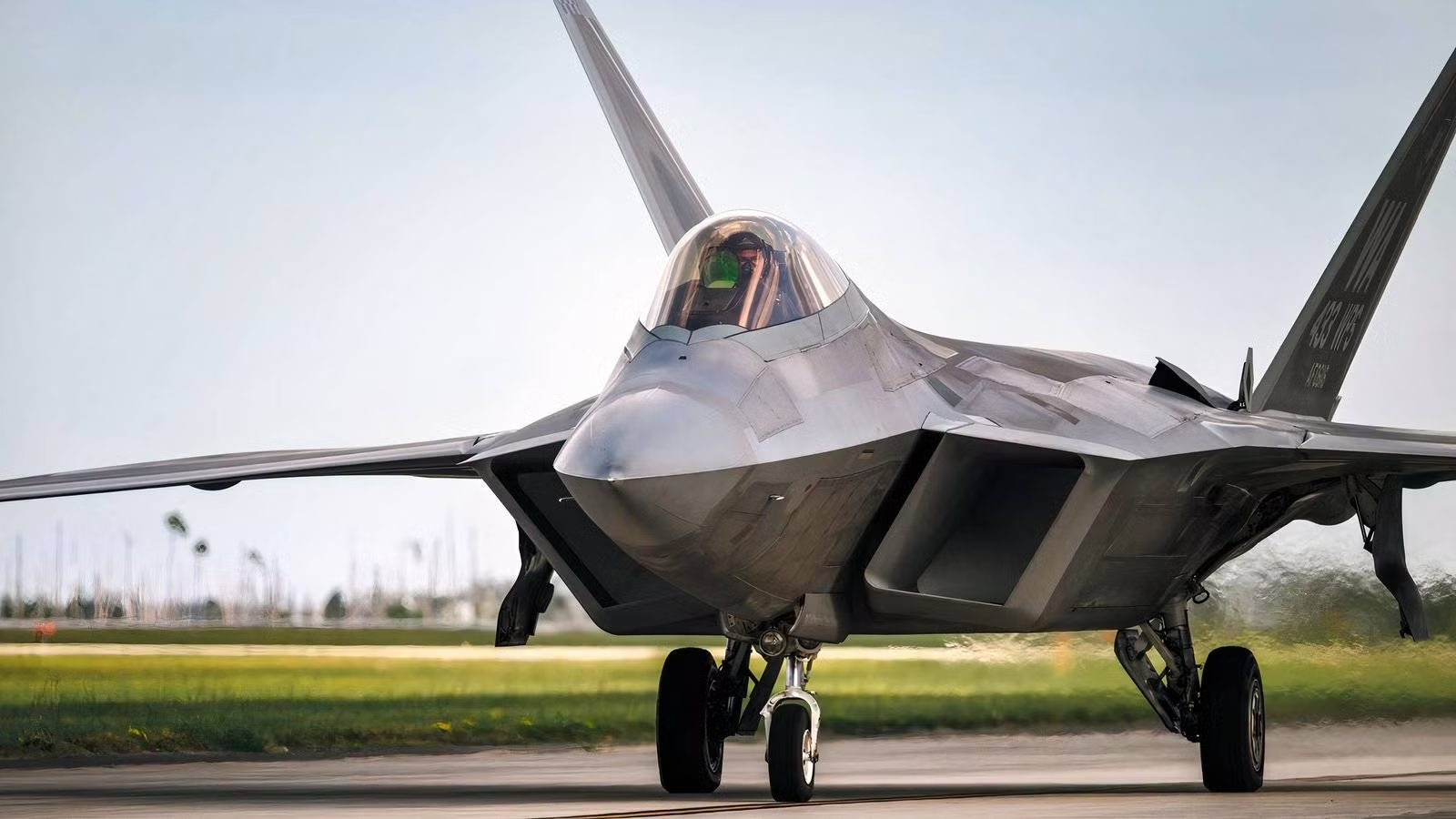
In the open record, the US Air Force describes the top speed of its premier stealth fighter simply as “Mach two class.” It’s not surprising that the performance specifications of the Lockheed Martin F-22 Raptor are classified to a degree, given the continued active service of what was the world’s first fifth-generation fighter jet.
While the USAF may not publish the exact number, it is widely referenced that the Raptor tops out at around 2.25 times the speed of sound, based on data points from a discontinued Air Force Academy publication. That is especially available because it is below the approximate top speed of the older  Boeing F-15EX Eagle II which is listed as Mach 2.5 despite being an older airframe.
In the defense of the Raptor, its true feat of speed is not actually sprint performance but rather its ability to fly at what is known as ‘supercruise’ around Mach 1.8 on long flights. Another important footnote with that speed difference is the fact that the F-22 has thrust vectoring exhaust nozzles. As a result, the F-22 is able to out-dogfight nearly any other platform in the world while also evading radar and traversing the battlespace at record speeds, although it is not exactly the fastest warbird in the sky today.
The Number The Air Force Stopped Publicizing

The assumed true speed limit of the Raptor as it is believed to be today doesn’t come from a classified Pentagon brief, but rather an old Air Force study guide. It was once published at the US Air Force Academy. The USAFA published the F-22A’s specifications, including its top speed, in the 2016 print and digital issue of Contrails, a foundational handbook issued for cadet rote-memorization. Yet, the Open Secret remains an unpublished fact as the Air Force declines to put the exact figure on the aircraft’s fact sheet available online.
Today, all documentation provided by the USAF, including from the home of the F-22 at Tyndall Air Force Base, genericizes the jet’s performance. Even so, official data rates each of its twin Pratt & Whitney F119 engines within the 35,000-lb (15,875 kg) thrust class. Meanwhile, Airman Magazine provides a performance range rather than a single fixed metric. In its technical archive, the officially endorsed Outlet describes the fighter as being capable of sustaining Mach 1.82 supercruise and readily able to exceed Mach 2 with afterburners.
Why Supercruise Is The Ultimate Requirement

Two industrial teams developed competing flyable prototypes for the 1970s Advanced Tactical Fighter contract. A Lockheed-led team fielded the YF-22 against the Northrop-McDonnell Douglas YF-23. Ultimately, Lockheed won the bid that would eventually produce the F-22 Raptor. This Cold War program was designed to counter advanced Soviet and Chinese designs like the Su-27 Flanker and the MiG-29 Fulcrum by incorporating the performance of an air superiority fighter into a stealth airframe.
From the outside, the speed requirements focused on tactical persistence rather than a single, high-speed dash capability. The super cruise ability of the Raptor drastically expands its operational envelope, offering a massive range and speed advantage over older fighters. Reinforcing the value of this at a strategic and tactical level, the sixth-generation Boeing F-47 will adopt new variable cycle engines to dramatically enhance supersonic range at a level never seen before.
Specification | F-22 Raptor | F-15EX Eagle II |
Estimasted Maximum Speed | 1,500 miles per hour (2,414 km/h) | 1,650 miles per hour (2,655 km/h) |
Service Ceiling | 65,000 feet (19,812 meters) | 60,000 feet (18,288 meters) |
Ferry Range | 2,001 miles (3,220 km) | 2,417 miles (3,889 km) |
Thrust Afterburner | 35,000 lb of thrust (156 kN) | 29,000 lb of thrust (129 kN) |
Maximum G-Load | 9.0-G | 9.0-G |
The reason is simple: its supercruise capability is directly tied to survival on a battlefield dominated by advanced integrated air defense systems and other stealth aircraft. By combining a low radar cross-section, integrated avionics, and high-speed cruise, the Raptor severely shrinks the engagement zones of enemy surface-to-air missile batteries. It degrades an adversary’s ability to track the jet.
Another massive advantage is in beyond-visual-range engagements. In practice, the velocity of the plane dramatically amplifies standoff weapons energy by launching them above the speed of sound. Its air-to-air missiles are speculated to have a striking distance of as long as 125 miles (201 km). For ground strike, the F-22 can release 1,000-lb (453 kg) precision bombs from an altitude of 50,000 feet (15,240 meters) while cruising at Mach 1.5, striking moving targets 24 miles (38.6 km) away thanks to its altitude and speed, which give every munition it carries more kinetic range.
What The Two F119 Engines Deliver

The Raptor is powered by two P&W F119 engines, the world’s first operational fifth-generation fighter powerplant. These give the jet a combined 70,000 lb of thrust. The F-22’s empty weight sits in the 40,000-lb (18,143 kg) class, giving it an excellent thrust-to-weight ratio that allows the fighter to accelerate and climb aggressively without ever leaning on its afterburners.
Beyond raw power, the F119 introduces extreme maneuverability through its unique two-dimensional thrust-vectoring nozzles, which can pitch up or down by 20 degrees. The jet’s flight control system automatically manages these nozzle angles alongside a digital engine controller regulating hundreds of airframe parameters.
Meanwhile, to protect its stealth profile at high speeds, the Raptor carries its full air-combat load entirely inside internal weapon bays, typically six AIM-120 radar-guided missiles and two AIM-9 Sidewinders. That prevents external missiles from creating aerodynamic drag or radar reflections. The problem is, in 2026, the F-22 operational fleet is both small and continuing to show its age.
A Small Fleet Asked To Cover A Wide Gap

While initial Raptor production lines wrapped up with 183 airframes, only 143 are fully combat-coded, as The War Zone reported. The remaining airframes are relegated to training and test configurations. To protect the platform’s viability, recent defense budget requests allocate $90.34 million toward a targeted Raptor modernization initiative. Multiple frontline combat units are routinely sidelined for extensive depot-level maintenance, causing minor inventory fluctuations across military logs.
This ‘Raptor 2.0’ or ‘Super Raptor’ upgrade package includes advanced infrared search-and-track sensors, a redesigned pilot-vehicle interface, and stealth-compatible external fuel tanks engineered to boost the jet’s operational range. Concurrently, the service contracted LIFT Airborne Technologies to field a next-generation flight helmet specifically optimized for F-22 cockpit operations.
The addition of specialized external tanks directly addresses the Raptor’s primary tactical bottleneck, for which its super Cruise was already intended to tackle: range. While the Raptor preserves fuel far better than the standard afterburner dash of any other fighter, internal fuel volumes still limit the fighter’s persistence over long distances. These radar-evading external tanks add critical combat reach without compromising the airframe’s low radar cross-section as its range is extended specifically for the Pacific Theater.
As the US military pivots to the Pacific and focuses its efforts on deterring Chinese aggression in the first and second island chains, range becomes a greater concern for every platform but primarily tactical aircraft. That is why the low drag tank and pylon program is specifically working to overcome the ‘tyranny of distance’ in the Western Pacific.
The Raptor’s combat radius is just 590 nautical miles (1,092 km), whereas the future Boeing-built F-47 fighter slated to succeed will boast a theater reach exceeding 1,000 nautical miles (1,852 km). The Air Force intends to acquire at least 185 of these next-generation F-47 aircraft, matching the exact footprint of the current Raptor fleet while drastically expanding American air power across heavily contested, long-range theaters.
Congress Keeps The Raptor Flying While The F-47 Waits

Despite the age of the F-22, in June, the House Armed Services Committee overwhelmingly adopted an amendment blocking the retirement of any Raptors through 2032. The measure was bundled into the Defense budget for next year. The legislative package also extends minimum total fighter inventory requirements through 2035, and authorizes the Air Force to purchase more Boeing F-15EX jets to supplement the total fighter force.
There are a long list of strategic and political reasons for lawmakers to push these decisions on the Air Force. However, one of the most notable among them is the fact that the inventory of the USAF has dipped to its lowest point since the end of WWII. At less than 5000 airframes, the ‘divest to invest’ strategy for fleet modernization has made Capitol Hill anxious about the combat readiness levels of the current Force despite the service pushing to aggressively liquidate Legacy planes in order to free up funding for new aircraft.
Thus, Congress is forcing the Air Force to hold onto its aging stealth fleet. Until the F-47 officially enters service, the F-22 remains the primary air-superiority platform the newer jet is meant to replace, leaving the legacy fleet to carry the burden of frontline missions.
Ultimately, the Raptor’s operational worth over the next decade will be measured by readiness data. The program’s survival rests entirely on how many of its 185 airframes can remain mission-capable, how much extra combat radius they can squeeze from the LDTP and how well its out-of-production F119 engines can be sustained.