dailynewsnblog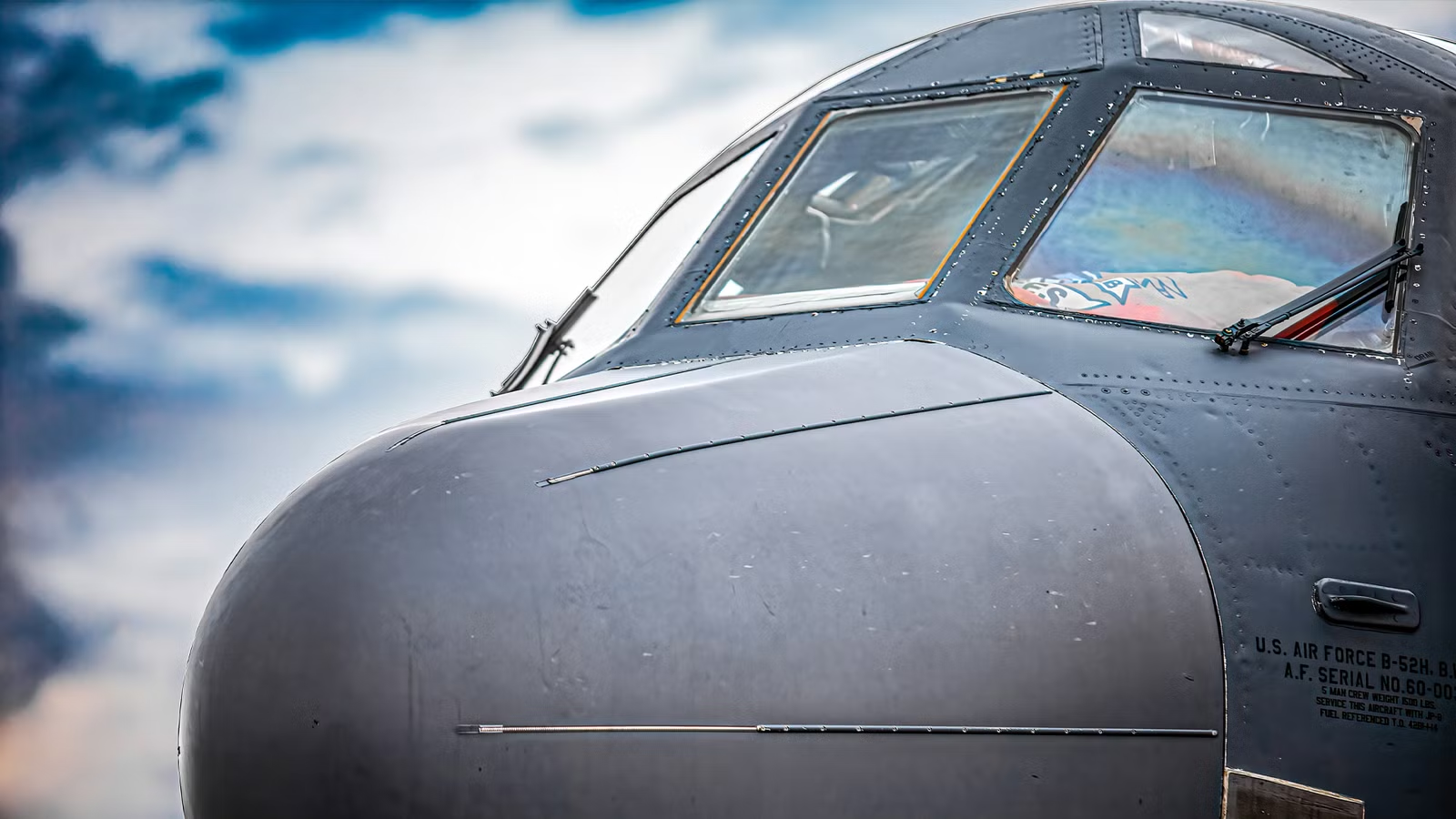
The Boeing B-52 Stratofortress is one of the most unique jet aircraft ever built. Its distinctive eight-engine layout likely wouldn’t be built today, while its massive anhedral wings require outrigger wheels to ensure stability on the ground. Having first entered service in 1955, during a time when Boeing wasn’t even delivering commercial jets, this Cold War-era bomber has become an icon of the United States Air Force.
It has long served as an integral part of the USAF’s long-range strike arsenal, and there are no signs of that changing anytime soon. Today, only about 10% of the B-52s ever built are still in service, but after years of being considered for retirement, the USAF has instead decided to upgrade these aircraft to a new B-52J variant.
Once these upgrades are completed, it’s expected that the B-52 will remain in service until the 2050s. This means that the type will have flown with the USAF for around a century (although the planes themselves will be slightly younger).
Overview Of The Stratofortress

The Boeing B-52 Stratofortress is an eight-engined high-wing long-range strategic bomber flown by the United States Air Force. In total, 744 were built from 1952 to 1962. The B-52 originated from a post-Second World War request for a new long-range bomber, and its design underwent several changes.
These included a shift from propellers to jet engines, switching from a tandem cockpit to conventional side-by-side seating in the flight deck, and incorporating bicycle landing gear, which required the use of outrigger wheels. The B-52 was designed to carry nuclear bombs, but is also capable of delivering conventional ordnance. In addition, the Stratofortress was originally armed with a tail gun, which was removed in 1991.
The current B-52H features a crew of five, with two pilots, a weapons system officer, a navigator, and an electronic warfare officer. Due to the low thrust of early turbojets, the B-52 required eight engines to meet its payload and range requirements, and it has a combat range of 7,600 NM (14,200 km), along with a service ceiling of 50,000 ft. Only three B-52As were produced and were loaned to  Boeing for testing, while the B-52B was the first variant to enter service, featuring added thrust.
The B-52C added fuel capacity, a gross weight bump, and a new fire system, while the B-52D added capacity for conventional bombs to be used in the Vietnam War and was modified with updated ECM systems. The B-52E incorporated avionics improvements, while the B-52F included more powerful engines. The B-52G added fuel capacity and a gross weight bump, alongside aerodynamic changes, while the B-52H received modernized avionics and new Pratt & Whitney TF33 turbofans.
The Next Upgrade To The B-52

The B-52H has been close to the chopping block for years due to the type’s advanced age. However, in 2018, the USAF elected to proceed with re-engining the B-52s instead, confirming the name ‘B-52J’ in 2023 and completing the program’s Critical Design Review on May 4, 2026.
The primary new feature of the B-52J will be new Rolls-Royce F130 turbofans, a military derivative of the Rolls-Royce BR700. The B-52J will retain its iconic eight-engine layout, as changing it would require the aircraft’s systems and wings to be fully redesigned. In addition to the engines, the B-52J will also incorporate a new FADEC system, along with an AN/APQ-188 AESA radar, and will receive significant upgrades to its avionics, including new digital displays in the flight deck.
Boeing B-52 Variants | Number Built | Introduction Year | Boeing B-52 Variants | Number Built | Introduction Year |
|---|---|---|---|---|---|
B-52A | Three | Test aircraft | B-52F | 89 | 1958 |
B-52B | 50 | 1955 | B-52G | 193 | 1959 |
B-52C | 35 | 1956 | B-52H | 102 | 1961 |
B-52D | 170 | 1956 | B-52J | 76 to be converted | 2032 projected |
B-52E | 100 | 1957 |
It’s one of the most thorough upgrades to the B-52, costing the USAF over $18 billion in total when combining all of the B-52J’s upgrades, and all 76 B-52H aircraft will be upgraded. The first B-52Hs will begin arriving in Boeing’s San Antonio facility later in 2026 for the upgrades, with the first flight scheduled for 2029.
It’s planned for the B-52J to enter service with the USAF in 2033, a delay of about three years compared to the original target of 2029. In the long term, the B-52J will be one of only two strategic bombers the USAF will operate, alongside the upcoming Northrop Grumman B-21 Raider. Meanwhile, the Rockwell B-1 Lancer and the Northrop B-2 Spirit will be retired.
Why The B-52 Stratofortress Will Stay In Service

Primarily, the B-52s are still flying because they work. The type has an excellent range, can deliver a large amount of ordnance, and has carried nuclear weapons effectively in the past. In addition, the platform has proved adaptable for upgrades such as the upcoming B-52J, while being a cost-effective aircraft for the USAF to operate, given how long they’ve been in service.
The same is not necessarily true for the B-1 and B-2, which are younger but will be retired sooner. The B-1 Lancer carries more payload than the B-52, but it’s also a supersonic aircraft that’s more stressed than the B-52, while also having a shorter range and high maintenance costs, largely due to its variable geometry wings.
Aircraft | Number In Service | Introduction Year |
|---|---|---|
Boeing B-52H Stratofortress | 76 | 1961 |
Rockwell B-1B Lancer | 45 | 1986 |
Northrop B-2A Spirit | 19 | 1997 |
Northrop Grumman B-21 Raider | 100 on order | 2027 planned |
Meanwhile, the B-2 Spirit is slower than the B-52 and carries less payload while also having extremely high maintenance costs, and its stealth technology is likely no longer cutting-edge, which is why it’s set to be replaced by the B-21 Raider. The B-52 is not easily maneuverable, and it lacks stealth technology, which makes the B-1 and B-2 better options against an enemy with robust air defenses.
However, most of the US’s combat focus since the fall of the Soviet Union has been on conflicts against opponents without comprehensive air defenses, which means that the B-52 is rarely in danger. Even against an enemy with sophisticated defenses, the Boeing B-52 is still effective once these defenses have been eliminated.
The Boeing B-52’s Legacy

The B-52 entered service during the height of the Cold War. The United States’ military policy towards the Soviet Union was centered around containment, with the US Air Force relying heavily on nuclear-capable B-52s to remind the USSR of the nation’s capabilities. Operation Chrome Dome is one of the most famous examples of this, where the USAF continuously kept B-52s airborne and had these planes loiter near Soviet borders.
Eventually, the rise of surface-to-air missiles saw the B-52 switch to a low-altitude role instead. The Stratofortresses were heavily deployed in major bombing campaigns during the Vietnam War. Large and slow to maneuver, these planes were vulnerable against North Vietnamese MiG fighters, resulting in 17 B-52s being shot down, but they were not completely defenseless.
The presence of the rear-facing gun helped ward off enemy fighters, with B-52 tailgunners having logged two air-to-air kills during the Vietnam War. The use of the B-52 in the Vietnam War gave the USAF crucial information on how to improve its effectiveness in a hostile air environment, leading to upgraded armament and avionics.
These planes were heavily relied upon for Operation Desert Storm, and have continued to serve in major conflicts in the 21st century, such as the Iraq War. Most recently, the USAF deployed B-52s to Iran as part of Operation Epic Fury, initially launching long-range cruise missiles from outside Iranian borders, before flying directly over Iran once adequate air superiority had been achieved.
A Potential Replacement For The Boeing B-52

The United States Air Force plans to consolidate its strategic bomber fleet to just the B-52J and the B-21 Raider, but by 2050, the B-52 will have been in service for 95 years, with all active examples being close to or above 90 years old. This length of service is unprecedented for any aircraft fleet, and while the USAF will soon begin modernizing its B-52s, it’s also exploring what it will operate once these aircraft finally reach their limits.
The USAF is conducting an active study to determine what long-range strike capabilities it might need in the future. This defines areas such as weapons systems, size, and performance. This could result in a brand new aircraft being ordered for the branch’s bomber fleet, although the study is still in its early phases.
In addition, the USAF may elect to purchase more B-21 Raiders or even perform another upgrade to the B-52 Stratofortress. While the B-52 is ancient by aviation standards, what really matters regarding an aircraft’s airworthiness is flight hours and cycles. If it’s determined that the B-52 has enough life remaining within its airframe to justify its continued use, then the USAF may elect for this path instead.
The largest maintenance costs associated with aging aircraft are primarily from the engines and avionics, but both of these are being upgraded with the B-52J. As such, while the planes themselves are old, the B-52 has continued to receive upgrade after upgrade to make it suitable for a century.
Catch what other flight trackers miss
Emergency squawks, holds, NOTAMs — unique signals, live, no signup.
Open tracker
Catch what other flight trackers miss
Emergency squawks, holds, NOTAMs — unique signals, live, no signup.
Open tracker