dailynewsnblog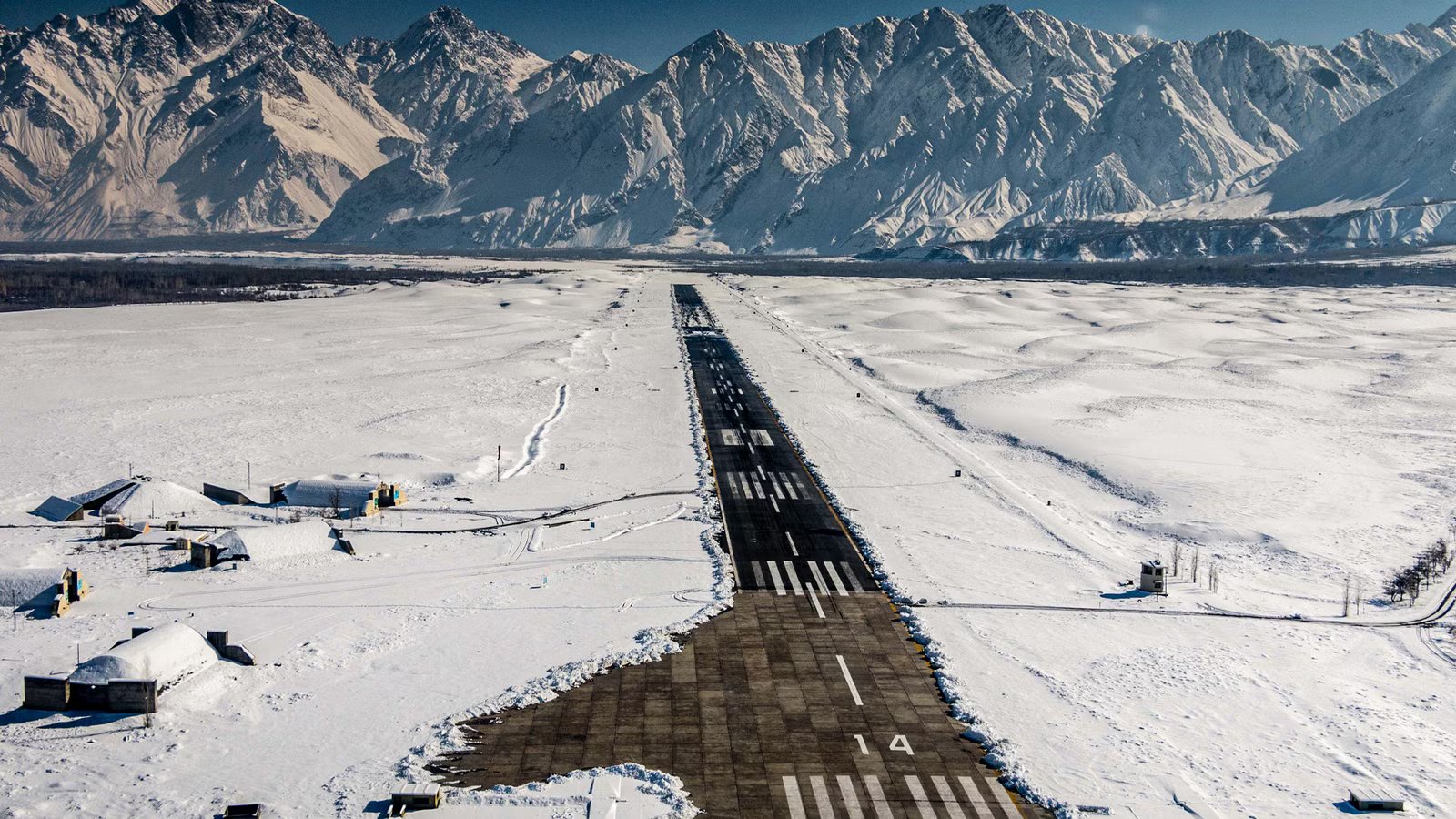
Nestled in the remote Gilgit-Baltistan region of northern Pakistan, Skardu Airport (KDU) has emerged as one of the most fascinating and intimidating airports in modern aviation. Situated at an elevation of approximately 7,316 feet (2,230 meters) above sea level, the airport lies deep within the Karakoram mountain range, home to some of the tallest peaks on Earth, including K2, the world’s second-highest mountain. Although the airport itself features long asphalt runways capable of handling large aircraft, its surrounding geography creates extraordinary operational challenges that few commercial airports can match.
Interest in Skardu has surged in recent years thanks to cockpit videos posted online by pilots and aviation enthusiasts. These videos reveal aircraft threading through tight valleys, mountains rising to nearly 19,000 feet, before performing the dramatic “Zulu bend” maneuver to align with the runway. The footage has drawn comparisons to other famous mountain airports such as Tenzing-Hillary Airport and Innsbruck Airport, both of which are internationally recognized for their dangerous approaches. Yet Skardu differs from many airports on “most dangerous” lists because the runway itself is not especially short or restrictive. Instead, the real difficulty lies in simply reaching the airport safely through one of the harshest flying environments in the world.
A Runway Longer Than Many International Airports

At first glance, Skardu Airport appears surprisingly accommodating for such a remote mountain destination. Its main runway measures approximately 11,944 feet (3,641 meters), making it significantly longer than the runways at many regional international airports across Europe and Asia. A secondary runway measuring around 8,740 feet (2,664 meters) adds further operational flexibility. These dimensions allow the airport to handle aircraft such as the Airbus A320 and Boeing 737, which are regularly operated by Pakistan International Airlines on flights between Islamabad and Skardu. For passengers unfamiliar with the airport’s reputation, the runway size creates the illusion that operations there should be relatively routine.
However, runway length is only one part of the equation. Unlike airports located on flat terrain, Skardu sits in a narrow valley system surrounded by towering mountains, severely limiting approach paths. Aircraft cannot descend directly from cruising altitude in a standard straight-in approach. Instead, pilots must carefully follow valleys through the Karakoram landscape while maintaining precise altitude control to avoid terrain. In many cases, aircraft remain hemmed in by mountains on both sides for extended portions of the arrival.
The airport’s elevation adds another layer of complexity. At over 7,000 feet above sea level, thinner air reduces aircraft engine performance and aerodynamic efficiency. High-altitude operations often require longer takeoff rolls, altered climb profiles, and stricter weight calculations. During the summer months, warm temperatures further reduce air density, creating high-density-altitude conditions. The combination of both creates conditions known as ‘hot and high’. Even with a long runway available, aircraft performance margins are narrower than at sea-level airports.
The “Zulu Bend” That Defines the Approach

The most famous aspect of flying into Skardu is the “Zulu bend,” a sharp visual maneuver performed during the final stages of the approach. After navigating through mountain valleys from Gilgit, pilots must execute a carefully timed turn between steep terrain features before entering the Skardu Valley and aligning with the runway. This approach is generally used by smaller aircraft, such as turboprops, that cannot climb over mountain terrain.
Unlike a conventional instrument-guided approach, in which pilots follow electronic glide paths and navigation aids, the Zulu bend relies heavily on visual references. Pilots must constantly monitor terrain, airspeed, descent rate, and aircraft configuration while simultaneously preparing for landing. Entering the turn too fast can make alignment difficult, while descending too steeply risks destabilizing the approach. There is little room for error, particularly during periods of reduced visibility or turbulence.
The maneuver is especially demanding because aircraft often transition from relatively high altitudes into a confined valley environment over a short period of time. Crews must carefully manage energy to avoid excessive speed buildup while still maintaining safe terrain clearance. In many ways, the Zulu bend resembles tactical terrain flying more commonly associated with military operations than standard airline procedures. This unusual combination of commercial aviation and mountain flying is one reason Skardu continues to attract enormous attention online.

Why Bhutan’s Paro Airport Is Among The World’s Scariest
The landing at Paro is a white-knuckle roller-coast ride through deep Himalayan valleys to an abrupt touchdown on a short runway.
A Visual Approach In Modern Aviation

One of the most remarkable facts about Skardu Airport is that, despite being served by modern commercial jets, it still relies heavily on Visual Flight Rules (VFR) operations. Most major airports around the world use precision approaches, such as Instrument Landing Systems (ILS) and GBAS Landing Systems (GLS), among others, that allow aircraft to land precisely and safely even in poor visibility. Skardu’s mountainous geography makes implementing such precision approaches extremely difficult due to terrain interference and limited maneuvering space.
As a result, pilots operating into Skardu frequently depend on visual contact with the surrounding terrain throughout the approach. This means that weather conditions must meet strict visibility minimums before flights can proceed safely. If clouds obscure the valleys or reduce visibility below operational limits, flights are often delayed, diverted, or canceled entirely. Passengers traveling to Skardu frequently experience schedule disruptions because the airport’s operations are more influenced by mountain weather than by runway availability.
Visual operations also place enormous responsibility on flight crews. Pilots must maintain constant situational awareness while navigating between terrain features that rise thousands of feet above the aircraft. Unlike precision approaches that provide continuous guidance, Skardu demands more active manual monitoring throughout much of the arrival.
The Brutal Reality Of Mountain Weather

The weather is perhaps the single most unpredictable factor affecting operations at Skardu Airport. The Karakoram Range creates highly unstable atmospheric conditions due to sharp elevation changes, narrow valleys, and rapidly shifting wind patterns. Calm weather can deteriorate in minutes as clouds form along mountain ridges or strong winds funnel through valleys. These sudden changes are one reason why flights into Skardu are considered operationally sensitive even during relatively stable seasons.
Wind shear is a constant concern for pilots approaching the airport. As wind moves across mountain peaks, it can generate powerful downdrafts, updrafts, rotor turbulence, and sudden crosswinds that affect aircraft stability. During winter months, heavy snowfall and blowing snow can further complicate operations by reducing visibility, obscuring terrain references, and creating icy conditions on the runway and surrounding surfaces. Downdrafts are particularly dangerous because they can reduce an aircraft’s altitude unexpectedly during approach, forcing pilots to react quickly while navigating through narrow valleys with very limited room for error.
Visibility issues are equally problematic. Valleys that appear clear from a distance can quickly become obscured by localized cloud layers or mist. Since Skardu relies heavily on visual procedures, losing sight of terrain references can immediately compromise safety. This is why pilots often make conservative decisions to abandon approaches early rather than attempt to continue in marginal conditions. Unlike flatland airports, where missed approaches are relatively straightforward, mountainous terrain severely limits escape routes once an aircraft commits to an arrival path.
Lukla: 5 Fast Facts About The World’s Most Dangerous Airport
With Sir Edmund Hillary having to buy land to construct an airport in Nepal and an accident-ridden history, Lukla Airport is one of a kind.
How Skardu Compares To Lukla And Innsbruck
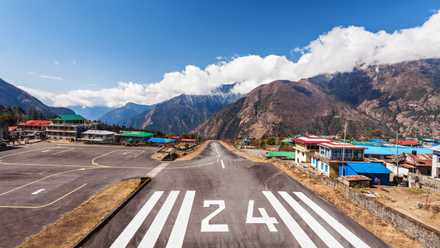
Skardu is often mentioned alongside Tenzing-Hillary Airport, more commonly known as Lukla Airport. The famous Himalayan airport is known for its tiny runway and steep gradient. Lukla’s runway measures just 1,729 feet (527 meters) in length and features a dramatic uphill slope ending at a mountain wall. Aircraft operating there are generally small turboprops such as the DHC-6 Twin Otter, carrying fewer than 20 passengers at a time. Once committed to landing at Lukla, pilots have virtually no possibility of a go-around due to terrain and runway limitations.
Skardu presents a very different type of challenge. Commercial aircraft can physically land and stop on its runways without unusual difficulty. The danger lies in navigating through the surrounding mountains rather than handling the runway itself. This distinction makes Skardu unique among airports frequently labeled “dangerous.” Pilots are not primarily concerned with braking performance or runway overruns; instead, they focus on terrain clearance, weather conditions, and maintaining a stable approach profile.
The airport also shares similarities with Innsbruck Airport in the Austrian Alps. Innsbruck requires aircraft to remain high above mountainous terrain before descending sharply into a narrow valley for landing. Both airports are known for turbulent wind conditions and terrain-constrained procedures. However, Innsbruck benefits from far more advanced infrastructure, navigation systems, and weather monitoring technology than Skardu, highlighting how remote and rugged the Pakistani airport truly is.
Why Skardu Captivates Aviation Enthusiasts

Few airports in the world combine dramatic scenery and operational difficulty quite like Skardu. Cockpit videos filmed during approaches often show aircraft flying low between towering mountain walls before suddenly emerging above the runway. The visuals resemble scenes from action films more than ordinary airline operations, which explains why videos of Skardu regularly go viral among aviation communities on Reddit, YouTube, and flight simulation forums.
For aviation enthusiasts, Skardu represents a rare example of traditional pilot skill remaining central to airline operations in an age increasingly dominated by automation. Modern airliners are equipped with sophisticated autopilot systems capable of flying highly precise approaches under normal conditions. Yet at Skardu, pilots still rely heavily on visual judgment, terrain awareness, and manual energy management. Watching experienced crews perform these procedures offers insight into the demanding realities of mountain aviation that most passengers never witness.
The airport also symbolizes the broader challenges of operating commercial aviation in remote regions. Skardu serves as a critical gateway to northern Pakistan, supporting tourism, local transportation, and access to some of the world’s most famous mountaineering destinations. Despite its intimidating reputation, flights continue to operate safely because of strict operational procedures, conservative weather minimums, and extensive pilot training. That balance between danger, discipline, and breathtaking scenery is precisely what has transformed Skardu Airport into one of the most fascinating aviation destinations on Earth.