dailynewsnblog
The protein universe is about to get bigger.
Scientists can now use AI to build proteins never before seen in nature. These designer proteins may become therapeutics, environmental sensors, or even the building blocks of synthetic life.
Despite enormous potential, however, AI tools still struggle to design complex proteins, like enzymes, from scratch. Unlike small proteins or peptide binders that disrupt cellular signaling, enzymes are shape shifters with a catalytic core. Getting the right shape is only half of the battle. The components must also quickly move, align, and interact at just the right moment.
But effective AI-designed enzymes may be here soon. This month, Nobel laureate David Baker’s lab at the University of Washington unveiled two types of AI-designed proteases. Proteases are like molecular scissors that cut other proteins at specific sites. The enzymes are notoriously tough to engineer, but designer versions could be made into powerful medications.
In test tubes, Baker’s synthetic scissors chopped up proteins associated with Alzheimer’s and ALS, a common motor disease. In cells, they acted like switches for inflammation-related proteins, activating them only after a precise snip and, in turn, changing how the cells behaved.
The findings open the door to destroying disease-related proteins long considered undruggable. “Proteases are just the beginning,” said study author Anqi Chen in a press release.
There’s another reason for optimism too.
In a separate paper, the Baker lab introduced RFdiffusion3, the lab’s latest generative AI model for protein design. Rather than mainly working at the level of amino acids, the tool zooms in on individual atoms, giving scientists finer control over their synthetic creations.
“The field is maturing from predicting and accurately building protein shapes and interactions to designing machinery that physically changes matter at the atomic level, in targeted and programmable ways,” said Baker in the press release.
Tailor-Made
Proteins are finicky things. Strings of molecules called amino acids twist into helices and sheets, then fold into intricate 3D shapes.
Not all amino acids are built the same. Some are relatively sleek; others sport sprawling branches called side chains. These branches influence how proteins fold and interact with their surroundings, affecting how drugs rev up or dampen their activity or change DNA and RNA behavior. Add in a protein’s ability to change shape and engineering one to behave predicably seems like an impossible dream.
With generative AI, the dream is becoming reality. Algorithms are expanding the protein universe, allowing scientists to engineer smaller or wholly new gene-editing tools, for example, or tiny antibodies that fight viruses or serve as antidotes to snake venom.
Enzymes, however, are tougher to crack. Many enzymes orchestrate an intricate dance between metals, target molecules, and other ingredients—such as water—to make a reaction happen. Any hiccups can torpedo the whole process.
Take proteases. These molecular scissors sever the chemical connections linking amino acids. Their core does the cutting, while other parts orient them so they dock to the target or otherwise control activity.
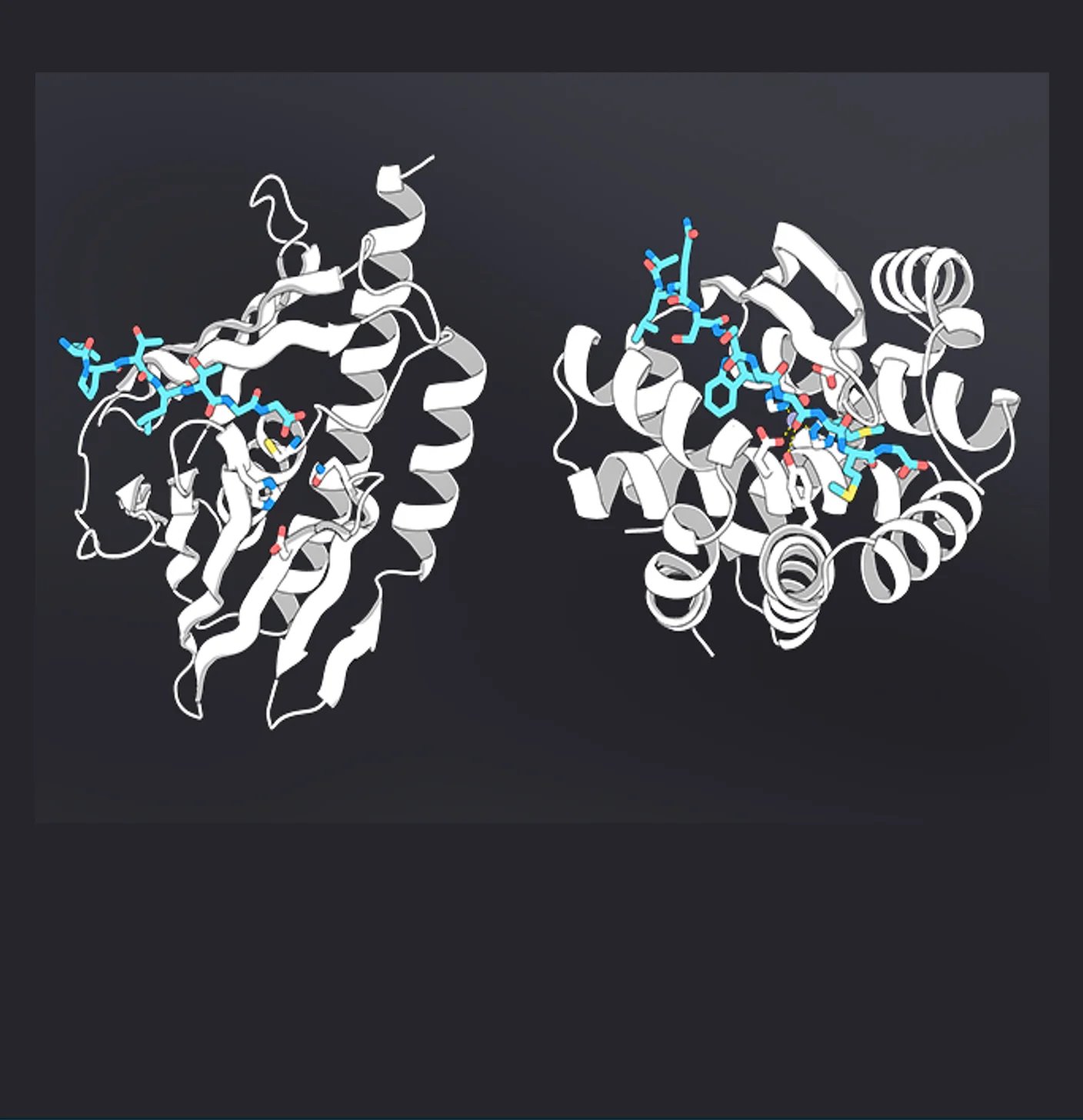
In two new studies, the Baker lab team designed two proteases. One, a zinc protease, uses a metal to drive the reaction. The other, a cysteine protease, forms a vulnerable chemical intermediate with the target, making the bond easier to break. Both strategies depend on getting specific amino acids into precise positions.
The team took inspiration from existing enzymes found in a crayfish’s digestive system and in yeast. With RFdiffusion2, their in-house design tool, the researchers built new protein backbones around each enzyme’s catalytic core to help it dock to the target. They used AI tools to select the best amino acids and built the protein around those structural constraints.
After repeating the process dozens of times, the team turned to AlphaFold3 to predict the resulting structures. Most looked nothing like known proteins, suggesting the AI wasn’t simply borrowing nature’s existing blueprints.
Thirteen of the synthetic cysteine proteases worked in a test tube test, a success rate of nineteen percent. But all were less active than the original yeast enzyme. The zinc proteases were even trickier. The team had to tweak amino acids near the catalytic core to accommodate another molecular player in the reaction. They found 36 percent of the 135 candidates could precisely cut their targets. One of these targets was amyloid-beta, a protein that forms toxic clumps in Alzheimer’s disease. The best designs made the reaction roughly 100 million times faster than when the protein target naturally broke down.
Designer proteases have a leg up compared to other protein-based medicines. Antibodies, for example, require a high dose because they only latch onto one target at a time. But with proteases, “you just need a small amount because each scissor molecule can cut many, many target molecules,” Baker said in a video provided to journalists.
But the overall low efficacy of the enzymes the team designed exposed an uncomfortable truth: Current AI tools still struggle to create more complex molecular machines.
A Magnifying Glass
To build better proteins, the lab developed RFdiffusion3, a protein design tool that zooms into the atomic world. Protein modeling algorithms, like AlphaFold3, already operate at this level, and some design tools can tweak atoms around catalytic cores. But most still focus on shuffling amino acids.
RFdiffusion3 uses atoms as the basic unit when generating the protein backbone and side chains, better accounting for the precise interactions that make enzymes work.
That’s not to say the model fully maps every atom. Each amino acid is represented by 14 atom slots—four for the backbone and 10 for side chains—that capture its structure and dynamics. Think of dots on a motion-capture suit. The dots don’t track every muscle twitch, but they do provide enough information to reconstruct movement.
This extra detail benefits enzyme design. Scientists can specify atomic positions around the catalytic core to better control the enzyme’s shape and chemical properties. The resulting blueprint more precisely maps out which amino acids to use and where to put them.
The team tested the tool on two types of newly designed enzymes in test tubes. One broke down paraoxon, an environmental pollutant. Using quantum chemistry data to model how the enzyme changes shape, the AI produced four active candidates on the first try, which the researchers further improved for speed and precision.
They also tested a zinc protease designed to cut a protein that, when misfolded and clumped, leads to kidney, heart, and nerve disease. Of 96 designs, 56 cleaved more than 10 percent of their target, a low but promising hit rate for enzymes designed from scratch.
Proteins don’t work in isolation. RFdiffusion3 can also design them in the context of other molecules—DNA, RNA, and drugs—accounting for the atomic details of their interactions. This could help researchers build final structures better tailored to their molecular partners.
As with all AI-designed proteins, each candidate will have to be vetted in cells. But the team is hopeful the upgraded tool could unlock more creative possibilities. “We anticipate RFD3 [RFdiffusion3] will be broadly useful for a wide range of biomolecule design challenges and applications,” they wrote.