dailynewsnblog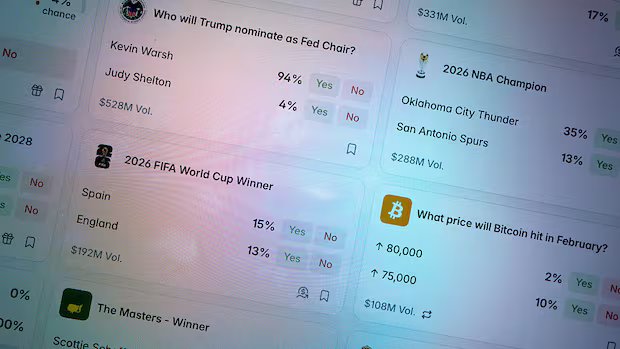

Listen to this article
Estimated 6 minutes
The audio version of this article is generated by AI-based technology. Mispronunciations can occur. We are working with our partners to continually review and improve the results.
Looking to make money on prediction markets as they move into Canada? New research suggests the odds aren’t exactly in your favour.
Prediction markets like Polymarket and Kalshi let users wager on the likelihood of real-world events — known as buying and selling contracts — which, in Canada, will be limited to events tied to economic indicators, financial markets and climate trends. For example, current contracts on Polymarket include, “Will there be a Bank of Canada rate hike in 2026?” and “Will any month of 2026 be the hottest on record?”
Unlike gambling in a casino, prediction markets don’t have a house to bet against. Instead, users play against each other and the markets themselves make money by charging small transaction fees for each wager.
A paper published by researchers at Yale University and London Business School suggests that only three per cent of Polymarket accounts, dubbed “skilled traders,” consistently earned profits and placed accurate predictions. They found a larger pool of losing traders directly funded those profits.
As these markets prepare to expand into Canada through Wealthsimple’s partnership with Kalshi, experts say Canadians should understand who they’re competing against.
“You need to be sophisticated,” Roberto Gómez-Cram, co-author of the paper and an assistant professor of finance at the London Business School told CBC News in an interview.
“If you are just clicking there, you will be eaten alive.”

Toronto-based online investment giant Wealthsimple is bringing prediction market betting to Canada through its new app, Wealthsimple Predict. Prediction markets allow users to wager on the outcomes of real-world events, but critics warn they’re just another dangerous form of gambling.
Average users fund winning minority
The research paper, which has not yet been peer reviewed, pulls data from Polymarket, and their sample includes $13.76 billion US in trading volume across 1.72 million accounts.
It further suggests nearly 70 per cent of trading volume comes from less-skilled traders. This means the market’s winners are largely funded by the crowd’s mistakes.
Since there is no house to bet against, the system requires a large volume of trade in order to function. The more users that buy positions on contracts, the more money goes into the platform, which means more earnings for skilled traders.
Market owners have suggested that if enough people bet on the outcome of an event, it creates a kind of wisdom of the crowd that produces remarkably accurate results.
However, the researchers suggest that those accurate results only really come from that small minority of skilled traders.

What makes a trader skilled?
The researchers suggest top traders have skills that include the ability to process news at a rapid rate, extensive and consistent trading experience and sometimes advanced knowledge of computer programming.
“If they’re using algorithms to trade, they’re probably also using algorithms to find news and build a good predictive model,” said Theis Ingerslev Jensen, a co-author of the paper and an assistant professor of finance at Yale University.
Jensen says skilled traders aren’t just people sitting at home and trading behind a username. Instead, he says, they have “a systematic process” that takes time to develop.
The authors of the paper say traders also use computer programming skills and data from polls and crowd-sourced investment analysis platforms. This allows them to trade against the mistakes of the crowd, a skill often sharpened by years of experience working in economics.
Skilled traders also typically closely follow political and financial news, the authors said, and they work to understand probabilities rather than relying on intuition and manage a diverse portfolio of trades instead of just a few large ones.
“I would say to the typical user, you shouldn’t bet on prediction markets in the hopes of becoming a skilled trader,” said Jensen.
Front Burner21:42Why are prediction markets coming to Canada?
Bigger firms taking notice
Prediction markets have exploded in popularity in recent years, rising from a monthly trading volume of $100 million US in 2024 to $24 billion US in 2026. As they’ve grown, financial firms have begun recruiting skilled traders.
Florida-based hedge fund Tyr Capital is among the firms hiring a prediction market trader.
“We’re really looking for someone with the right background in finance and economics who would understand the types of products that we trade,” said Tyler Wellener, Tyr’s chief strategy officer.
Those products include contracts tied to central bank decisions and other macroeconomic events.
Wellener says skilled traders require the same analytical abilities used in traditional financial markets, rather than gambling instincts.

Prediction markets like Kalshi and Polymarket have exploded in popularity, processing billions in daily trades. For The National, CBC’s Nora Young breaks down how they work and why experts say it’s just another form of gambling that comes with risks of insider trading and manipulation.
The ‘fantasy’ of winning
There’s concern among some experts that people who don’t truly understand prediction markets see them as an easy way to make money.
Luis Seco, a professor and director of the mathematical finance program at the University of Toronto told CBC News that he believes prediction markets should be viewed as entertainment.
“I don’t see a very big upside for individuals to participate,” said Seco, adding that people are living in “a fantasy” if they think they can win against hedge funds that will employ professionals to make educated bets.
Seco, who was not involved in the paper, says with the amount of money and diversification options that hedge funds can deploy, they can manage risks better than ordinary people.
He warns that people interested in prediction markets should be very careful.
“These are new markets which are dominated by the big players,” he said. “And at the end of the day, the retail investor, as he’s very well known in Wall Street, is the one who always loses.”