dailynewsnblog
Credit:
Mitchell Institute for Aerospace Studies
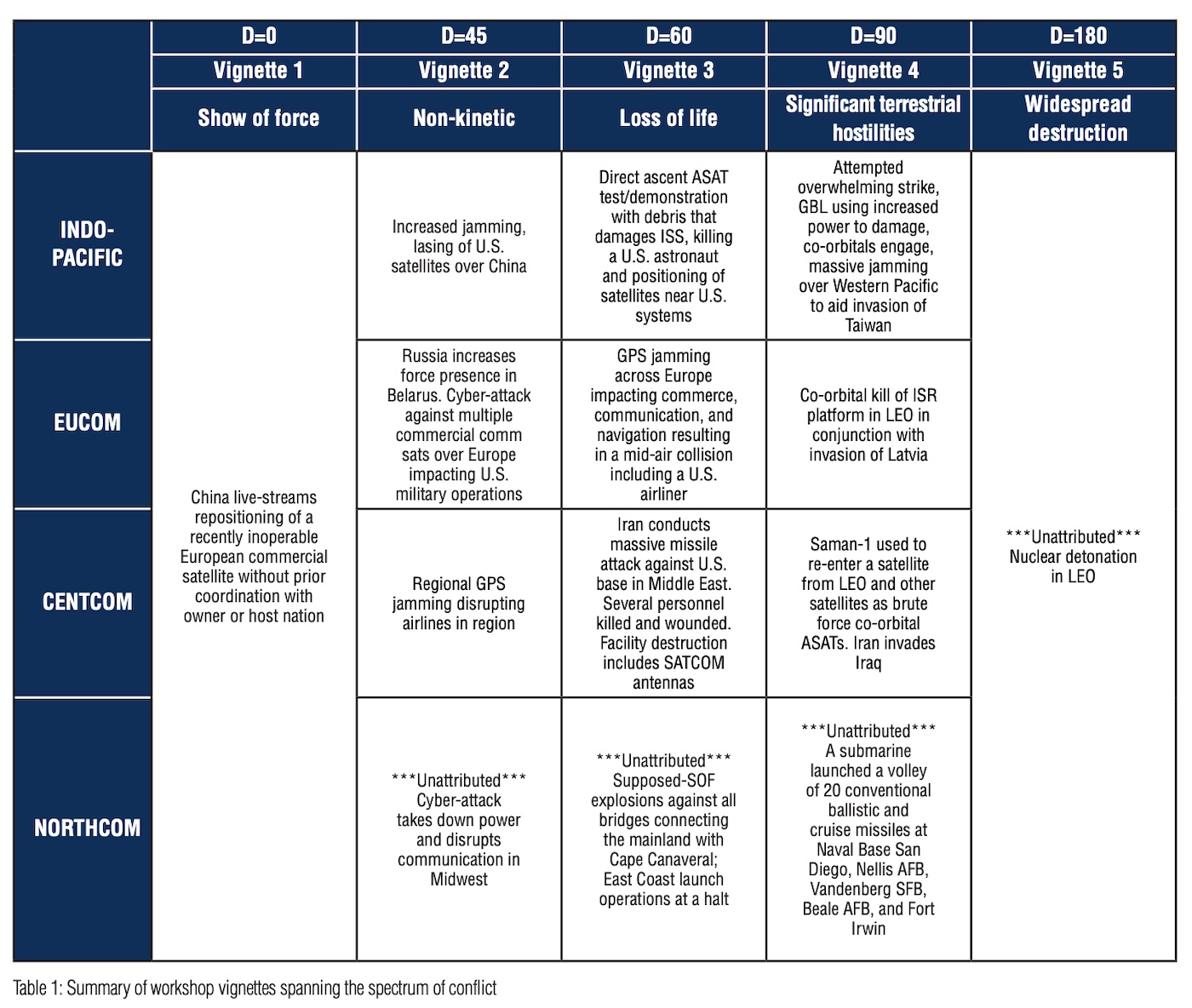
The workshop presented a series of scenarios to participants. The simulated events at days 0, 45, 60, 90, and 180 included attacks in space and on the ground.
Credit:
Mitchell Institute for Aerospace Studies
US and allied military commanders would have to decide when and how to respond in such scenarios. Governments might prefer a diplomatic response over a military reaction in some situations. If a military response is warranted, should it be in space or in another domain, like land, sea, air, or cyber? All of these domains are inextricably linked, with terrestrial infrastructure enabling space operations and space-based assets supporting military activities on Earth. An attack on one inevitably affects the other.
“It was really no surprise, but conflict in space is a complex topic,” Galbreath said.
Unraveling these complexities could take time, delaying a US response.
“Because there are still few widely accepted definitions for what constitutes conflict in space, decision-making can become slower, less certain, and more reactive,” said retired Air Force Col. Jennifer Reeves, a coauthor on the Mitchell Institute’s report.
Boiling the frog
It’s also easy to get lulled into a sense of normalcy or complacency. GPS jamming and cyberattacks on space-related infrastructure are already happening, and it’s sometimes difficult to find who is doing them.
“The workshop also underscored the central importance of attribution,” Reeves said. “Before leaders can choose a credible response, they need confidence about what happened, who did it, how broad the effects were, and whether those effects were actually intentional.”
“This ambiguity creates opportunity for our adversaries,” Reeves said. “Repeated non-kinetic attacks, those things like jamming, lasing, and cyber effects can gradually normalize hostile behavior if they are not clearly identified and addressed over time. That can desensitize us to actions that in another context would be seen as deeply provocative. This is why the workshop emphasized the danger of what some participants described as a ‘boiling the frog dynamic.’ If pressure is applied slowly and persistently, the threshold for response keeps moving.”