dailynewsnblog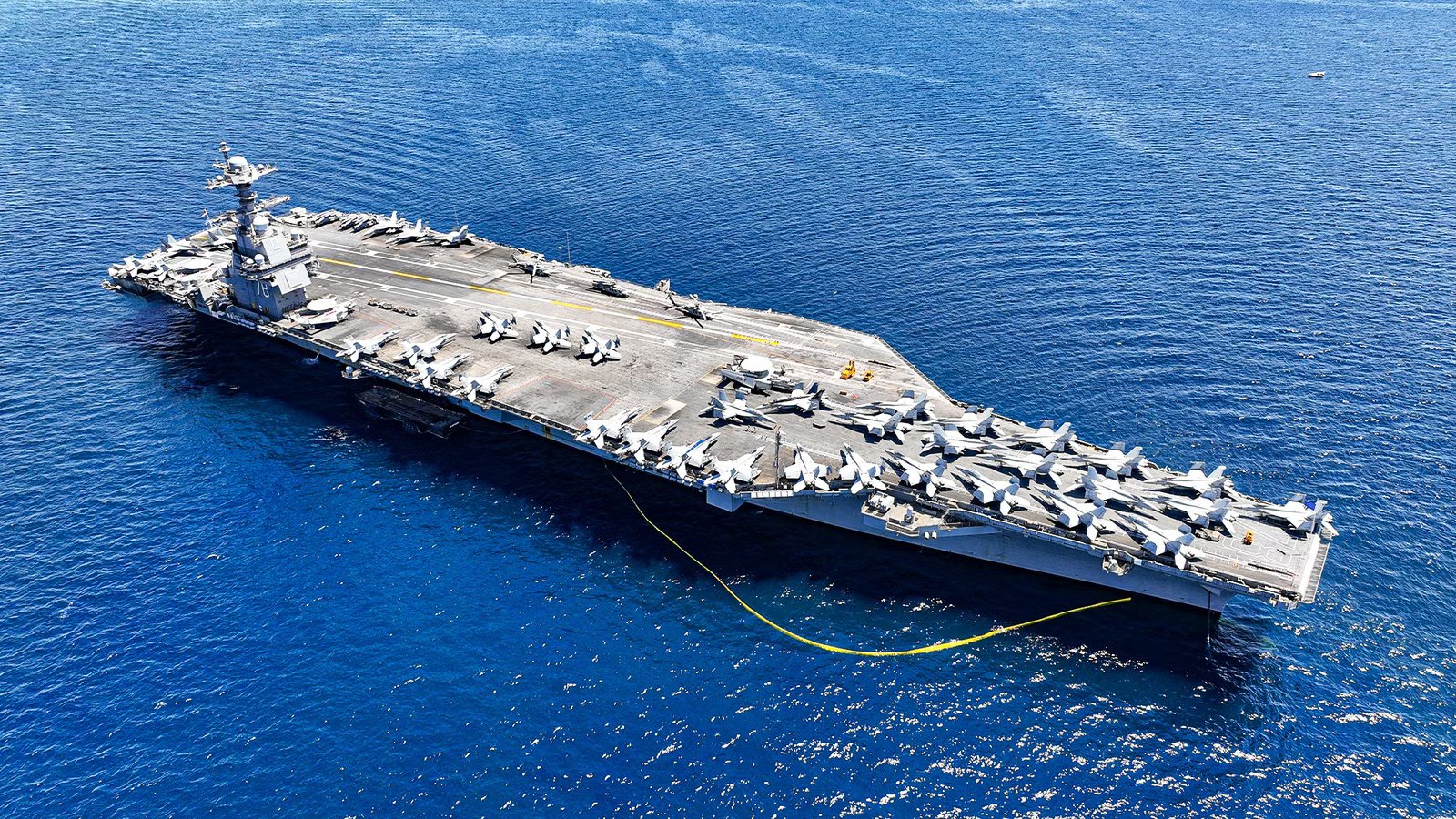
The United States Navy has operated some of the largest and most capable aircraft carriers ever built, but only a handful fundamentally changed naval warfare. From the 65,000-ton Midway-class ships that entered service at the end of World War II to the 100,000-ton nuclear-powered Gerald R. Ford-class aircraft carriers now entering service, these floating airbases have become central to US global power projection.
According to the fleet data from the US Navy, historical records from the Naval History and Heritage Command, and carrier specifications compiled by The National Interest, this ranking compares the five most powerful American carrier classes by displacement, combat capability, aircraft capacity, endurance, and long-term strategic impact.
For the US military, aircraft carriers remain critical because they allow Washington to deploy airpower globally without relying on foreign air bases. That capability has become increasingly important in the Pacific and the Middle East, where the US Navy continues to expand operations against growing Chinese naval power and regional threats in the Gulf.
5
The Midway Class
Built For World War II, Yet Powerful Enough To Survive Into The Jet Age

When the Midway-class aircraft carrier entered service in 1945, it represented a dramatic leap in carrier design, which was America’s first true supercarrier. With a displacement of roughly 65,000 tons and an enormous wartime air wing capacity of around 130 propeller-driven aircraft, the class immediately became one of the largest naval aviation platforms ever constructed. According to the Naval History and Heritage Command, the US Navy ultimately built three ships in the class: USS Midway, USS Franklin D. Roosevelt, and USS Coral Sea. Unlike earlier wartime carriers that prioritized rapid construction, the Midway-class vessels were heavily armored and specifically designed to survive sustained combat operations against enemy fleets.
Catch what other flight trackers miss
Emergency squawks, holds, NOTAMs — live signals, no signup.
Open tracker
Catch what other flight trackers miss
Emergency squawks, holds, NOTAMs — live signals, no signup.
Open tracker
The biggest challenge facing the Midway-class carriers emerged almost immediately after the war ended. Naval Aviation was rapidly transitioning from piston-engine aircraft to heavier and faster jet fighters, which required stronger flight decks, steam catapults, and significantly larger operational areas. The Midway-class ships underwent repeated modernization programs throughout the 1950s and 1960s, including angled flight decks and updated arresting systems, allowing them to continue operating frontline jets. According to Naval Technology, those upgrades dramatically reduced their aircraft capacity to approximately 60–70 jets, but they also extended the class’ operational relevance for decades. USS Midway itself remained in service until 1992, an extraordinary 47-year career spanning Korea, Vietnam, and the Cold War.
What made the Midway-class especially significant was not simply its size, but the strategic doctrine it introduced. These carriers helped establish the concept of the “supercarrier,” a floating airfield capable of independently projecting American military power across entire regions. During the Vietnam War, Midway-class ships launched thousands of sorties against targets in Southeast Asia, demonstrating how carriers could replace vulnerable forward air bases. Although later nuclear-powered carriers would surpass them in size and endurance, the Midway-class vessels laid the foundation for every American supercarrier that followed. Without them, the transition to modern carrier strike group doctrine likely would have evolved much more slowly.
4
The Kitty Hawk Class
These Massive Cold War Carriers Became Symbols Of American Naval Reach

The Kitty Hawk-class aircraft carrier marked the final evolution of large conventionally powered American supercarriers before the Navy fully embraced nuclear propulsion. Entering service in 1961, the class displaced roughly 83,000 tons and typically carried 70 to 85 aircraft. According to the US Navy Fact File, the ships combined enormous operational capacity with global deployment flexibility, enabling the Navy to maintain a near-constant presence during the Cold War. Three vessels were built: USS Kitty Hawk, USS Constellation, and USS America. The related USS John F. Kennedy shared many design characteristics, though it technically formed its own subclass.
The Kitty Hawk-class carriers became closely associated with Cold War crisis-response operations. Throughout the Vietnam War, these ships routinely deployed to the Pacific, where they launched sustained strike missions against North Vietnamese targets. Their large deck areas and advanced steam catapult systems allowed them to operate increasingly sophisticated aircraft, including the F-14 Tomcat and A-6 Intruder, later in their careers. The ships also reflected a transitional era in carrier aviation, balancing conventional fuel-powered propulsion with increasingly advanced electronics, radar systems, and command-and-control capabilities. According to The National Interest, the class proved remarkably versatile, serving in conflicts and deterrence missions for nearly five decades.
Perhaps the most important legacy of the Kitty Hawk-class was its role as the bridge between older oil-fired carriers and the nuclear-powered future. Although these ships still relied on refueling logistics that limited their endurance relative to nuclear carriers, they demonstrated the operational scale required for future carrier strike groups. USS Kitty Hawk itself remained active until 2009 and spent years forward-deployed in Japan, giving the US Navy a permanent carrier presence in Asia. That deployment model would later become central to US Indo-Pacific strategy. Even though the class is now retired, its operational history proved that supercarriers were indispensable instruments of American military diplomacy during both wartime and peacetime deterrence operations.
3
USS Enterprise
The World’s First Nuclear Supercarrier Changed Naval Warfare Forever

The legendary USS Enterprise (CVN-65) occupies a unique place in naval history as the first nuclear-powered aircraft carrier ever built. Commissioned in 1961, Enterprise displaced approximately 93,000 to 94,000 tons and introduced a level of endurance that conventional carriers simply could not match. Powered by eight nuclear reactors, the ship could operate for years without refueling, fundamentally changing how the US Navy planned global deployments. According to the Naval History and Heritage Command, Enterprise could normally carry around 60 aircraft but surge to approximately 90 during emergencies, making it one of the most flexible naval aviation platforms of its era.
Enterprise quickly became one of the most recognizable warships on Earth, with Einstein’s mass–energy equivalence formula, E=mc², for nuclear fission written on the flight deck. During the Cold War, the carrier participated in the Cuban Missile Crisis, Vietnam War operations, and numerous strategic deployments across the Atlantic and Pacific Oceans. Its nuclear propulsion allowed unprecedented operational independence, eliminating the need for constant fuel replenishment that constrained earlier carriers. The ship also introduced new possibilities for sustained high-speed transit, enabling rapid redeployment between theaters. According to Encyclopedia Britannica, Enterprise served continuously through some of the most critical geopolitical confrontations of the late twentieth century, becoming both a military asset and a symbolic representation of American naval power.
What truly set Enterprise apart, however, was its technological influence on every carrier that followed. Although the ship itself remained a one-off design because its eight-reactor configuration proved too expensive and complex, its success convinced the Navy that nuclear propulsion represented the future of supercarrier operations. The lessons learned from Enterprise directly informed the development of the later Nimitz-class carriers, which adopted a simpler and more sustainable two-reactor arrangement. Enterprise officially left active service in 2012 before final decommissioning procedures began in 2017, ending more than half a century of operations. Few warships in history had a greater influence on global naval strategy or carrier development.
2
The Nimitz Class
Ten Nuclear Supercarriers Have Dominated Global Operations Since 1975

The Nimitz-class aircraft carrier remains one of the most successful aircraft carrier programs ever created, becoming the backbone of modern US naval power. The first ship of the class to enter service was USS Nimitz (CVN-68) in 1975. This class standardized the nuclear-powered supercarrier concept and served as the foundation of American naval aviation for decades. Ten ships were ultimately built, each displacing approximately 100,000 tons and carrying an air wing of around 90 aircraft. According to the US Navy Fact File, these carriers can operate for over 20 years between reactor refueling while supporting sustained combat operations worldwide. That combination of endurance, airpower, and logistical capacity transformed the United States into the world’s dominant carrier operator.
The Nimitz-class carriers played central roles in nearly every major US military operation from the late Cold War onward. They launched combat sorties during Operation Desert Storm, operations in Afghanistan after September 11, and missions against ISIS in the Middle East. Their massive flight decks enabled them to operate increasingly advanced aircraft, including the F/A-18E/F Super Hornet and the stealthy F-35C Lightning II. Unlike earlier carriers, the Nimitz-class vessels were designed around integrated strike group operations, coordinating cruisers, destroyers, submarines, and carrier air wings into highly flexible naval formations. According to CSIS, the class remains one of the most powerful conventional military tools available to any nation.
Another reason the Nimitz class ranks so highly is its longevity and adaptability. Despite some ships approaching 50 years of service, continuous modernization programs have enabled them to remain operationally relevant in the face of emerging threats. Updated radar systems, electronic warfare capabilities, and compatibility with fifth-generation aircraft have ensured these carriers remain central to US strategy. Their presence alone often serves as a geopolitical signal during international crises. Even as the newer Gerald R. Ford-class carriers enter service, the Nimitz-class fleet will continue to operate well into the 2030s and 2040s, ensuring its lasting influence on naval warfare and American military power.
1
The Gerald R. Ford Class
America’s Newest Supercarrier Combines Automation, Nuclear Power, And Massive Air Capability

The Gerald R. Ford-class aircraft carrier currently represents the absolute peak of aircraft carrier technology. It is the most advanced aircraft carrier ever built. USS Gerald R. Ford (CVN-78), the first aircraft carrier of its type, entered service in 2017. The class displaces more than 100,000 tons and carries an air wing of approximately 90 aircraft. According to the US Navy Fact File, the class incorporates numerous technological advances over the Nimitz design, including electromagnetic aircraft launch systems (EMALS), advanced arresting gear, improved nuclear reactors, and dramatically expanded electrical generation capacity. Three additional Ford-class carriers are currently under construction, while the Navy ultimately plans to field a fleet of ten ships.
The Ford-class design focuses heavily on efficiency and sortie generation rates. Compared to the Nimitz class, these carriers require hundreds fewer sailors due to increased automation, thereby lowering long-term operational costs while improving onboard workflow. The new EMALS launch system replaces traditional steam catapults, allowing smoother launches for both heavy fighters and lighter unmanned aircraft. According to Naval Technology, the class is expected to generate significantly more combat sorties per day during high-intensity operations. The ships are also designed to integrate future technologies, including advanced drones, directed-energy weapons, and next-generation electronic warfare systems. That flexibility makes the Ford-class especially important as the Navy prepares for increasingly contested operations in the Pacific.
Comparison Of Major US Navy Aircraft Carrier Classes
Carrier Class | In Service | Ships Built | Displacement | Aircraft Capacity | Propulsion Type | Key Technological Feature |
Midway Class | 1945–1992 | 3 | 65,000 tons | 60–130 | Conventional | First true US supercarrier |
Kitty Hawk Class | 1961–2009 | 3 | 83,000 tons | 70–85 | Conventional | Peak conventional carrier design |
USS Enterprise (CVN-65) | 1961–2017 | 1 | 93,000–94,000 tons | 60–90 | Nuclear | First nuclear-powered carrier |
Nimitz Class | 1975–present | 10 | ~100,000 tons | ~90 | Nuclear | Long-endurance global deployment |
Gerald R. Ford Class | 2017–present | 1 active, 3 building | 100,000+ tons | ~90 | Nuclear | EMALS and advanced automation |
Ultimately, the Gerald R. Ford class ranks first because it combines all lessons learned over eight decades of carrier warfare into a single platform. It retains the massive air wing and endurance of the Nimitz class while introducing technologies specifically designed for future conflicts involving drones, hypersonic threats, and advanced networked warfare. The class also reinforces America’s broader naval strategy, particularly in the Indo-Pacific, where carriers remain central to deterrence operations against peer competitors. Although questions about carrier vulnerability in modern missile warfare continue to spark debate, the Ford class demonstrates that the US Navy still considers the supercarrier indispensable to American military power projection in the twenty-first century.