dailynewsnblog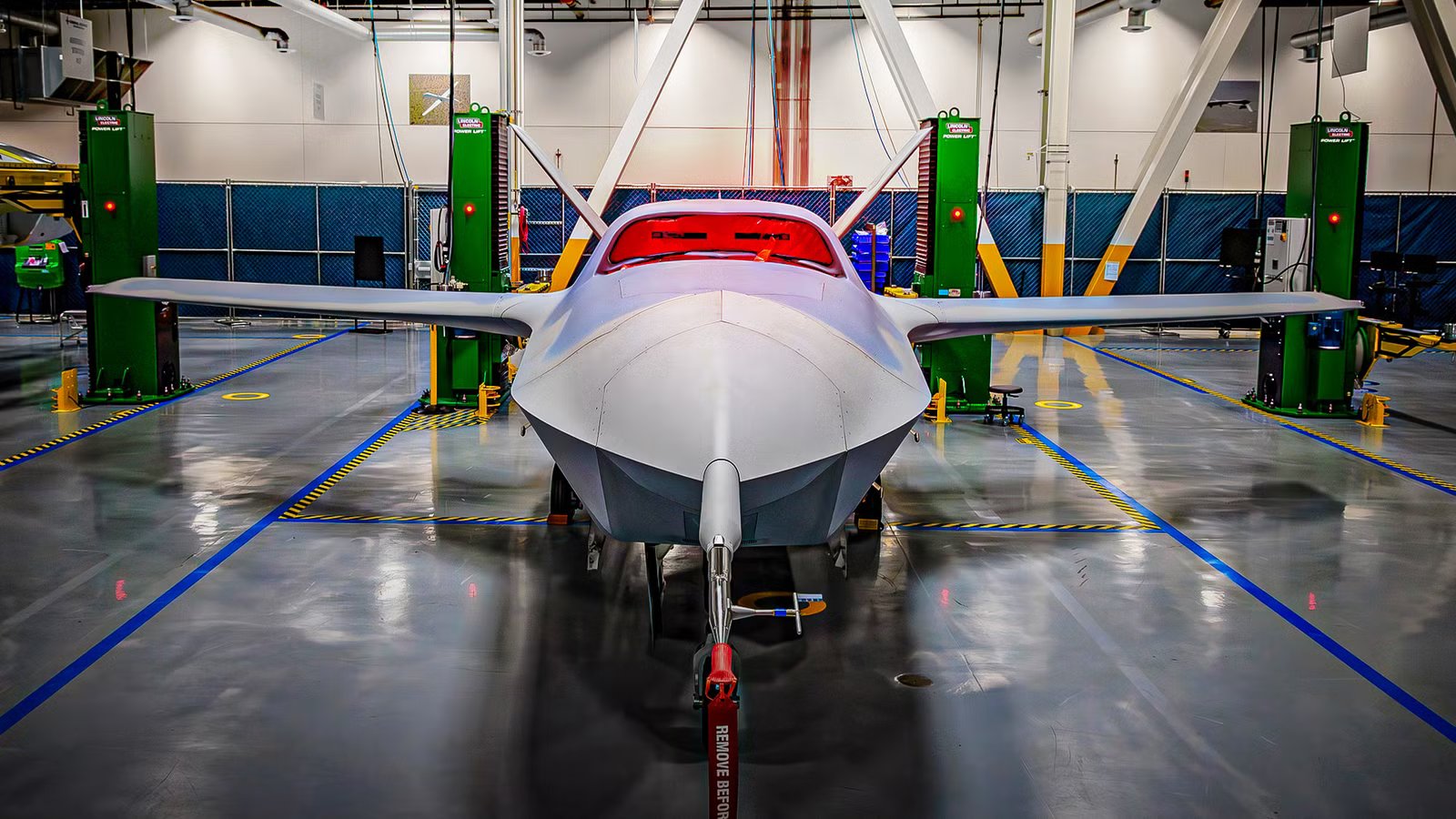
The next era of air warfare is taking shape, and on the battlefield tomorrow, many of the warplanes will fly without a pilot. The leading military forces around the world are all pursuing advanced drones, and the United States is leading the charge with the most aggressive fleet goal of 1,000 Loyal Wingman drones. The Collaborative Combat Aircraft program aims to provide large-scale, low-cost air power en masse for the US Air Force and Navy alongside their new stealth fighters.
The drones will be a major force enhancement for fifth-generation Lockheed Martin F-35 Lightning II jets now operated by the US military branches and a growing list of 19 partner nations. One of the first major steps forward for this future crewed-uncrewed teaming program took place on April 23, when the Netherlands became the first international partner in the CCA program.
The Anduril Fury, or YFQ-44A, and the General Atomics FQ-42A are currently the last contenders to become production-grade loyal wingmen. They are slated to cost no more than $30 million per unit, or about one-third to a quarter of the price of a modern fighter jet. For example, the price of an F-35 Joint Strike Fighter varies between $82 and $120 million, and the Boeing 4.5-Gen F-15EX strike fighter also costs around $90 million per airframe.
Building The Ultimate Loyal Wingman

CCAs are designed to be attritable, meaning that while they will be combat effective, they will still be cheap enough to be lost if necessary. The drones will use common AI architectures, allowing them to adapt autonomously to mission changes to shift from reconnaissance to a strike role, based on the commander’s instructions. They can serve as decoys, electronic jammers, or ‘missile sponges,’ forcing enemies to waste munitions on drones rather than the F-35.
The new advanced drones serve as forward nodes, extending the F-35’s sensor reach into dangerous areas without exposing the manned jet. Pilots will manage multiple CCAs, likely four to eight per crewed jet, using a touchscreen or tablet-like interface. This allows the pilot to solely deal with high-level decision-making while drones handle the ‘dirty’ work of scouting or attacking.
Loyal Wingman also acts as a missile truck to significantly increase the total firepower available to a single pilot. Advanced AI algorithms handle flight navigation and basic combat maneuvers, allowing the pilot to focus on battle management. By fielding at least 1,000 CCAs, the Air Force creates a numbers advantage that crewed fighters alone cannot match.
The Dutch Connection: Partnership In Advanced Air Defense

The primary goal of international cooperation is to ensure that Allied F-35 fleets can communicate with and control the same drones as the US Air Force. International cooperation transforms the CCA from an air support drone into a global coalition force. By integrating as many operators of the JSF as possible into the Loyal Wingman program, there will be an exponentially larger and more powerful force of uncrewed support aircraft available for every Ally around the world.
The Netherlands is directly funding two prototypes, which accelerates the testing phase without solely relying on US taxpayers. International partnerships help distribute the financial and industrial burden of the ambitious fleet size being targeted by the US. Joint procurement through Foreign Military Sales or co-production allows for larger production runs, lowering the per-unit cost for every nation involved.
The Roadmap To Uncrewed Air Power

The Air Force Research Laboratory’s CCA program has expanded from the 2014 Low Cost Attritable Aircraft Technologies that eventually evolved into the Off-Board Sensing Station program in 2021. LCAAT paved the way for the Low Cost Attritable Strike Demonstrator, which is now splitting the group of three original contractors into two directions. Anduril and General Atomics remain focused on USAF requirements, while the Kratos-designed CCA has gained favor with the US Marines.
In early 2026, contracts were awarded to Beehive Industries, Honeywell, and Pratt & Whitney to develop specialized low-thrust engines for Increment Two drones, according to IDGA. The Air Force plans to buy between 100 and 150 aircraft in phase one, with a final target of over 1,000 units by the end of the program.
The Navy is reportedly aiming for a lower price point of around $15 million per Loyal Wingman drone, according to USNI. The Navy is aiming for interchangeability with the Air Force drones but using shared software and architecture, and is developing airframes tailor-made for carrier-based operations.
According to USNI, the Navy issued contracts for development to Anduril, Boeing, General Atomics, and Northrop Grumman in late 2025. The Navy has not yet committed to a total estimated procurement volume, but it will likely be a lower number of airframes than the Air Force, although still in the hundreds.
The General Atomics XQ-67A Drone For The US Air Force: What To Know
The XQ-67A is set to redefine what unmanned combat drones are capable of and deliver a new kind of weapon system to the USAF.
Uncrewed Air Support For The Corps

The Kratos XQ-58A Valkyrie is a low-observable, runway-independent combat drone now being advanced by the US Marines to the next stage in development. It can be launched from a truck using rocket assistance. The Valkyrie can take off with a maximum weight of three tons, fly to an altitude of 45,000 feet (13,716 meters), and has a range of 3,000 miles (4,828 km). The drone can be remotely piloted to execute missions solo or paired with a manned platform to act as a Loyal Wingman.
A more disposable, low-maintenance, and inexpensive unmanned aircraft, the XQ-58A was created to solve the problems of attrition tolerance, maintenance, and cost. The USAFRL assessed that the Valkyries can do the same crucial tasks as current manned and unmanned high-end aircraft. Valkyries leveraged improved design tools and modern commercial manufacturing techniques to show that it is possible to deploy a capable, attritable aircraft rapidly and affordably.
The XQ-58 was developed under the AFRL’s LCAAT program. The drone was successful in several trials, and the prototype now resides at the National Museum of the US Air Force. Valkyrie was sidelined due to its smaller size, as the USAF selected the YFQ-42A Dark Merlin and the YFQ-44A Fury to move ahead with the CCA Increment One prototype phase.
That didn’t spell the end for XQ-58, as even before the announced Airbus program, Kratos was still working with the US Marines on the Penetrating Affordable Autonomous Collaborative Killer Program. According to The War Zone, Kratos is working on at least five variants for the USMC with a special emphasis on electronic warfare.

From 76 F-22 Raptors To 200 Next-Gen Fighters: How Much Larger America’s Air Superiority Fleet Could Get
A closer look at the future of air power in the US Armed Forces.
The New American Armada: Drone Swarm Strategy

The US Department of Defense announced on February 6 that it was pushing ahead with plans to build a drone force of 300,000 units by 2027. Presently, the US Armed Forces have a combined total of just over 16,000 unmanned aerial vehicles of varying sizes and complexity, according to Warpower. The ambitious ‘Drone Dominance’ program aims to multiply the current inventory by nearly 19 times.
Hegseth stated last year that he intends to see tens of thousands of small drones delivered this year, with hundreds of thousands to follow in 2027. The vast majority of that number will not be large and complex drones but rather small, man-portable, expendable units. The services plan to eventually reach a combined total in the thousands of large, jet-powered UAVs as well.
The first round of contractor competition is underway, with 25 companies entered into what he dubbed the ‘gauntlet,’ focused on making devices for the US Army and Marines. At the same time, the US Air Force and Navy are pursuing separate programs to develop Loyal Wingman drones that can operate autonomously alongside stealth fighters or bombers.
Airbus Partners With US-Based Kratos On Valkyrie Combat Drones For German Air Force
A groundbreaking partnership takes flight, bringing cutting-edge combat drones to the German Air Force.
The US Drone Dominance Plan

The newly announced DDP was preceded by the Pentagon’s Replicator One and Replicator Two initiatives. The first program was focused on the same goal as the current initiative announced by Hegseth, to rapidly field thousands of ‘all-domain autonomous’ systems to overcome an adversary’s advantage in mass. The second program, which only recently began, is focused on detecting and destroying small drones from adversaries.
Under Hegseth’s stated procurement plan, he claims that the second round of competition will deliver 30,000 drones by July at an average price of $5,000 each. There will be two rounds of contractor competition to ‘drive costs down and capabilities up’ to cut the unit cost in half. The intent is to fund the manufacture of 340,000 drones in total over two years.
Secretary Hegseth ordered the US military to arm every US Army squad with unmanned systems by the end of 2026 in response to this evidence. As the US faces the same low-cost drone swarms in Iran as it observed in Ukraine, it recently debuted the Low-Cost Uncrewed Combat Attack System, a one-way attack drone modeled after Iran’s successful Shahed-136. America has also moved to draw on Ukraine’s expertise in fighting these exact systems for nearly four years to aid in advancing US programs.
The DDP is an open architecture approach designed to support America’s rearmament of drones. It will dramatically improve the supply chain resilience and significantly lower the cost of UAVs like LUCAS by sourcing very similar or even identically designed drones from multiple vendors. The new LUCAS drone costs between $30,000 and $60,000 per unit but matches the striking capability of a $2.5 million Tomahawk missile and was confirmed to have been used in combat since the beginning of Operation Epic Fury.