dailynewsnblog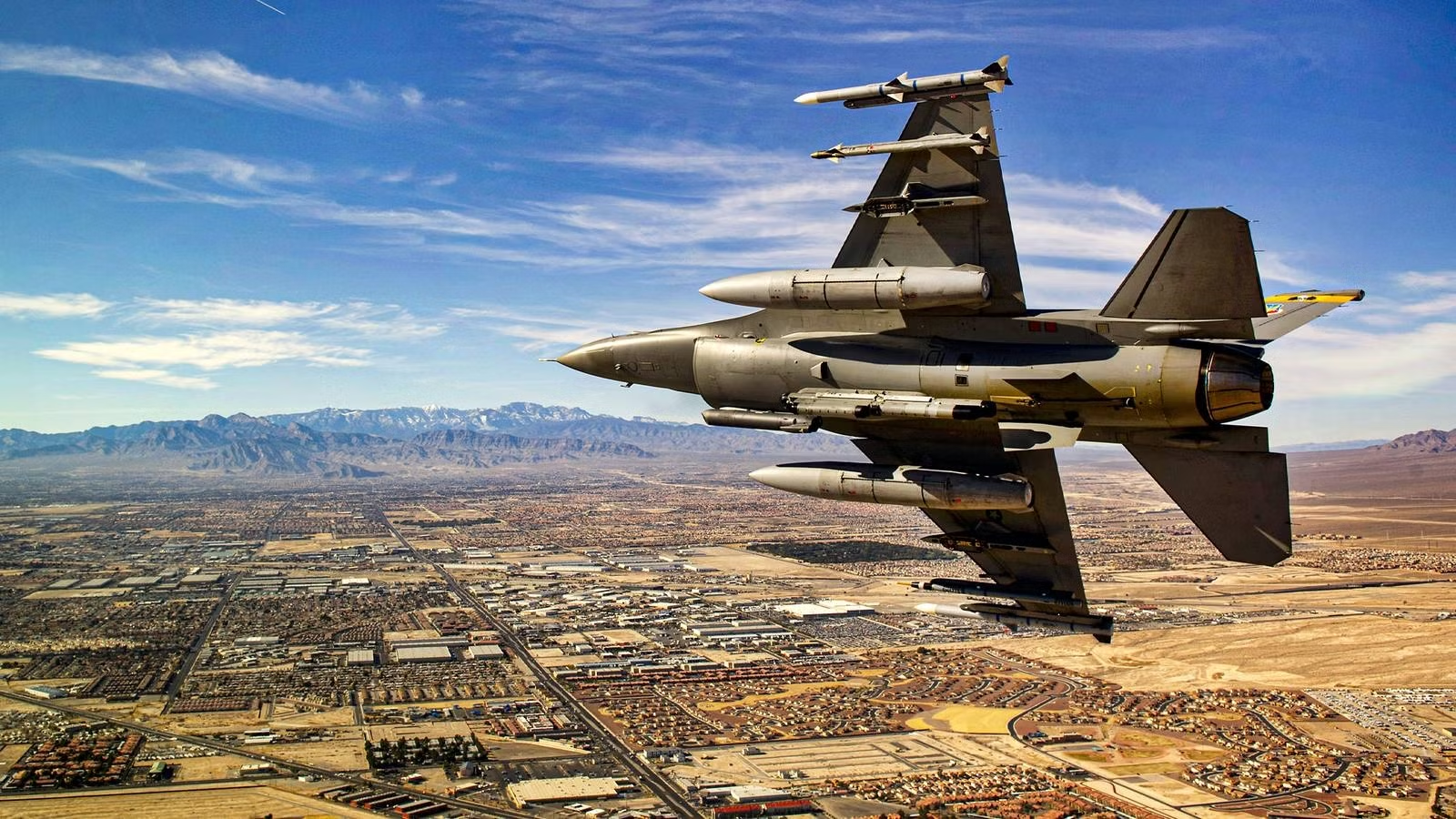
The fighter plane selected by the US Air Force to pioneer a breakthrough in artificial intelligence was not one of its latest and greatest 5th generation stealth jets. Instead of the Lockheed Martin F-35 Lightning II, the General Dynamics F-16 Fighting Falcon was chosen. The aircraft belongs to VENOM, or Viper Experimentation and Next-Generation Operations Model.
Also known as the Viper, a half dozen examples of the venerable F-16 are serving the Air Force and Defense Advanced Research Projects Agency as advanced autonomy testbeds. Even before the VENOM project kicked off, the F-16 was also the airframe chosen for the X-62A VISTA. That program began trailblazing AI-powered dogfighting when it first flew in 1992.
The F-16 has been the backbone of the Test Pilot School for years, supporting a long list of projects like the ambitious multi-axis thrust vectoring test of the early 1990s and others. The simple reason is its tried and true design that the Air Force, and many of its pilots, are intimately familiar with.
The Budget Logic Behind The Legacy Choice

Not only does the Air Force already have an abundance of F-16s that are bought and paid for, but it is one of the cheapest planes in the fleet to operate on a per-hour basis. The estimated cost to fly in an F-16 is between $20,000 and $27,000 per flight hour. In comparison, the F-35 is around $34,000 at the low end and over $40,000 per flight hour depending on configuration and conditions.
VENOM avoids diverting F-35s that are individually worth at least $80 million apiece. That cost asymmetry will also be reflected in the operation drones that result from the research of the VENOM jets. The F-16 testbed was never meant to be the end state because it’s a bridge to the CCAs that the Air Force wants to make even cheaper than a Viper.
Loyal wingman drones are expected to be around $30 million each, which is about half the flyaway price of an F-16. Removing the pilot from the cockpit does save a substantial amount of money in design and production, but another reason that CCAs will be so cheap is that they are not going to be stealthy, long-range, high payload, or high performance. Which also makes the F-16 a better analog for a CCA than the F-35, aside from the cost savings.
The Real Target Isn’t The Viper At All

The final production target for VENOM is a new class of aircraft the Air Force calls Collaborative Combat Aircraft, or CCA. It will be a jet-powered, semi-autonomous unmanned aircraft built to fly alongside crewed fighters such as the F-35 and the planned Boeing F-47. The CCAs extend crewed aircraft sensors and weapons while absorbing risk that would otherwise fall on a human pilot.
Every lesson the F-16 testbeds return on how an AI handles a merge, a formation, or a weapons pass is explicitly designed to be a lesson the CCA fleet inherits. The faster the Air Force can prove an autonomy behavior is safe on a crewed F-16, the faster it can trust that same code running on an uncrewed aircraft.
In the words of James ‘Fangs’ Valpiani, Ph.D., DARPA program manager:
“These groundbreaking flight tests of VENOM-modified F-16s advance the infrastructure needed to develop trusted, autonomous air combat capabilities.”
That reframes the entire question. The F-16 isn’t competing with the F-35 to be the autonomous fighter of the future. It’s a disposable proving ground for software that will eventually fly inside an aircraft that doesn’t yet exist in mass production. The numbers behind that program explain why cost discipline was baked into the testing philosophy from the start.
VENOM Takes Off: Air Combat Evolution

The latest round of F-16 AI testing builds on the foundation laid by the DARPA with the X-62 and the Air Combat Evolution program. The acronym VISTA stood for Variable Inflight Simulation Test Aircraft, as the plane’s simulator software allowed it to make the characteristics of multiple different platforms. This was made possible thanks to the fact that the Viper is a ‘known quantity’ because the US military has been flying it for over five decades.
The primary limitation of VISTA is that it was a limited project with a one-of-a-kind airplane. Based out of Eglin Air Force Base, VENOM scales up the data collection. This round of testing takes six standard, mass-production frontline F-16 Vipers and retrofits identical Venom Autonomy Kits (VAK) to all of them.
Venom makes multiple aircraft available simultaneously, which not only allows for a higher operational tempo but also multi-ship formation. To maximize the testing potential of the new fleet, DARPA’s Artificial Intelligence Reinforcements (AIR) program will introduce AI-piloted Vipers to formation flying with other autonomous jets for the first time.
An Airframe The Air Force Knows Cold

Using one of the most mature and refined airframes in the entire inventory of the US Air Force from a technical and operational perspective makes it possible to validate AI behavior against an exceptionally well-documented baseline. This is a powerful tool for eliminating variables and dramatically enhances a program focused on repetitive testing. Major Trent McMullen of the 40th Flight Test Squadron highlighted the value of the F-16 in this regard, commenting:
“These simulations provide an efficient way to train the autonomy to learn complex air combat tactics. A specific scenario can be run 1,000 times and the variations and decisions made throughout that mission can be studied. We can then make recommendations to the developers on how to improve the autonomy’s behaviors and overall performance.”
Running that volume of trials against an airframe whose flight characteristics are already exhaustively documented lets engineers isolate anomalies in the software rather than chase variations induced by the airframe itself. The F-16’s digital fly-by-wire system also benefits because its characteristics have been exhaustively mapped by millions of flight hours in thousands of planes.
The jet also happens to be a high-performance proving ground rather than simply a safe vehicle. The Viper’s top speed can exceed Mach 2 at altitude, and it’s capable of reaching altitudes above 50,000 feet (15,240 meters) and can sustain loads up to nine G with full internal fuel. The VENOM software has the opportunity to learn how to manage a fast, high-load aircraft before it becomes the template that will create virtual pilots for numerous ‘loyal wingman’ drones in development now.
What Cheap Actually Means In Dollars

Air Force leadership has discussed acquiring 1,000 to 2,000 CCAs through the mid-2030s, and the underlying math is built around pairing roughly two CCAs with each of the service’s next-gen advanced crewed fighters. Against that backdrop, the economic logic of the F-16 choice becomes almost self-evident.
The Air Force’s cost target for CCA, set by former Secretary Frank Kendall, was to produce the drones at roughly one-third the cost of an F-35. That puts a rough ceiling around $34 million per aircraft, and Air Force officials said in March 2026 that the program was beating that goal. Colonel Timothy Helfrich, the acquisition executive at the Air Force Life Cycle Management Center, gave these remarks during a panel, according to Air and Space Force Magazine:
“What we’re doing in that phase is, we’re taking these operational use cases that we’ve defined through operational analysis. They each have some basic attributes to them… We’re going to follow the data and follow the analysis, and figure out which of these provides the best return on investment. Because you may need to buy many of the less expensive ones, or less of the more exquisite ones.”
In June 2026, the Air Force moved the CCA program ahead to Increment One. The service awarded low rate initial production contracts to Anduril, building the FQ-44A Fury, and General Atomics, building the FQ-42A Dark Merlin, for the first 150 aircraft, with the full Increment 1 procurement and development effort valued at roughly $8.9 billion. So now the hardware that the VENOM project aims to empower with AI software is progressing in lockstep.
The Ultimate Loyal Wingman: Building On Legacy

CCAs are designed to be attritable, meaning that while they will be combat effective, they will still be cheap enough to be lost if necessary. The drones will use common AI architectures, allowing them to adapt autonomously to mission changes to shift from reconnaissance to a strike role, based on the commander’s instructions. This allows the pilot to solely deal with high-level decision-making while drones handle the ‘dirty’ work of scouting or attacking.
Pilots will manage multiple CCAs, likely four to eight per crewed jet, using a touchscreen or tablet-like interface. They can serve as decoys, electronic jammers, or ‘missile sponges,’ forcing enemies to waste munitions on drones rather than the F-35. Loyal wingman also act as missile trucks to significantly increase the total firepower available to a single pilot.
The drones will be a major force enhancement for F-47 pilots as well as the F-35 jets now operated by three US military branches and a growing list of 19 partner nations. A major step forward to make crewed-uncrewed teaming a multinational endeavor took place on April 23 when the Netherlands became the first international partner in the CCA program. The Netherlands is directly contributing funding to the prototypes, which accelerates the testing phase without solely relying on US taxpayers.
This hearkens back to the multinational production of the F-16, in which the Netherlands was a key partner. The F-35 inherited that legacy as NATO’s Joint Strike Fighter, and now the CCA is building on that same foundation once again. International cooperation transforms the CCA from an air support drone into a global coalition force. By integrating as many operators of the JSF as possible into the loyal wingman program, there will be an exponentially larger and more powerful force.