dailynewsnblog
Connecting airports are the invisible backbone of commercial aviation, the facilities that make point-to-point routes flourish into expansive international transportation webs. For passengers finding themselves on layovers or airlines scheduling flight banks, an airport’s transfer volume defines its operational identity.
This list ranks the top ten major US airports based on their overall share of connecting passenger traffic relative to local origination and destination passengers. Looking at route data, carrier schedule statistics, and flight bank dynamics, this list spans coastal international gateways to central fortress hubs.
10
Newark Liberty International Airport
A coastal gateway that is on the rise

 Newark Liberty International Airport (EWR) is a vital dual-purpose hub for
  United Airlines in the greater New York metropolitan region. Handling over 49 million passengers annually, the facility processes a substantial volume of local travelers while acting as a key international transfer point for transatlantic and domestic flight connections.
United Airlines has a dominant presence at the airfield, controlling approximately 68% of total flight capacity and fully occupying Terminal C. The carrier operates direct nonstop flights to 42 international destinations from Newark, using its position to link secondary domestic markets with transatlantic routes and high-yield corporate travel corridors.
Newark’s strength lies in high-yield local origination and destination demand rather than pure transfer volume. United runs coordinated connecting banks through the airport, though heavy airspace congestion in the Northeast limits its ability to operate solely as a high-density domestic transfer engine.
9
Seattle-Tacoma International Airport
The heart of Pacific Northwest aviation

 Seattle-Tacoma International Airport (SEA) sits at position nine on this list, operating as the dominant air travel gateway for the Pacific Northwest. The airport caters heavily to the booming local tech economy, but it serves an equally crucial role as a primary transfer point for passengers flying across Alaska, the West Coast, and transpacific routes.
Processing over 52.7 million passengers annually, the facility sees  Alaska Airlines and its subsidiary Horizon Air hold more than 50% of total passenger capacity.
  Delta Air Lines also has a substantial secondary hub at the airfield, creating a competitive dynamic that drives high flight frequencies across 96 domestic and 36 international nonstop destinations.
Seattle-Tacoma has approximately 70% of its traffic originating or terminating locally in the Puget Sound region. However, the remaining transfer share represents millions of passengers connecting between regional West Coast routes, Hawaiian destinations, and remote Alaskan communities spanning over 2,000 miles (3,218 km) to the north.
8
Miami International Airport
The true gateway to the Americas
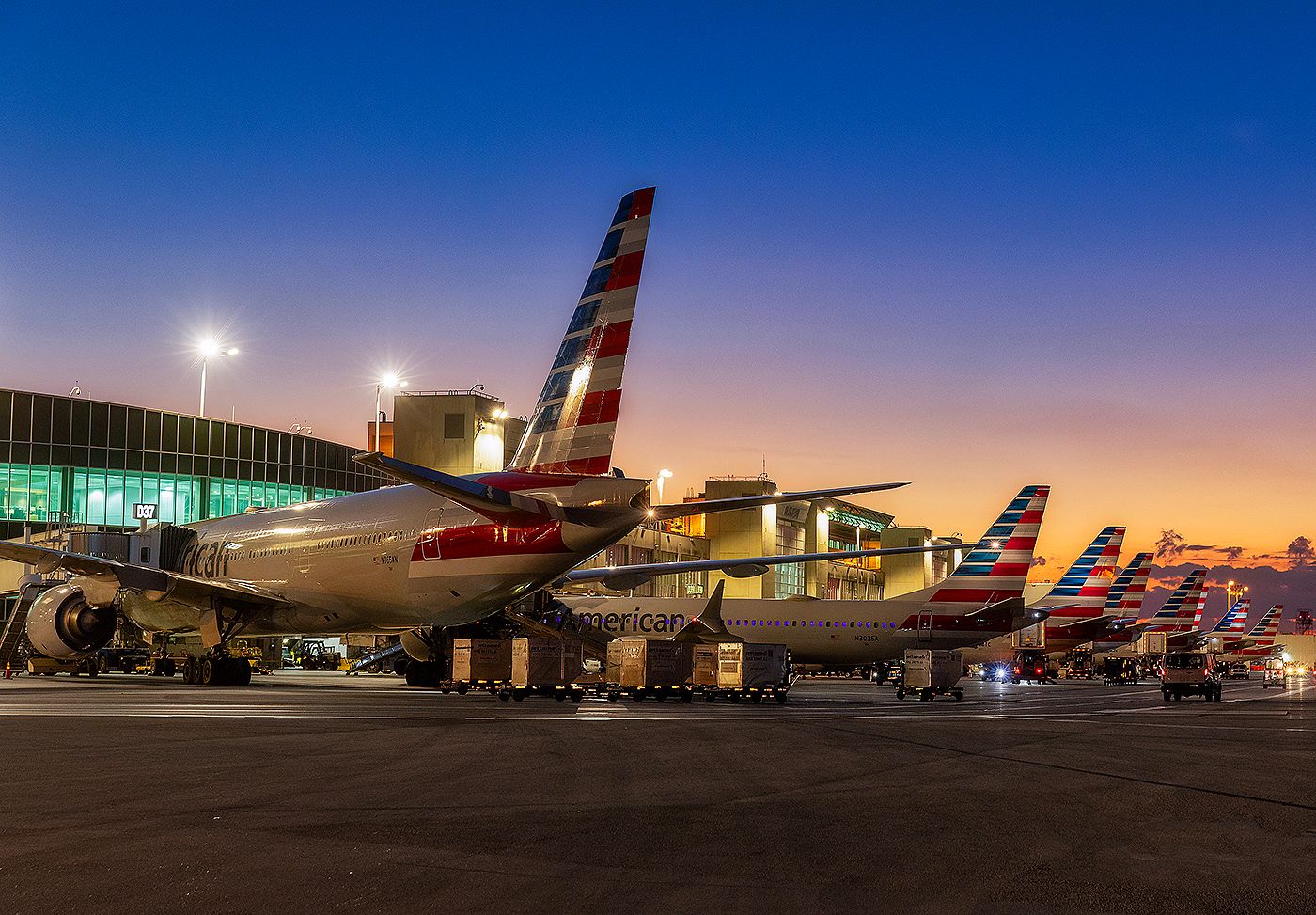
 Miami International Airport (MIA) is one of the largest international gateways in the US, sitting at position eight on this list. While widely recognized as a major destination for South Florida tourism, the airport operates an extensive connecting complex that moves millions of transit passengers annually across Latin America, the Caribbean, and Europe.
Handling 55.3 million total passengers, the facility functions as American Airlines’ main hub for Latin American operations. American controls more than 50% of total passenger traffic at the airport, operating major connecting banks through Concourse D to link dozens of domestic cities with over 100 international destinations.
Miami’s geographical location at the southeastern tip of the United States makes it a highly capable coastal gateway rather than a central domestic crossroad. Fifty five percent of travelers originate or end their journeys locally, while the remaining transfer traffic relies on its prime location for connecting to the rest of the Americas and beyond.
7
Phoenix Sky Harbor International Airport
Connecting transcontinental flight banks across the Sunbelt

 Phoenix Sky Harbor International Airport (PHX) holds position seven on this list, operating as an important southwestern hub for American Airlines. The airfield accommodates millions of local travelers visiting Arizona, and it also serves an essential operational function as a high-density domestic transfer node linking West Coast cities with transcontinental route networks.
Handling over 51.6 million passengers annually, the facility sees American Airlines hold a leading 40% market share. The carrier runs extensive connecting flight banks across Terminal 4, operating direct routes to over 100 domestic and international destinations. Alongside,  Southwest Airlines also maintains a massive secondary operating base.
Connecting traffic at Phoenix accounts for roughly 35% to 40% of total passenger throughput. It has long been a vital relief valve for coastal airspace congestion that has only become more problematic in recent years. The desert hub enables American Airlines to route high-volume East-to-West passenger flows efficiently across the southern region of the United States.
6
George Bush Intercontinental Airport
United Airlines’ central mid-continent stronghold

 Houston George Bush Intercontinental Airport (IAH) comes in at position six on this list, serving as an essential mid-continent hub for United Airlines. Located in Houston, the airfield operates as a central connecting engine that links domestic flight corridors across the United States with high-density international routes into Central and South America.
United Airlines holds nearly 60% of total flight operations at the airfield, running extensive flight banks across five terminal buildings. Handling over 48 million passengers every year, the hub offers nonstop service to more than 200 destinations, making it one of the most connected airports in North America.
United has relied heavily on this hub for its expansion into Central and South America, and its location allows United to channel transcontinental domestic passengers seamlessly while also serving as the carrier’s paramount gateway for corporate energy sector travel.
5
Philadelphia International Airport
A fast-growing alternative to New York
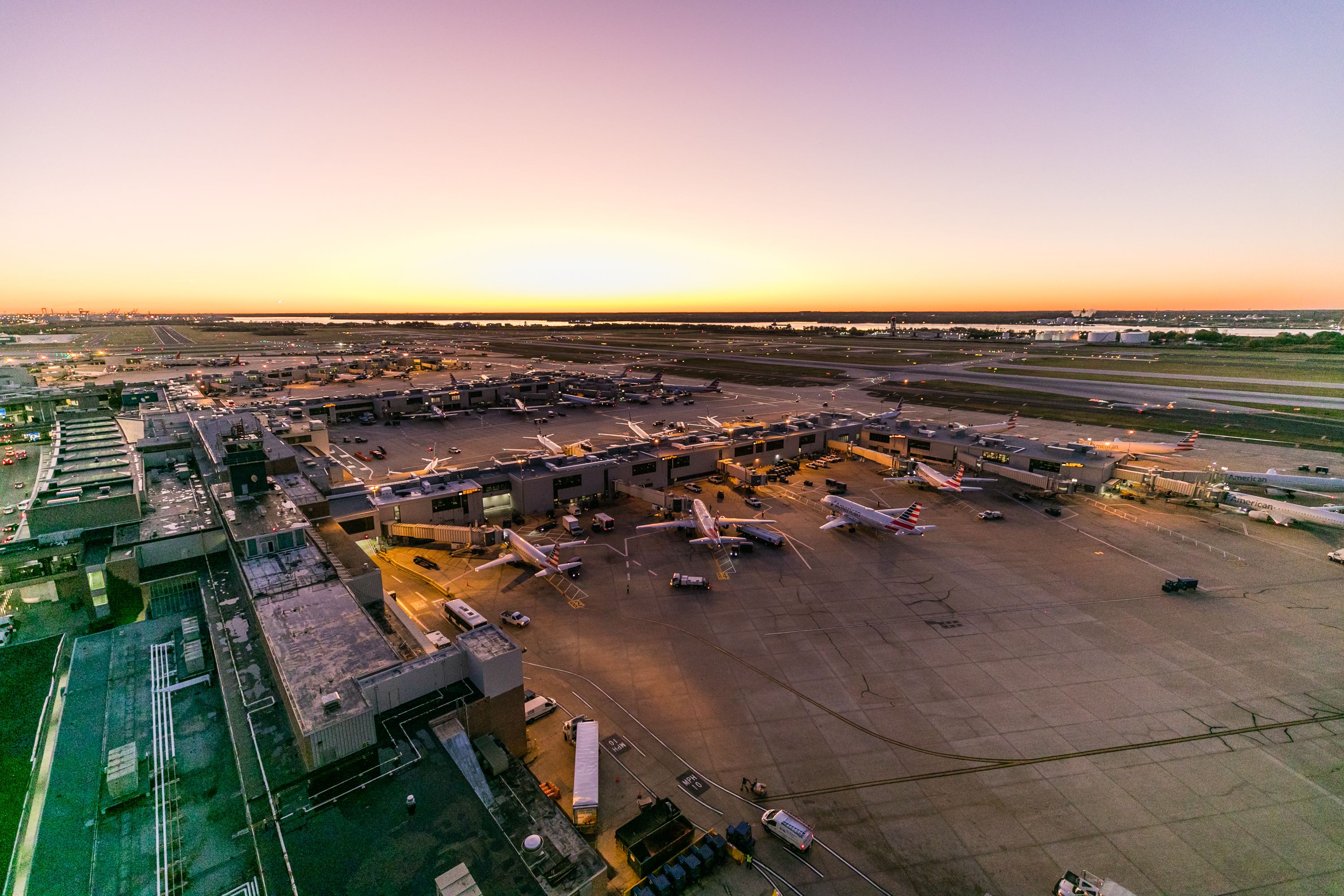
 Philadelphia International Airport (PHL) holds position five on this list, operating as a core transatlantic hub for American Airlines. The airport accommodates substantial regional passenger travel across Pennsylvania, and also plays a critical role in aggregating domestic feeder flights from smaller American markets and funneling them directly onto long-haul European routes.
With over 30 million annual passengers, the airport sees American Airlines control approximately 67% of total passenger capacity. The carrier runs tightly scheduled flight banks across seven terminals, offering nonstop service to major European capitals including London, Rome, and Dublin. The key appeal for many passengers is its lack of congested airspace seen in areas like nearby New York.
With plenty of new routes being announced, Philadelphia is fast becoming one of the most critical connector hubs in the American Airlines network. A key reason for this is that the airport is an efficient East Coast connecting node where transatlantic flight banks can operate with higher transfer efficiency and fewer air traffic delay problems.
4
Salt Lake City International Airport
Delta’s dominance shaping the Mountain West

Salt Lake City International Airport (SLC) operates as the main Mountain West hub for Delta Air Lines, located 5 miles (8 km) west of downtown Salt Lake City. The airport serves a growing local metropolitan area in Utah, though the facility acts mainly as a high-volume transfer engine connecting West Coast non-hub cities with Midwestern and East Coast flight networks.
Delta Air Lines has taken a firm grip on the airport, with about 70% of total capacity being held by the airline. During the first quarter of 2026, the carrier ran 21,242 flights, providing 2.79 million seats out of Salt Lake City, placing the facility fourth among all operational hubs across Delta’s domestic network, as per Bolt Flight.
Salt Lake City ranks at position four because roughly six out of ten travelers passing through the airfield never leave the terminal. Its central geographic location gives Delta an optimal mountain staging ground to route regional traffic, supported by a newly modernized terminal facility engineered for rapid gate transfers.
3
Minneapolis–St. Paul International Airport
Leaving the competition behind with over 70% market share

 Minneapolis-St. Paul International Airport (MSP) holds position three on this list, and has become a dominant Upper Midwest hub for Delta Air Lines. As well as processing substantial local travel across Minnesota, the airfield operates as a high-volume transfer engine, with plenty of regional and transcontinental domestic routes to choose from.
Delta Air Lines and its regional connection partners, Endeavor Air and SkyWest Airlines, hold approximately 71% of total passenger traffic at the facility. Hometown carrier Sun Country Airlines occupies a distant second position with roughly 13% market share, while legacy rivals including American Airlines and United Airlines each hold 4% or less. Operating out of Terminal 1, Delta provided 3.55 million seats across 26,946 departures in the first quarter of 2026, while continually expanding transatlantic service to European destinations including London, Paris, Amsterdam, Rome, and Copenhagen.
Minneapolis–St. Paul connecting passengers account for approximately 60% to 65% of its overall traffic volume. Its high operational reliability and central location allow Delta to run dense transfer banks smoothly, moving millions of passengers through Terminal 1 without relying heavily on local originations.
2
Detroit Metropolitan Wayne County Airport
Built to sustain connecting passenger growth

 Detroit Metropolitan Airport (DTW) holds position two on this list, being Delta Air Lines’ second-largest hub network. Located in Romulus, Michigan, the airfield functions as a critical mid-continent connecting complex that channels passenger traffic between East Coast corridors, the Midwest, and long-haul international routes across Europe and Asia.
The airport is one of Delta’s major growth centers, with two-way traffic climbing 2.2% to 23,340,073 in the 12 months leading to April 2026. Its 2-mile (3.2-km) linear McNamara Terminal features an elevated express tram, specifically engineered to move connecting passengers rapidly between domestic and international flight banks.
Featuring a relatively small local market relative to its annual volume, the airport relies heavily on coordinated domestic feeder banks to sustain its extensive transpacific and transatlantic route offerings. Despite this, the airport only trails Atlanta in terms of operation size for Delta, thanks in part to the 2008 merger with Northwest Airlines.
1
Charlotte Douglas International Airport
The perfect connecting hub that is overlooked by many
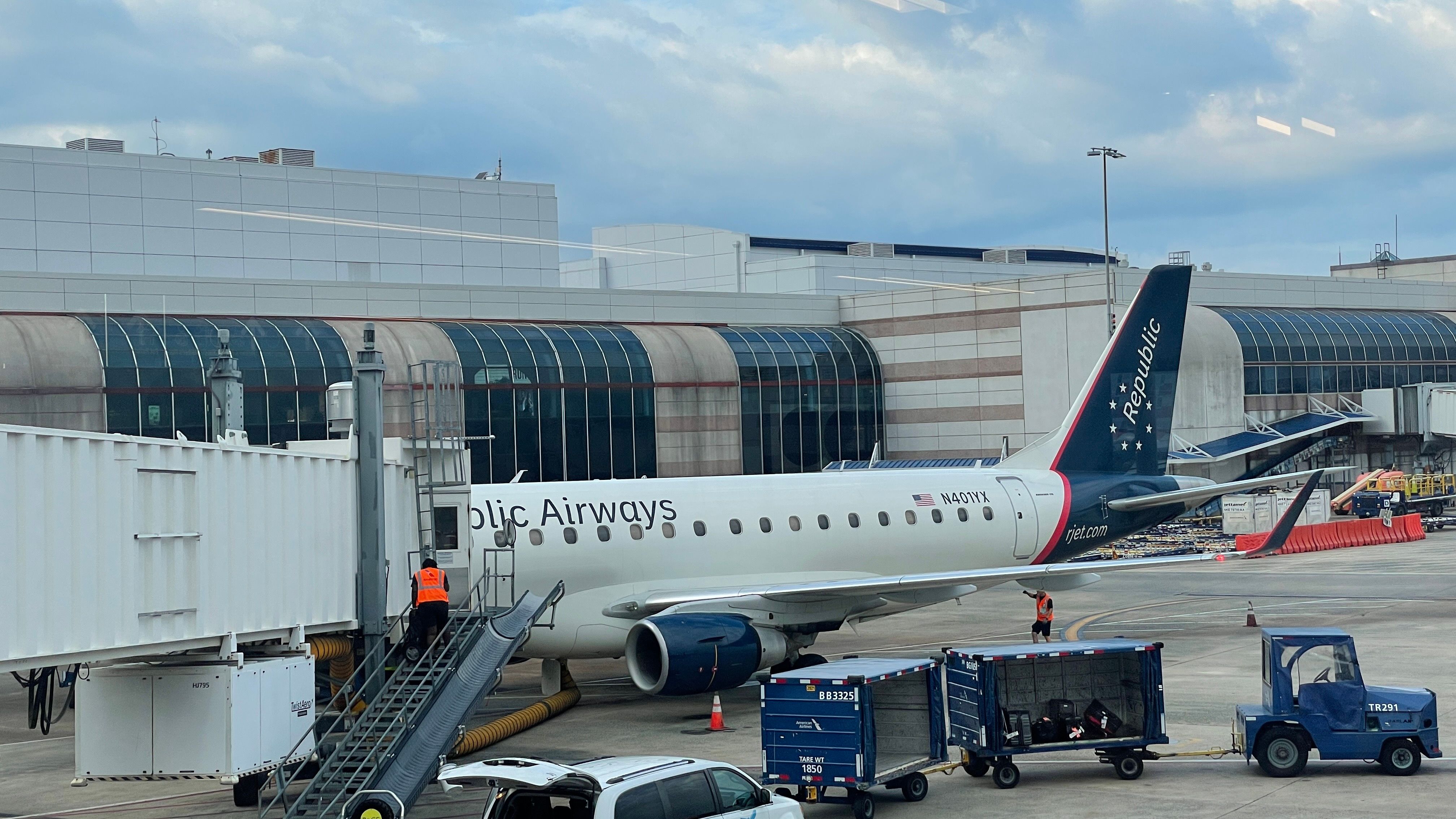
 Charlotte Douglas International Airport (CLT) takes the top position on this list and is now the ultimate connecting engine in American commercial aviation. Located in North Carolina, the facility is American Airlines’ second-largest hub, built specifically to aggregate massive passenger flows moving along the East Coast, the Sunbelt, and international flight corridors.
American Airlines holds an incredible nearly 90% of total passenger traffic at the airport, operating approximately 646 daily departures across a dense schedule of connecting flight banks. Processing over 53 million total passengers annually, the airfield funnels travelers efficiently through five concourses, linking small regional markets in the Southeast directly to major metropolitan destinations.
At Charlotte, seven out of every 10 passengers passing through its gates never step foot outside the terminal complex. With only about 30% of travelers originating or terminating locally, the facility stands as the ultimate example of a high-density, transfer-dependent airline fortress hub.
Catch what other trackers miss
Emergency squawks, holds, NOTAMs — live signals, no signup.
Open tracker
Catch what other trackers miss
Emergency squawks, holds, NOTAMs — live signals, no signup.
Open tracker