dailynewsnblog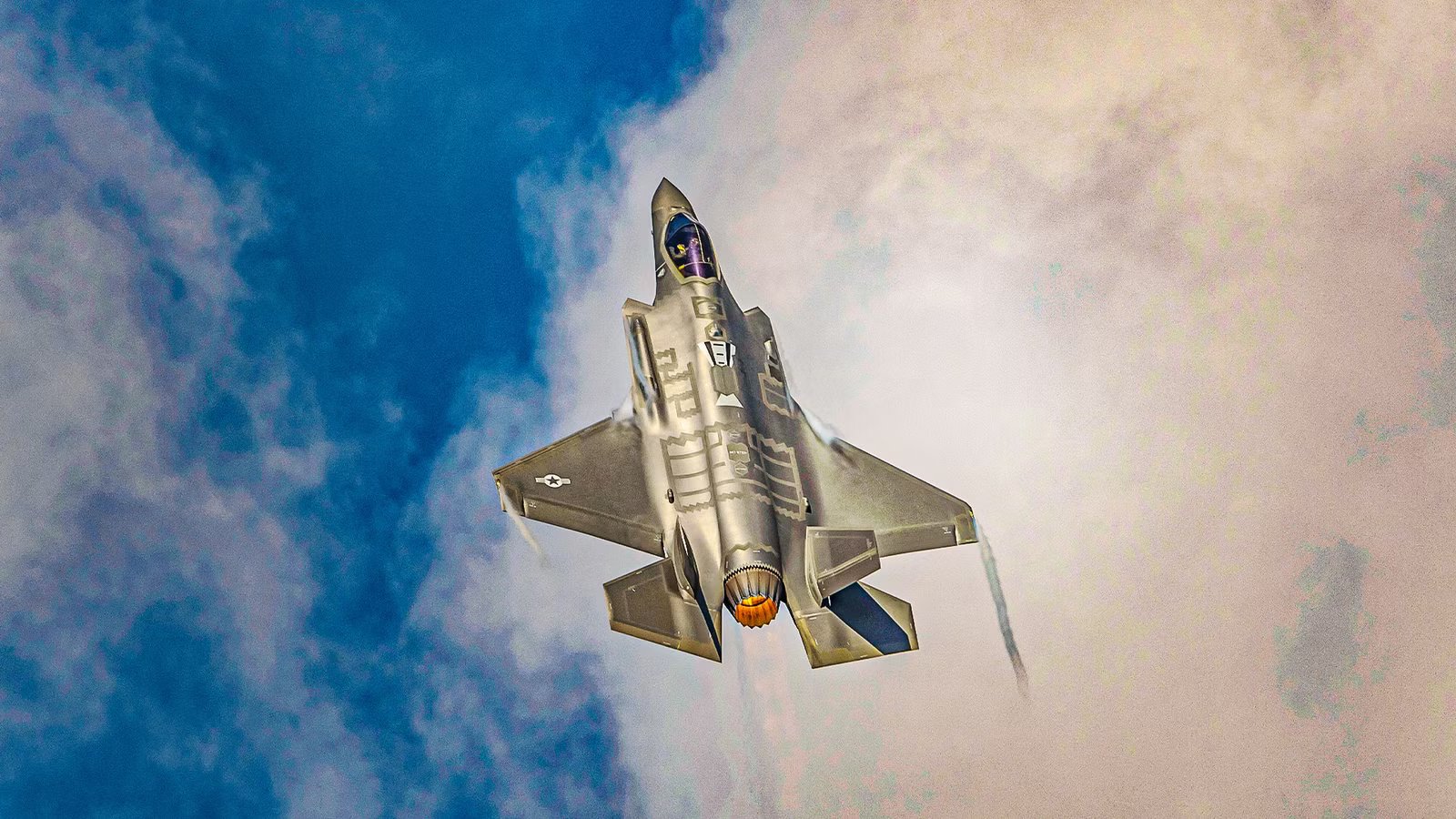
In 2025 the United Kingdom decided to rejoin the North Atlantic Treaty Organization’s airborne nuclear burden sharing mission. Under the Strategic Defense Review last year, the UK selected the Lockheed Martin F-35A Lightning II as the aircraft to carry out this nuclear deterrence mission. This may be puzzling to some observers as the Royal Air Force and the Royal Navy already operate the F-35B stealth ‘jump jet’ variant.
The key difference between the two planes is the fact that the F-35A is certified to carry the B61-12 nuclear gravity bomb, and the F-35B is not. The F-35B has a much smaller internal weapons bay due to its lift fan, which makes it possible for the aircraft to perform short take-off or vertical landing operations. It is the only one of the three variants with a second engine, which is solely dedicated to vertical lift.
The UK will take delivery of 12 A-variants to supplement its 48-strong fleet of F-35B Joint Strike Fighters. Adopting this aircraft also brings the RAF into alignment with the seven other NATO nations that will operate the F-35A to perform the same mission in the event of a ‘doomsday’ scenario. The UK has lacked this ability since it retired the WE.177 bomb in 1998, carried by the V-Force of strategic bombers.
Rebuilding The UK’s Second Pillar Of Deterrence

The UK’s decision to rejoin NATO’s Airborne Nuclear-Sharing Mission is driven by a need to counter rising tactical nuclear threats from Russia, restore a strategic ladder of escalation, and reinforce geopolitical ties with the US and NATO allies. Since the invasion of Ukraine, Russia has repeatedly used aggressive nuclear rhetoric and tactical threats to intimidate Europe. Since retiring the WE.177 air-dropped bomb in 1998, the UK has possessed only one nuclear-armed platform, the Royal Navy’s Trident strategic ballistic missiles.
The UK government determined that relying solely on massive, strategic submarine-launched missiles was insufficient. Announced initially at the June 2025 NATO Summit and codified in the 2026 Defence Investment Plan, the purchase of a dozen F-35As allows the UK to field ‘Dual Capable Aircraft.’ Rejoining the shared air mission allows the RAF to signal a direct, visible, and localized countermeasure to Russian posturing.
Trident launch carries a catastrophic, civilization-ending amount of firepower. Joining NATO’s airborne mission gives allied commanders a ‘lower-rung’ option on the ladder of escalation. Still, building a brand-new British air-dropped nuclear bomb or a cruise missile from scratch would cost billions of pounds and take over a decade. The UK Government’s Plan for Change allows the RAF to step into an existing armament supply chain.
That delivers an upgrade at a fraction of the cost, leaving the core defense budget free to fund the £64 billion Dreadnought-class nuclear submarine modernization. Operating an aircraft that carries US-owned weapons also intertwines the US more deeply into European defense infrastructure. Thus, simultaneously addressing anxieties regarding America’s long-term commitment to European defense, volunteering for the DCA mission directly answers US demands for Europe to shoulder more of the alliance’s nuclear burden.
Recapitalizing The UK’s Stealth Fighter Fleet

Prime Minister Keir Starmer announced the intent to purchase 12 F-35A models for the RAF in large part to rescue the financial value of the procurement program. Procuring a Tranche 2 batch of F-35s costs billions upfront, but the true burden is lifetime maintenance. The F-35A has a 15% lower purchase price, 8% lower running costs, longer range, and a larger payload than the B variant. However, because the F-35A requires a traditional runway, these aircraft cannot operate from the ski-jumps of the Queen Elizabeth-class carriers.
This would change the strategy for the Royal Navy as only one carrier can deploy with a full air wing at a time. But by capping the F-35 fleet at roughly 75 aircraft by 2033, the UK can redirect £16.2 billion directly into developing the Tempest, ensuring that high-tech manufacturing, intellectual property, and over 20,000 defense jobs remain within the UK economy. To offset the lack of crewed jets on flight decks, the Royal Navy is also heavily investing in uncrewed options under initiatives like Project Vixen, also known as Project Vanquish.
The F-35B is the most expensive variant in the Joint Strike Fighter family. The F-35A flyaway price can be as low as $80 to $90 million, depending on the contract details, yet the jump jet model nearly doubles that with a price tag of around $120 to $130 million. Additionally, the incredibly complex engine systems inside of it demand greater maintenance in complexity, frequency, and cost intensity. While the UK is the most significant partner of the 19 total in the multinational program, and has a special relationship with the US, this is still a financial strain.
The UK is the only tier-one partner in the JSF program and has completely fulfilled its initial order of F-35B jets. Although the original goal has not officially been changed, the total lifetime cost of the fleet has tripled to over £71 billion. The enormous investment by the UK in the F-35 was intended to be a long-term solution for stealth airpower, but the continuous snowballing cost is now casting doubts on whether the fleet will truly be fully assembled.
The Burden Of Exquisite Warplanes

Delays in rolling out Lockheed Martin’s Technology Refresh Three software upgrades have pushed the integration of crucial British weapons like the Meteor beyond-visual-range missile and Spear 3 cruise missile into the 2030s. Another bottleneck is a severe human resource shortage. A UK Defence Committee investigation revealed that there is an extreme shortage of trained pilots relative to the size of the fleet. Meanwhile, the National Audit Office reports reveal that the fleet suffers from an acute shortage of qualified engineering supervisors, technicians, and flight instructors as well.
Catch what other flight trackers miss
Emergency squawks, holds, NOTAMs — live signals, no signup.
Open tracker
Catch what other flight trackers miss
Emergency squawks, holds, NOTAMs — live signals, no signup.
Open tracker
Earlier this year, the Pentagon assessment categorized the TR-3 software infrastructure as predominantly unusable and slashed US F-35 procurement in half for the rest of the year. TR-3 is a strict prerequisite for integrating the crucial Meteor missile, advanced electronic warfare suites, and enhanced internal weapons racks needed for the F-35 to reach its full capability. The TR-3 package is now expected to be delayed as long as 2031 to reach full combat readiness due to delays with both Skunk Works and Pratt & Whitney.
With the fulfillment of the initial order of 48 F-35B jump jets for the Fleet Air Arm, it now looks very unlikely that any will be purchased for the Royal Air Force and land-based rules. Although the BAE Aerospace Systems assembly line for the Eurofighter Typhoon has been officially shut down, a recent commitment of $750 million to upgrade the fleet to a 4.5-Gen standard appears to be creating a bridge to the sixth-generation era.
Next-Gen Air Power On The Horizon

The UK is one of the founding members of the trilateral global combat air program, which aims to introduce a next-gen air superiority stealth fighter by 2035. The trilateral program includes Italy and Japan, but since the faltering of the Future Combat Air System, it may also bring on other partners like Germany, Canada, or even India. The program recently received formal funding of $6.1 billion through the Edgewing office, according to the Times of India. It brings together major aerospace makers, including BAE Systems, Leonardo, and JAIEC/Mitsubishi Heavy Industries.
Also known as the BAE Tempest, GCAP will not be an exact replacement for the F-35A. Because Japan is a strictly non-nuclear partner, the GCAP jet itself will not carry nuclear weapons. Instead, its massive range, advanced electronic warfare tools, and autonomous drone swarms will be used to blind enemy radars and dismantle air defenses. This carves out a safe aerial corridor, allowing the UK’s nuclear-capable F-35As to penetrate heavily defended airspace.
A Sustainable High-Low Fleet For The Future Of UK Air Power

While the UK remains committed to the F-35 as its primary carrier-borne fighter, significant dissatisfaction with program costs and evolving concerns regarding long-term US reliability have led to a major strategic pivot. Currently, the UK expects to receive its 75th F-35 by 2033, according to the UK Defense Journal. The Royal Navy is potentially moving away from relying primarily on manned STOVL fighters and instead increasing investment in a hybrid air wing that utilizes domestic drone and unmanned technology to reduce reliance on the US.
The Royal Navy’s primary alternative is not another manned aircraft, but a suite of autonomous systems designed to operate alongside a smaller fleet of F-35Bs. Project Vanquish was established in 2026 with the goal of demonstrating jet-powered autonomous drone capability that is compatible with the Queen Elizabeth aircraft carrier. Like the US Navy and US Air Force pursuing the collaborative combat aircraft, or loyal wingman drone, the UK is now reprioritizing unmanned options for its Lightning carrier force.
This April, the first production-grade Boeing MQ-25A Stingray took flight in its first demonstration for the US Navy. That flight was a watershed moment for the future of unmanned naval aviation. Although the American Navy is not seeking to replace manned platforms but rather complement them with a drone that can perform air-to-air refueling and surveillance, Project Vanquish aims for more.
The aviation transformation strategy seeks to employ drones that can perform intelligence, surveillance, and reconnaissance as well as strike and air-to-air refueling. This program aims for the integration of ‘uncrewed where possible’ and ‘crewed where necessary’ to achieve the highest capability per dollar for the Royal Navy by leveraging the rapid progression of unmanned aerial vehicle technology in recent years.