dailynewsnblog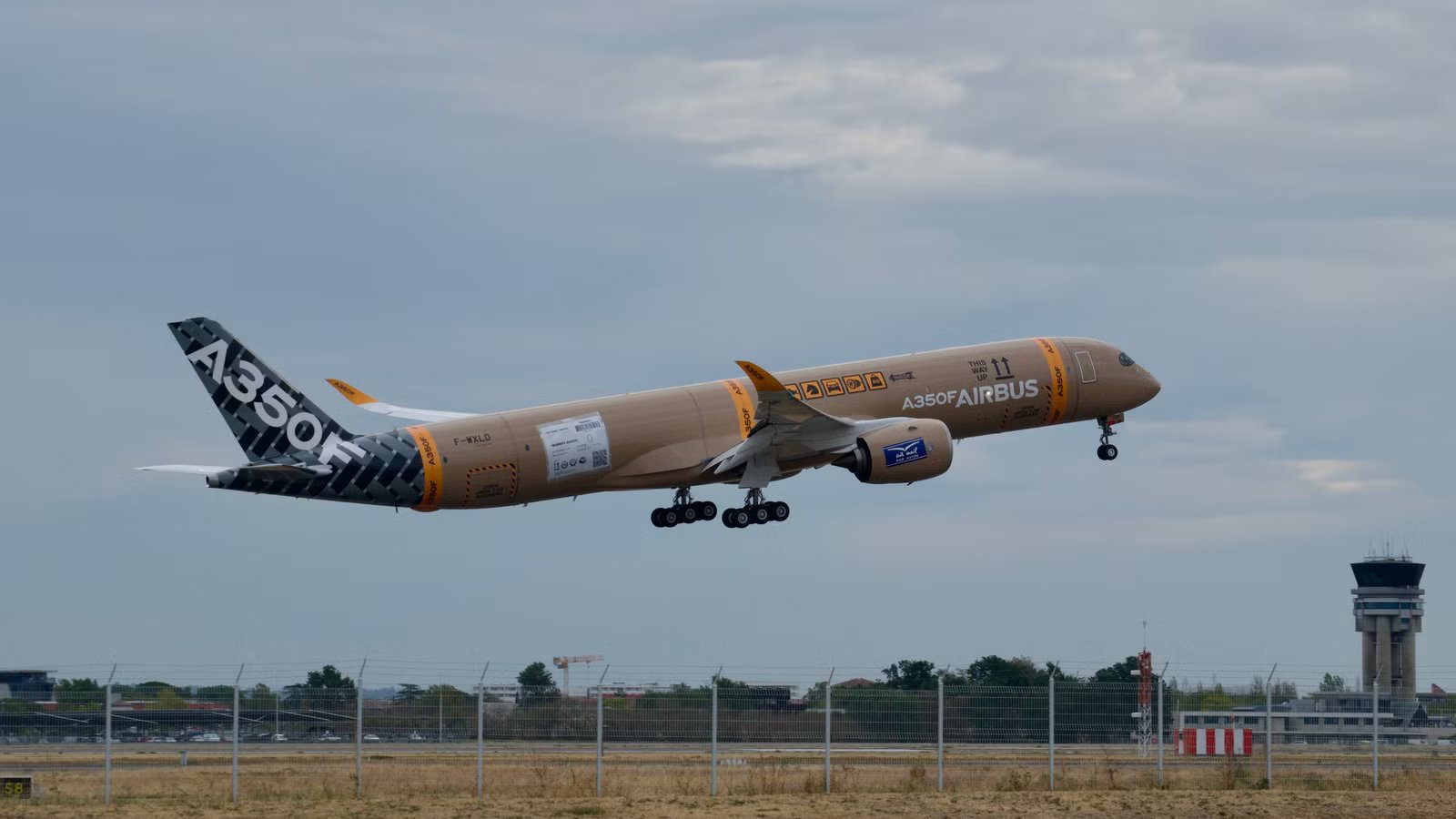
The economic dynamics of the freighter industry are somewhat different from those of the passenger airline industry. Fuel efficiency remains important to cargo operators, but the economics of freighters place an unusually strong emphasis on aircraft acquisition cost, utilization, payload, and residual value.
This helps explain why older aircraft remain economically viable in the freighter market long after they have become unattractive as passenger aircraft. This also means that freighters tend to be older, and this makes airport emissions and noise regulations more important. The two new large freighters designed to meet strict airport regulations are the Boeing 777-8F and the Airbus A350F.
Both are excellent and offer massive improvements compared with older freighters. However, the A350F has the advantage that its engine is the already mature Rolls-Royce XWB-97, now with 4.5 million flight hours. The new GE9X may be a worthy competitor, but it is stuck in the 777X’s certification purgatory. The GE9X, itself, was certified in 2020.
The Airbus A350F’s Maiden Flight

In late September, Airbus reported that its Airbus A350F freighter (based on the A350-1000) had completed its first test flight. The aircraft that flew was the first of two test aircraft and was fitted with special flight test instrumentation. The flight lasted for four hours and ten minutes, reaching an altitude of 25,000 feet (7,620 meters).
Airbus’s second A350F prototype is in an advanced stage of final assembly and is due to enter the paint shop in 2026. Lars Wagner, the CEO of Commercial Aircraft at Airbus, said that:
“This maiden flight is a major milestone for the A350F and for our customers worldwide. As the latest development of our highly successful A350 platform, the A350F is a true game-changer for the air cargo market, combining unmatched operational flexibility, fuel efficiency, and range.”
Airbus claims that its Rolls-Royce Trent XWB-97 engines offer a reduction in fuel consumption and carbon emissions of up to 40% “compared with competitor aircraft with similar payload-range capability.” Importantly, Airbus says it will be the first new freighter to fully meet the latest ICAO CO₂ emissions standards, which are now becoming a problem for Boeing. The aircraft will have a range of up to 4,700 nautical miles and a payload of up to 244,700 lbs (111 tonnes).
Boeing’s ICAO CO₂ Problem

Meanwhile, Boeing has three types of new-build cargo freighters: the 767-300F, the 777F, and the 777-8F. Boeing is in the process of delivering the last of its 767-300F freighters before new regulations kick in on January 1, 2028. The FAA has also given Boeing a waiver to build and sell up to 35 additional older-generation Boeing 777F freighters past that deadline through December 31, 2030.
This extension is due to ongoing delays in certification of the 777F’s next-generation replacement, the Boeing 777-8F. That freighter is now not expected to enter service until around 2029. The Boeing 767-300F already had a five-year exemption. However, it is unclear if the exemption will have any meaningful impact, as the underlying ICAO CO2 standard remains enforced elsewhere in the world.
The FAA exemption does not itself override the environmental rules of foreign regulators. Although EASA did not object to the US exemption, individual foreign authorities could still restrict the operation or registration of post-2027 777Fs. Despite the 767-300F’s emissions exemption from the US until the beginning of 2033, Boeing is still rushing to deliver the last of its orders by the original deadline.
Furthermore, it is not taking new orders. At the time of writing, Boeing lists ten outstanding 767-300F orders and 38 Boeing 777F orders (at least six of which are likely to be defunct orders). Boeing has continued to receive limited new orders for the 777F.
The 777-8F’s GE9X Engine Issues

The Boeing 777X is now delayed by seven years from its original schedule, as Boeing originally intended it to enter service in 2020. There have been multiple reasons for the certification delays. The 777X has faced an unusually difficult certification campaign, against the backdrop of substantially increased FAA scrutiny of Boeing following the 737 MAX accidents, including Boeing’s failure to fully disclose its MCAS software.
The 777X program has encountered problems with both the airframe and engine. These have included thrust-link cracking and, more recently, a GE9X mid-seal durability issue identified in 2026. GE has redesigned the seal and says the problem will not delay the planned 777X entry into service, but it illustrates the additional technical maturation still taking place around the new aircraft.
New-generation widebody freighters | Airbus A350F | Boeing 777-9F |
|---|---|---|
Engine | Rolls-Royce Trent XWB-97 | GE Aerospace GE9X |
Planned in-service date | 2027 | 2029 |
Based on | A350-1000 | 777-8 (777X) |
Maximum structure payload | 244,700 lbs (111 tonnes) | 260,000 lbs (118 tonnes) |
Orders | 115 | 89 |
In September 2026, Reuters reported that GE Aerospace CFO Rahul Ghai said that he was confident that the durability issue with the GE9X’s mid-seal would not hold up the planned entry into service. Although the 777X builds on the mature 777 architecture, it incorporates enough new technology that it faces substantially greater certification challenges than a relatively minor derivative.
Since 2018, Boeing has had long-running issues certifying its updated MAX 7, MAX 10, and 777X aircraft. These are issues that Airbus has largely avoided. While it’s unclear if Airbus will run into A350F certification delays, the type benefits from operating the already proven Rolls-Royce XWB engines, while Boeing is trying to certify the new GE9X.
Airbus Boasts 59% Of Large Freighter Market Share

Airbus is now planning to have its A350F enter service in the second half of 2027. With the competitor Boeing 777-8F now pushed back to around 2029, this provides an opportunity for Airbus. For now, the A350F is looking like the less risky option, especially considering its XWB-97 engine already has 4.5 million flight hours, while the GE9X’s flight hours are limited to testing.
Notably, the A350F is made of over 70% advanced materials, which Airbus says allows the aircraft to enjoy 101,400 lbs (46 tonnes) lighter maximum take-off weight compared with “competitor aircraft.” Airbus says it has received 115 orders from 14 disclosed customers and now has a 59% market share in the large freighter category.
With the 767-300F set to go out of production, customers have the option of either waiting for the 777-8F or ordering the 777F. It is worth noting that the 777F is a very capable freighter and that fuel efficiency is not as big a concern for cargo operators as it is for passenger airlines. It is also plausible that Boeing is offering attractive deals to purchase the 777F in an effort to keep its production line running and bridge to the 777X. The final 777-300ER passenger airliner was delivered in 2024.
Important Factors In Selecting Freighters

One of the most important factors airlines consider when they purchase aircraft is interoperability. It can be extremely expensive to operate a handful of very different aircraft. Airlines purchasing the Airbus A350F are generally those already operating passenger A350-900s and/or A350-1000s. This allows the freighter to fit neatly into their maintenance infrastructure.
Airlines purchasing the Boeing 777-8F are often replacing older Boeing freighters, or they are already operating Boeing 777 passenger aircraft. Often they order 777-8F aircraft alongside Boeing 777-9 and 777-8 passenger aircraft. While the manufacturers, Airbus and Boeing, point out the fuel efficiency of the aircraft, for freighters, fleet commonality is often at least as important.
Capital expenses of freighters are also more important than those of passenger aircraft. This is why many old passenger aircraft are converted to freighters, even though they are inefficient compared with the latest aircraft on the market. Potential discounts offered on the 777F can also be significant. Another major factor is regulations. Many airports have tight noise and emissions regulations, and this effectively makes many airports off-limits for older freighters.
The Only Freighter To Meet Emissions Regulations

For Boeing, the new regulations are becoming a major issue for its freighter sales. The 777F does offer some reprieve, with Freight Waves reporting that “the European Aviation Safety Agency, which is the primary regulator for Europe-based Airbus, did not object to the exemption. Still, the possibility remains that a foreign government could prohibit airlines from operating post-2027 classic 777s in their airspace.”
At the same time, the GE9X engine is also becoming an issue. The engine is the most powerful airplane engine ever developed and is designed to make the 777-9 competitive against the Airbus A350-1000 and its Rolls-Royce XWB-97 engines. GE Aerospace claims that it provides up to 10% specific fuel consumption improvements compared with the older GE90-115B engine and “a 5% specific fuel consumption improvement versus any twin-aisle engine available.”
More important than the fuel savings, it will allow the 777-8F to meet strict noise and emissions regulations at airports around the world well into the future. However, because it is also a new engine, its certification is being delayed, and airlines can’t wait forever for their aircraft. If Airbus meets its current schedule, the A350F will be the only new-generation large freighter entering service during the immediate 2027–28 regulatory transition.
Catch what other trackers miss
Emergency squawks, holds, NOTAMs — live signals, no signup.
Open tracker
Catch what other trackers miss
Emergency squawks, holds, NOTAMs — live signals, no signup.
Open tracker