dailynewsnblog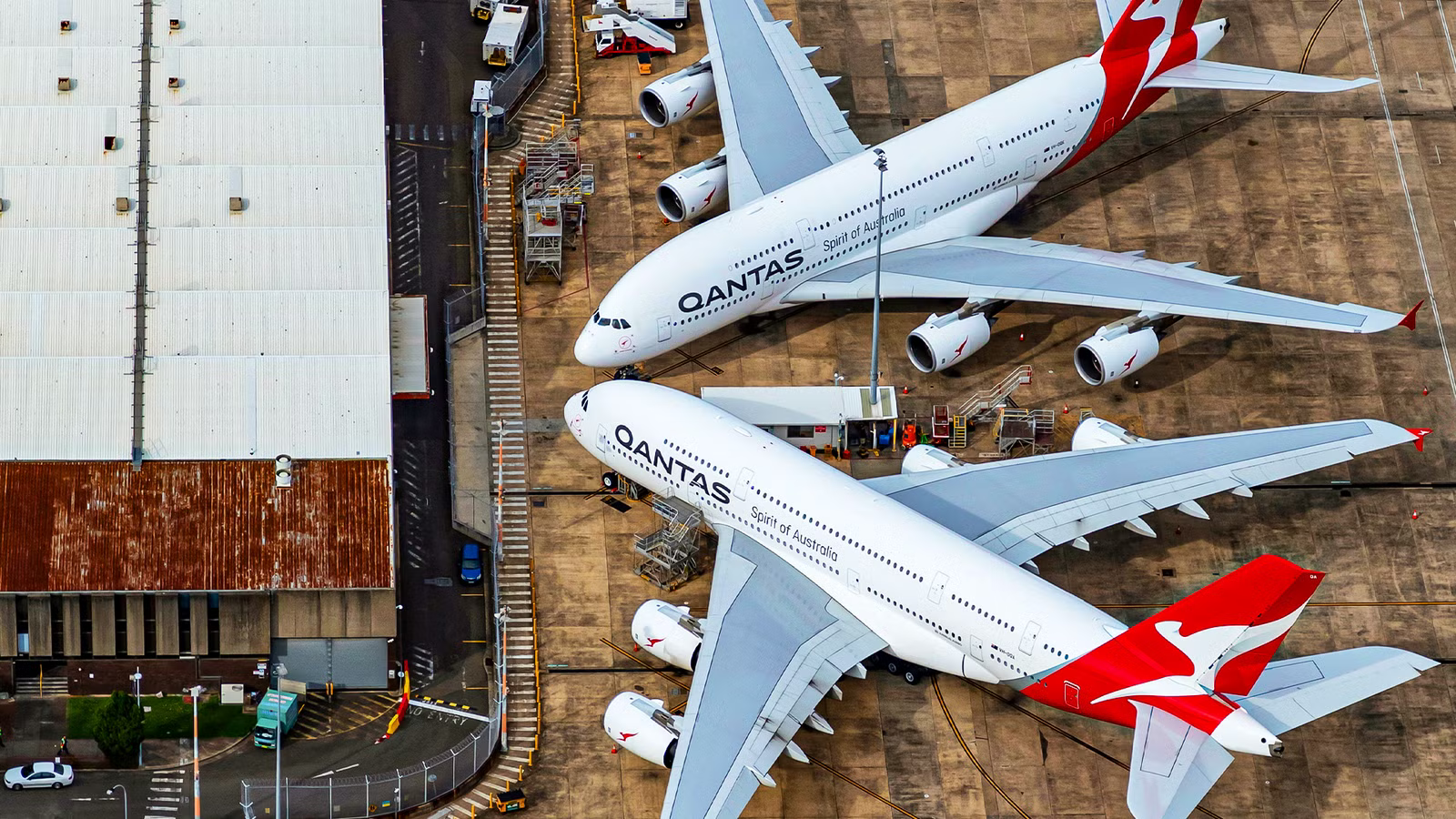
The United States is a major market for Qantas, as the US and Australia share close cultural and business ties. However, it’s also highly competitive, and the US airlines (American Airlines, Delta Air Lines, United Airlines) have significantly expanded their Australia networks. The competitors (which are really Delta and United, as Qantas partners with American) are as strong as ever, which presents some new challenges for the Australian flag carrier as it aims to refine and expand its US operations.
Qantas’ flagship aircraft is the Airbus A380, of which it operates ten examples. In the US, the A380s are flown on three routes hitting two cities (Los Angeles and Dallas/Fort Worth). Naturally, you’d expect that the carrier would deploy its flagship aircraft to what are some of its most important destinations, but the US market has become more challenging for Qantas. At the same time, it has ambitious plans ahead for the market and will continue to be a leading force, even if the situation is a slight challenge today.
Uneven Demand And Moving The A380s

Qantas serves five destinations in the United States: Honolulu Daniel K. Inouye International Airport (HNL), Los Angeles International Airport (LAX), San Francisco International Airport (SFO), Dallas/Fort Worth International Airport (DFW), and New York John F. Kennedy International Airport (JFK). Qantas serves all five destinations from Sydney Kingsford Smith Airport (SYD), while the JFK route has a stopover in Auckland Airport (AKL). LAX and DFW are also served nonstop from Melbourne Airport (MEL), while LAX has an additional service from Brisbane Airport (BNE).
In its 1H2026 results, Qantas has noted strong demand for travel from the US to Australia. The challenge, however, is that this traffic tends to prefer the US airlines, and this demand benefits Qantas to a lesser extent (Qantas does still capture this traffic, helped in part by the American Airlines joint venture). Meanwhile, although the airline is generally performing well on its US services, demand in economy class has declined, requiring some adjustments in aircraft assignments.
Qantas currently deploys the A380 twice-weekly between MEL and LAX, while the remaining five weekly flights are flown with the Boeing 787-9. In October, however, the A380 will be taken off the LAX route while the 787-9 will operate all flights per week. Instead, Qantas will deploy the displaced A380 on its route from SYD to Singapore Changi Airport (SIN), increasing A380 operations to twice daily on this route. After this switch, Qantas won’t have any A380 routes out of MEL, concentrating its double-decker operations out of SYD.
Higher Competition Across The Pacific

Qantas operates a metal-neutral joint venture with American Airlines, which makes the two, for all intents and purposes, one entity across the Pacific. Adding in American’s services, Qantas has a second daily service between SYD and LAX (using American’s 777-300ER) along with a winter seasonal route between BNE and DFW (with American’s 787-9). However, Qantas and American’s US-based rivals, which are Delta Air Lines and United Airlines, have significantly increased the size of their Australia networks.
In 2019,  Delta Air Lines only operated one nonstop route to Australia, flying daily between LAX and SYD with a Boeing 777-200LR. Today, however, it operates up to two flights per day between LAX and SYD, while also serving MEL and BNE. In 2019,
  United Airlines served SYD from LAX, SFO, and Houston George Bush Intercontinental Airport (IAH), while MEL was served from LAX and SFO. Today, it also serves BNE and Adelaide Airport (ADL) from SFO, while its upgauged and added frequencies on some of its more established services.
Airline | Australia Ports Served From US | US Ports Served From Australia |
|---|---|---|
Qantas/American Airlines | BNE/MEL/SYD | DFW/HNL/JFK/LAX/SFO |
Delta Air Lines | BNE/MEL/SYD | LAX |
United Airlines | ADL/BNE/MEL/SYD | IAH/LAX/SFO |
The US carriers are now much larger than they were pre-pandemic, and much of the rise in transpacific demand has been from the US side. From the Australia side, meanwhile, premium demand is still strong, but economy demand has weakened. This leaves Qantas more vulnerable than its US competitors in some cases, and so it’s cutting capacity on what appears to be a relatively weak service.
Swapping The A380 For The 787

With economy demand fairly weak from Australia to the US, the Airbus A380 becomes a difficult aircraft to operate. The routes from SYD to LAX and DFW still work, as SYD is Qantas’ largest hub while LAX and DFW are its largest US spokes. MEL, however, is the carrier’s secondary hub, where it has a smaller connecting network and less local demand. LAX was already Qantas’ only A380 route out of MEL, and the type was only flying to LAX twice a week at that.
Although the A380 has huge premium cabins, it also comes with 341 economy seats. This can already be a challenge to fill, but it becomes extremely difficult in market conditions like Qantas is facing today. The 787 that is displacing the A380 lacks first class, has 28 fewer business class seats, and 32 fewer premium economy seats, but it also has 175 fewer economy seats. Given Qantas’ issues with filling economy cabins, this helps preserve pricing power, which helps offset the loss of premium revenue.
Another benefit of the 787 is that it has significantly lower operating costs than the A380, and it was even once stated by former Qantas CEO Alan Joyce that flying two 787s was cheaper than one A380. Of course, this only tells one half of the equation, as it’s not guaranteed that two 787s would earn the same revenue as one A380 (especially considering that Qantas’ A380s have large first class cabins). However, recent changes in the airline industry have made operating costs more important now than ever.
Rising Fuel Costs Worldwide

The Airbus A380 works on routes like SYD to LAX because, although Qantas is spending more to fly the type compared to the 787, it’s also earning significantly more money through the aircraft’s massive capacity and large premium cabins. Ever since the 2026 Iran war began in February, however, oil prices have remained elevated and are sitting at close to $100 per barrel. This makes the economics of flying the A380 very difficult, considering its four-engine layout and huge size.
The A380 still makes Qantas money on the SYD to LAX and DFW routes because of the strong demand, but the route between MEL and LAX is more marginal. In addition, it’s also an extremely long route, at 6,883 NM (12,748 km), which makes the fuel cost disproportionately higher. The DFW route is even longer, but this is already a stronger route for Qantas. Therefore, while Qantas may have been able to sustain the A380 between MEL and LAX a year ago, the weaker economy demand and high fuel costs mean that the double-decker has to go.
It’s telling that Qantas is using the freed-up A380 capacity to place it on its route between SYD and SIN. As it stands, the carrier has one daily A380 flight that continues to London, while its second daily flight switches between using the A380 and the Airbus A330. This frequency, which does not continue to another destination, will switch to using the A380 every day of the week. SIN is a massive spoke for Qantas with strong demand, but it’s also about half the distance of the MEL to LAX route, meaning that it’s far cheaper to use the A380 here.
The End Of The Qantas A380

Qantas currently flies 29 Airbus A330s, ten A380s, and 14 787s, while it holds orders for 24 Airbus A350s (split between 12 A350-1000s and 12 A350-1000ULRs) along with 12 787s (split between another four 787-9s and eight 787-10s). Most of these aircraft were actually intended for growth and to partially replace Qantas’ Airbus A330 fleet, while the A380 would have been retired beginning in 2032, presumably with exercised options and future orders. However, this is no longer the case.
Qantas has recently announced that it would move up the retirement of its superjumbos to 2028, with the final flight of the aircraft type occurring in mid-2028. This is a rapid retirement timeline, and it means that Qantas’ A380 routes will see a massive cut in capacity. This capacity can be made up for with new Project Sunrise nonstops and additional frequency increases with smaller aircraft, but it’s notable that Qantas has moved up the double-decker’s retirement and will remove the type in such a swift fashion.
Rising fuel costs are the primary culprit here. Flying the A380 on 15-hour transpacific routes worked for Qantas when it could fill the seats and oil prices were hovering at around $60 per barrel, but with prices now at almost $100 per barrel, the economics have changed. The route between MEL and LAX may have worked a year ago, but with elevated fuel costs, the A380 is too expensive to operate with the revenue that it earns on this route. Smaller, more flexible planes are the way to go, and the A380 isn’t earning Qantas enough money anymore to justify its continued use.