dailynewsnblog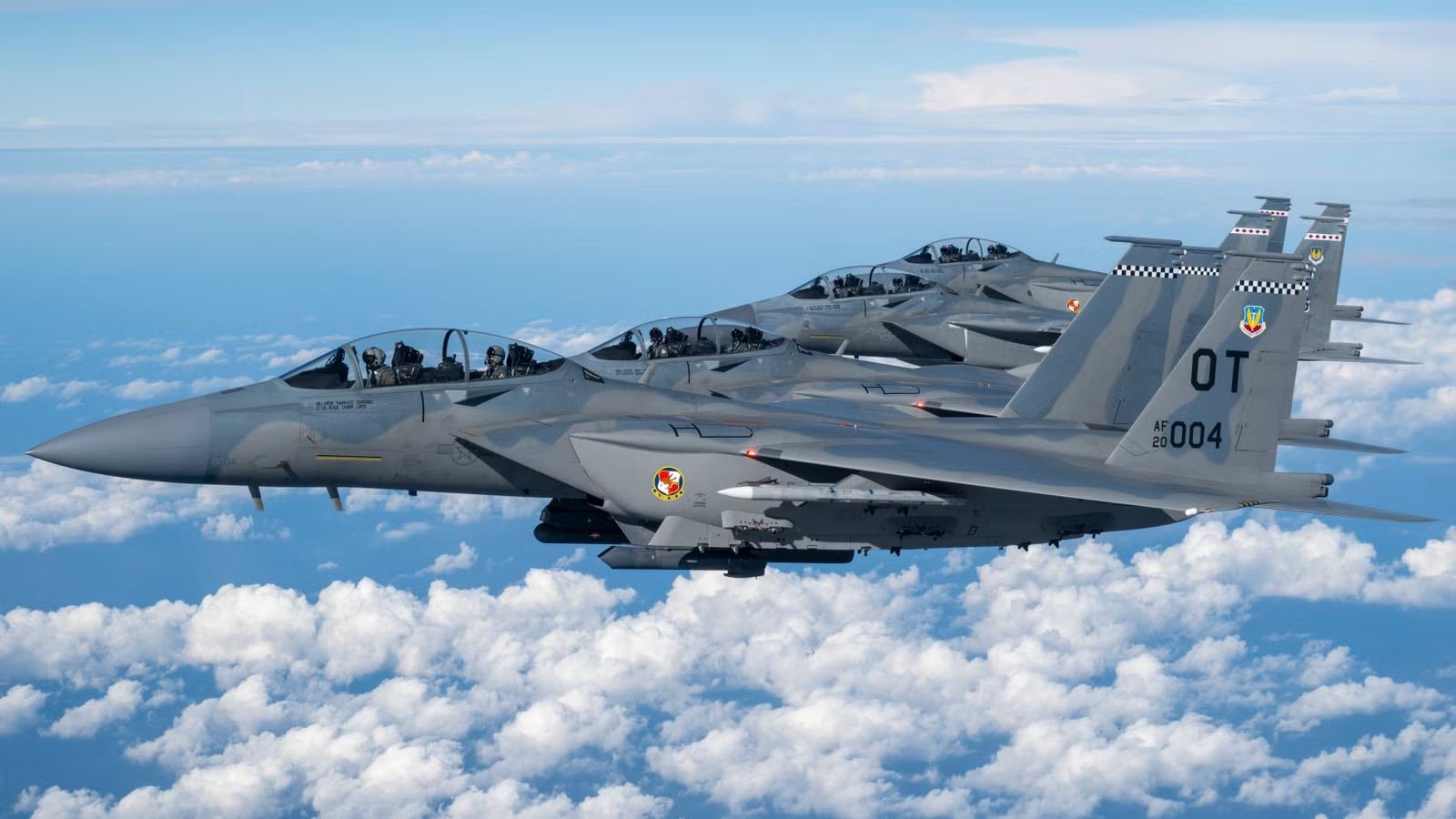
Range, especially realistic combat range, is one of the most important aspects of any modern fighter jet. Range is arguably both less and more important for the United States Air Force relative to most air forces in the world. The USAF is structured for power projection, and that requires range, both to ferry aircraft around the world and to conduct deep strikes into enemy territory. Most air forces are designed for the defense of their homeland and so do not require long-range capabilities to project power beyond their borders.
An exception to this is the increasingly modernized Chinese PLAAF, which is designed with the range to threaten targets in the East Pacific from the Mainland. Meanwhile, a fighter jet’s internal range is also less important for the USAF as it operates the world’s largest tanker fleet. As Russia and China’s tanker fleets are minimal and mostly used for strategic bomber patrols, their aircraft (e.g., J-20, Su-57, Su-35) need to carry large internal fuel volumes. US fighters can gas up when airborne. Listed combat radii are per a 2025 USAF infographic; actual combat ranges vary massively, with real-life ranges being extremely fuzzy and context-dependent.
5
Lockheed Martin F-22 Raptor
Combat radius of 590 nautical miles

The United States Air Force operates four families of fighter jets: the F-15, F-16, F-22, and F-35A, while also developing the next-generation F-47. It also operates the A-10 Warthog ground attack aircraft, and the iconic F-117 Nighthawk remains operational as an aggressor aircraft. As the A-10 is not a fighter jet, it is excluded from the list, and as the F-117 is not combat active, it is also excluded. The F-16 Fighting Falcon doesn’t appear on the list due to its comparatively modest combat radius, estimated at 250 to 350 nautical miles in a realistic combat loadout, extending up to 400 to over 550 nautical miles with external drop tanks. Its combat radius is listed by the USAF as 400 nautical miles.
The F-22 Raptor is the world’s first 5th-generation fighter jet and was designed around extreme stealth, air dominance, and its ability to supercruise. As a stealth aircraft, the F-22 carries fairly modest loads in its internal weapons bays, meaning that it doesn’t attract the same load-out penalties as other aircraft like the Eagle. It was designed to carry a large amount of internal fuel, although it was originally intended to be developed with stealthy drop tanks.
Budget cuts saw the planned development of Raptor’s stealth drop tanks axed. Still, it can carry non-stealthy 600-gallon drop tanks that extend its combat radius to over 900 nautical miles (at the expense of stealth). With a rising China and platforms like the J-20 increasingly threatening enablers like tankers, the USAF is finally developing stealthy drop tanks for the Raptor. In 2024, it was reported that the Air Force wanted the first of these tanks delivered for operational use in 2026. It is unclear if they are in service yet.
How Many Hours Can The F-35 Fly On Internal Fuel?
What do you think the answer is?
4
Lockheed Martin F-35A Lightning II
Combat radius of 670 nautical miles

The F-35A is the ground-based variant of the F-35 family and has a similar combat range compared with the carrier-based F-35C and a significantly longer combat radius compared with the STOVL F-35B. The F-35 mirrors the F-22 in several respects, including its aerodynamically efficient stealth profile, a low payload penalty due to internal weapons carriage, and the lack of dedicated drop tanks. That said, the F-35 has the option to sacrifice stealth and carry non-stealthy drop tanks and boost its range, and it can go “beast mode” and carry external munitions. Beast mode reduces its range.
Also, like the F-22, the USAF is exploring equipping its F-35As with stealth drop tanks or, perhaps more likely, a form of low-observable tanks that are not fully “stealthy.” These are in development as part of the ongoing Block 4 modernization effort and will cover all three variants. In 2019, Lockheed Martin looked into adding two 600-gallon drop tanks to the F-35, and these would have boosted fuel capacity by around 40%. There is also the option of adding smaller 480 or 460-gallon tanks.
There is also reporting that Israel has independently developed low-observable drop tanks for its F-35s, although more recent reporting in 2026 seemed to suggest that this remains a plan. Lockheed Martin gives the combat radius for the F-35A on internal fuel as “>590 nm,” although this seems to be a conservative figure. It should be noted that the combat radius is extremely fuzzy. The altitude (air density) has a significant impact on range, as does the speed at which an aircraft is flown. Flying the F-35 at supersonic speeds will quickly collapse its range, while flying the F-22 at supercruise will also collapse its range, but not as dramatically.
3
McDonnell Douglas F-15E Strike Eagle
Combat radius of 690 nautical miles

The F-15E Strike Eagle is currently the heavy hitter of the USAF’s tactical fleet, providing brute force to the fleet. As the aircraft is large and not constrained by stealth limitations, it is able to carry large external payloads and conformal fuel tanks (CFTs), while its large airframe allows it to carry a huge amount of internal fuel as well as drop tanks. The F-22 and F-35 are used more for high-end precision missions, with the F-22 optimized for air dominance and the F-35 optimized for stealth penetration to target high-value assets like air defense radars.
The Strike Eagle is also a major improvement over the earlier F-15C/D Eagle. The F-15 Eagle family has three distinct generations: the initial F-15C/D, the F-15E, and the F-15EX. To avoid the Eagle dominating this list, and due to the USAF phasing down its aging F-15C/Ds, the first generation is not listed here. The Air Force plans to completely retire its remaining fleet of F-15C/D fighter jets by Fiscal 2031. The aging jets are mostly assigned to Air National Guard units for home defense.
The F-15E first entered service in 1988 as a true multirole fighter jet. It has a large number of improvements over the older F-15C, including boosting its typical combat radius by around 100 nautical miles. It has a typical combat range of around 650 to 800 nautical miles, depending on loadout. Notably, Hi-Lo-Lo-Hi profiles can exceed 750 nautical miles even with heavy loads.
Why Some Countries Still Buy Old Military Aircraft
A closer look at the booming marketplace for used fighters around the world.
2
Boeing F-15EX Eagle II
Combat Radius of 690 nautical miles

The F-15EX is a generational upgrade over the F-15E and is essentially a completely different aircraft compared with the original F-15C/D Eagles. Interestingly, it is the newest fighter jet in USAF service, having entered service in 2024 (the F-35A entered service in 2016). The Air Force had planned to only purchase 129 of these jets, but in its Fiscal Year 2027 budget documents, it appears to be doubling the target to 267 jets. The budget request includes funding for 24 new F-15EXs.
The F-15EX is not a dramatic reworking of the F-15E airframe; instead, the jet’s upgrades emphasize improvements to digital flight controls, electronics, survivability, service life (20,000 flight hours), and payload integration. Improvements to range are real but incremental, boasting a realistic combat radius boost by around 50 nautical miles (with the aforementioned caveats). The EX can be expected to get a 5–15% improvement in practical range and endurance over its predecessor. The US Air Force infographic lumps it with the F-15E and conservatively lists the combat radius as 690 nautical miles.
It is also designed to be a missile truck operating in tandem with F-35As through the 2030s and 2060s. It is optimized for extremely heavy loads, carrying more missiles and larger standoff weapons. Variants of the EX family have been ordered or are in service with Japan, Israel, Korea, Singapore, Saudi Arabia, and Qatar. Israel is placing an order for 25 new F-15EX (F-15IA subvariant) aircraft, bringing its total to 50, while Japan is not ordering new airframes but is upgrading its F-15J fighters to the EX standard.
1
Boeing F-47
Combat radius of 1,000+ nautical miles

The upcoming Boeing F-47 is not “in service” with the United States Air Force, and while its demonstrator first flew in 2020, its first prototype is not expected to fly until 2028. That said, it is worth listing here as a major reason the Air Force wants it: its increased range over the existing F-22. The F-47 is intended to complement the F-35A and eventually replace the F-22 in the air dominance role.
It is being designed specifically with a focus on the massive distances of the Asia-Pacific and an acknowledgment that new platforms like the J-20 and future J-36 put tankers at risk, while the increasing number of ballistic missiles and other systems put forward operating bases at risk. This is creating an imperative to extend the range. As an interim measure, the Air Force is looking to extend its F-22 range with stealth drop tanks, but this is more of a stopgap measure.
An interesting infographic published by the USAF’s Chief of Staff, General Ken Wilsbach, shows the F-15E with a combat radius of 690 nautical miles, the F-22 with 590 nautical miles, the F-35A with 670 nautical miles, and the F-47 with 1,000+ nautical miles. This is a notable combat radius leap. It is also worth noting that the infographic has a range for the accompanying CCA (aka loyal wingman drones) of 700+ nautical miles.
Catch what other trackers miss
Emergency squawks, holds, NOTAMs — live signals, no signup.
Open tracker
Catch what other trackers miss
Emergency squawks, holds, NOTAMs — live signals, no signup.
Open tracker