dailynewsnblog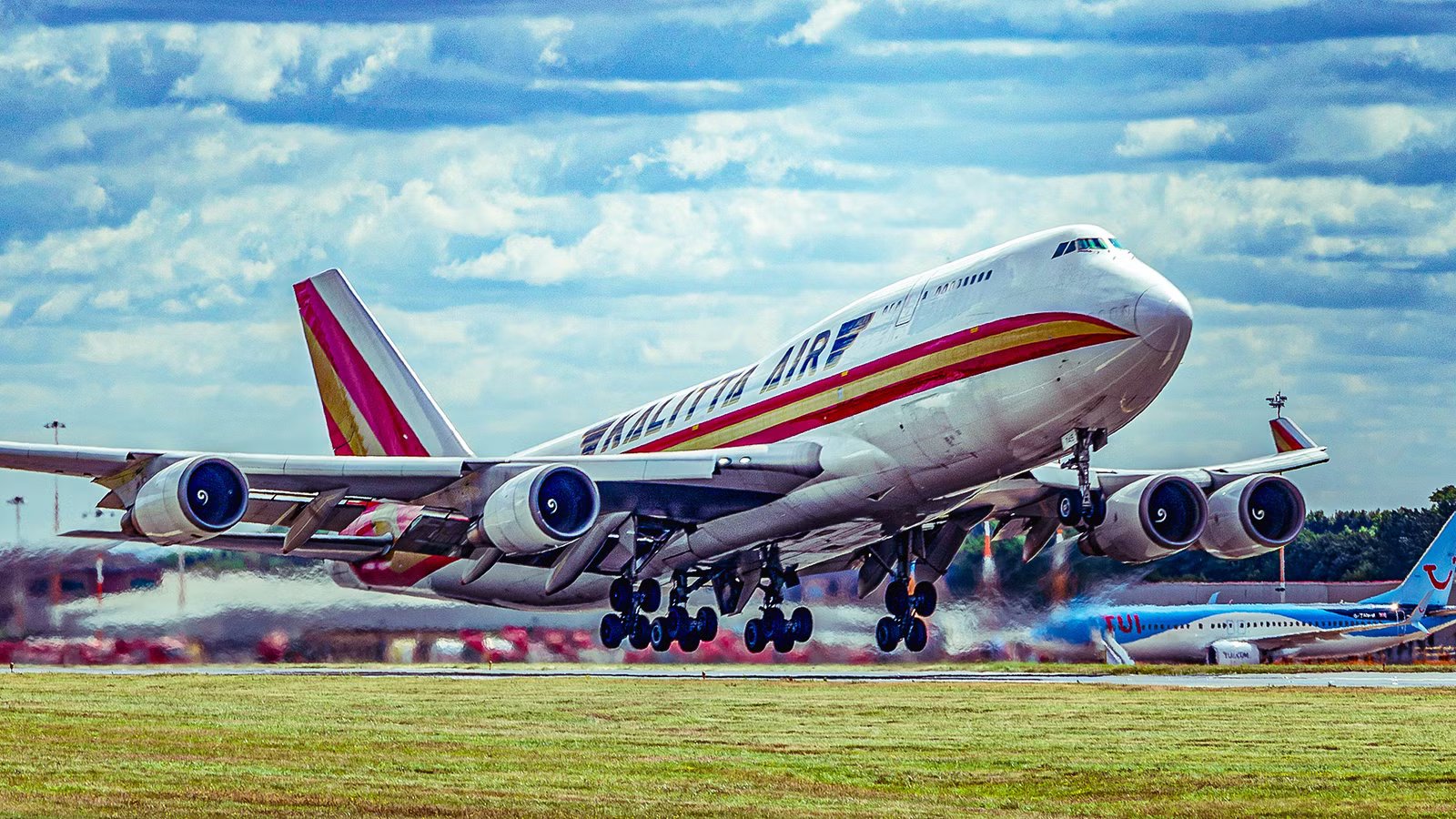
The Boeing 747 is an icon of aviation, but it’s a five-decade-old airframe that seats just slightly more passengers than a Boeing 777-300ER while flying about as far, and doing so with four engines rather than two. It doesn’t offer airlines anything that can’t be done by a more fuel-efficient twin-jet widebody, and while the latest 747-8 was larger with improved range, it wasn’t economical. Airlines could either go for the smaller, cheaper Boeing 777 or the larger, more economical Airbus A380. As such, the 747 has been obsolete for far longer than many realize.
But in the cargo airline industry, the picture looks very different. There are still hundreds of Boeing 747 freighters in service, and these airlines are still holding onto their aircraft. Only recently have true replacements emerged for the 747-400F, the most popular 747 freighter model, while the 747-8F remains unmatched. Consequently, the 747-400F will continue to persist, while the young fleet of 747-8Fs will remain in service for decades. There are multiple reasons behind the 747’s refusal to go away, one of which is a fundamental design element, while the others are far less striking.
The Current 747 Freighter Fleet

Currently, the vast majority of 747 freighters in service are either the 747-400F or the 747-8F. The 747-400F was sold in two subvariants: the standard model and the 747-400ERF. The 747-400 as a whole was the most popular variant of the 747 family, with 694 sales across all subvariants. Boeing delivered 126 747-400Fs and 40 747-400ERFs, but dozens of passenger 747-400s were converted into freighters as well. Today, there are over 250 747-400Fs in service, including all subvariants.
The 747-8F entered service in 2011, and it features a reprofiled wing, fuselage strength, updated technology, along with new General Electric GEnx-2B engines. While the passenger 747-8i sold in extremely low numbers, the 747-8F received 107 orders, more than twice as many as the passenger version. The type is positioned to be in service for the next several decades, especially given that there’s no clear replacement.
In total, there are over 350 747 freighters in service, and while some airlines have announced replacements for the older 747-400F, the type’s replacement cycle has hardly begun. Despite its obsolescence as a passenger airline, the 747 remains one of the most versatile aircraft that a cargo airline can operate, and carriers are hardly rushing to replace it. If anything, they cannot get enough of the 747 freighter, particularly as the type’s proposed replacements are still in development.
The Feature At The Front Of The 747

All factory-built Boeing 747 freighters are equipped with a nose cargo door that opens upwards, made possible by the flight deck being located on the upper deck. In the 1960s, when the 747 was developed, this was a conscious choice. The 747 was developed largely at the request of Pan American World Airways, who wanted a large aircraft with low per-seat costs, but in the 1960s, it was believed that supersonic transport would replace subsonic passenger planes. The 747, therefore, was designed with a nose door to maximize interior volume and allow for oversized cargo loads.
Catch what other flight trackers miss
Emergency squawks, holds, NOTAMs — live signals, no signup.
Open tracker
Catch what other flight trackers miss
Emergency squawks, holds, NOTAMs — live signals, no signup.
Open tracker
The nose door would help ensure that the 747 would still have a market as a new-build freighter even when SSTs became widespread. Of course, SSTs didn’t take over the world, and the 747’s success came primarily from passenger sales. Today, however, the cargo door is a major factor behind the 747’s continued operations, as it enables the plane to carry oversized loads in addition to standard pallets and containers.
Boeing 747 Variant | Sales | Entry Into Service |
|---|---|---|
747-100 | 205 | 1970 |
747-200 | 393 | 1971 |
747SP | 45 | 1976 |
747-300 | 81 | 1983 |
747-400 | 694 | 1989 |
747-8 | 155 | 2011 |
Total | 1,573 |
The only commercial freighters that can carry outsized freight were the Antonov An-124 Ruslan and the An-225 Mriya, but the only operational Mriya was destroyed in 2022 during the Russian invasion of Ukraine. Meanwhile, the only non-Russian operator of the Ruslan, Antonov Airlines, flies the freighter in very small numbers. In practical terms, the Boeing 747 is the only aircraft that can be used to carry outsized freight, making it a must-have for operators specializing in this type of cargo.

Why Do Cargo Airlines Still Prefer The Boeing 747 Over Newer Jets?
The new generation of jets has pushed out the icons of old, but one is still hanging around and is actually preferred over many of these new options.
The Other Reasons Behind The 747’s Persistence

Cargo airlines don’t care that much about fuel efficiency. This is because freight operators tend to use their aircraft less often than passenger airlines, and don’t operate as many long-haul and ultra-long-haul routes. Freighters already typically have significantly reduced range than their passenger counterparts in real-world operations, largely because of the heavy payloads they lift, and so the 747’s four-engine layout is not nearly as detrimental as it would be to carriers like  United Airlines,
  Air India, or
  Singapore Airlines today.
The 747’s high fuel burn is not as significant for freight carriers, and what’s more, the planes work. While the 747 platform as a whole is aging, freight operators can operate aircraft for much longer than passenger airlines because of how little these planes actually fly. Aircraft life is usually rated in hours and cycles, and while a 25-year-old aircraft may be considered old for passenger operators, it’s hardly a point of concern for cargo airlines. Naturally, maintenance costs are a point of concern, but the 747 is still widely used, so parts are available.
In addition, there hasn’t been a true replacement for the 747 freighter in the new-build market. The next largest new-build aircraft in service is the Boeing 777F, which is based on the much smaller 777-200LR. In the passenger market, the 747’s capabilities and qualities have largely been replicated by newer, more cost-effective alternatives, but this hasn’t happened in the new-build freighter market. This means that, for operators who need to lift large volumes of heavy cargo, the 747 is the only option. However, this won’t be the case for long.
The Upcoming Replacements For The 747

In March 2026, Atlas Air and Airbus made a surprising announcement that the carrier would become the largest customer for the Airbus A350F. The carrier had never before operated an Airbus, but is now confirmed to be taking 20 A350Fs with options for 20 more, and while these planes are officially earmarked for growth, it’s clear that the stage is set for the A350F to potentially replace at least part of Atlas Air’s 747-400F fleet. Of course, this is what the A350F is designed to do.
The A350 may look like the Airbus version of the modestly-sized Boeing 787, but the A350F has essentially the same fuselage length as the 747-400F. It features the wings, engines, gross weight, and rear fuselage of the A350-1000, with a shrunken forward fuselage. Although it has slightly less capacity than the 747-400F, it’ll be far more economical. In addition, the A350F will have the largest main deck cargo door of any in-production freighter, an attempt to replicate the capabilities offered by the 747’s nose door.
Aircraft | Boeing 747-400F | Airbus A350F | Boeing 777-8F |
|---|---|---|---|
Length | 231 feet 10 inches (70.66 meters) | 232 feet 2 inches (70.8 meters) | 232 feet 6 inches (70.87 meters) |
Wingspan | 211 feet 5 inches (64.44 meters) | 212 feet 5 inches (64.75 meters) | 235 feet 5 inches (71.76 meters) |
Engines | 4x General Electric CF6 OR Pratt & Whitney PW4000 OR Rolls-Royce RB211 | 2x Rolls-Royce Trent XWB | 2x General Electric GE9X |
Payload Capacity | 120 tons | 111 tons | 112.3 tons |
Range | 4,455 NM (8,250 km) | 4,550 NM (8,430 km) | 4,410 NM (8,170 km) |
Entry Into Service | 1993 | 2027 (projected) | 2028 (projected) |
Number Of Sales | 126 (not including 747-400ERF) | 101 | 68 |
The A350F is the most successful Airbus freighter in decades, and Boeing, having long been the dominant player in this market, responded with the 777-8F. In essence, it’s the 777X version of the A350F, offering virtually the same qualities and capabilities, while also being marketed as a replacement for the 747-400F. Notably, however, the 777-8F’s cargo door will be about 15% smaller than the A350F’s, though still larger than the 777F. Likely, Boeing is specifically targeting customers who don’t require the 747’s nose door.

Lufthansa’s 2 Different Boeing 747 Cabins: Compared
The airline will fly its 24-aircraft fleet on 40 routes this month.
What Will Happen To The 747-8F

The A350F and 777-8F are specifically targeted to replace the 747-400F. The Boeing 747-8F, however, is a fundamentally longer aircraft than all three, which means that replacing them with the A350F or 777-8F will result in a large capacity cut. Because these planes are fairly new, most operators will hang on to them for years or decades, although the 747-8F will face a potential parts challenge. Because the 747 is no longer in production, parts will be harder to source than in years past.
Of course, engines are the most complex components of any aircraft, and the 747-8F uses a scaled-down, bleed-air version of the General Electric GEnx found on the Boeing 787. While operators may still face maintenance challenges, especially as the worldwide 747 fleet shrinks, this won’t be a catastrophic trend that will result in 747-8Fs being retired before the end of their service lives. Instead, operators will face rising maintenance costs, but will likely keep the planes for their entire economic lives.
It’s difficult to say what will replace the 747-8F, since there’s no aircraft on the horizon that can serve as a replacement. While the 777-9 is longer than the 747-8, the economics of freighters make the 777-8 a better platform for a new-build cargo plane than the 777-9. Some airlines may choose to downsize by opting for the A350F or 777-8F and accepting their smaller sizes, but as a whole, the 747-8F will continue to reliably serve cargo airlines for decades after its introduction.