dailynewsnblog
All flight attendants basically have the same duties, no matter what aircraft or where they are in the world. They are responsible for keeping passengers safe and sound during flights and providing onboard service. Safety is always first, and the crew is trained to deal with emergencies such as medical emergencies, emergency landings, and evacuations. Although the job itself is the same, there are some subtle differences.
In the US, flight attendants often start their careers at regional airlines before heading to the major airlines later. It can be a good way to learn the basics and see if it is the right career path. It is not a job that suits everyone. What do flight attendants notice when working on a mainline jet compared to working on a regional jet? Let’s find out more in this guide.
Smaller Jet, Smaller Crew? Legal Requirements

The biggest difference between working on mainline aircraft compared to a regional jet is often crew size. Under FAA rules and § 121.391, cabins need one flight attendant for every 50 passenger seats (not actual passengers), so regional jets fly with just one or two flight attendants. That is why a 50-seat Bombardier CRJ needs only one flight attendant, while a 78-seat Embraer 175 needs two. In comparison, on an aircraft operating short-haul flights such as the Airbus A320 or Boeing 737, there will be three or four flight attendants, depending on the configuration but based on the same seat ratio.
Specifically, rule § 121.391 says that an aircraft having a maximum payload capacity of more than 7,500 pounds and having a seating capacity of more than nine but less than 51 passengers needs one flight attendant. Aircraft having a seating capacity of more than 50 but less than 101 passengers need two flight attendants.
On a  United Airlines Bombardier CRJ550, for example, a single flight attendant handles both first class and economy, rushing to finish first-class drinks before starting service in the back, according to The Points Guy. United converted the 70-seater CRJ700 regional jet into the CRJ550. The aircraft has 10 first-class seats, 20 Economy Plus seats, and 20 standard economy seats but only requires one flight attendant.
Regional Vs. Mainline – How Do They Compare?

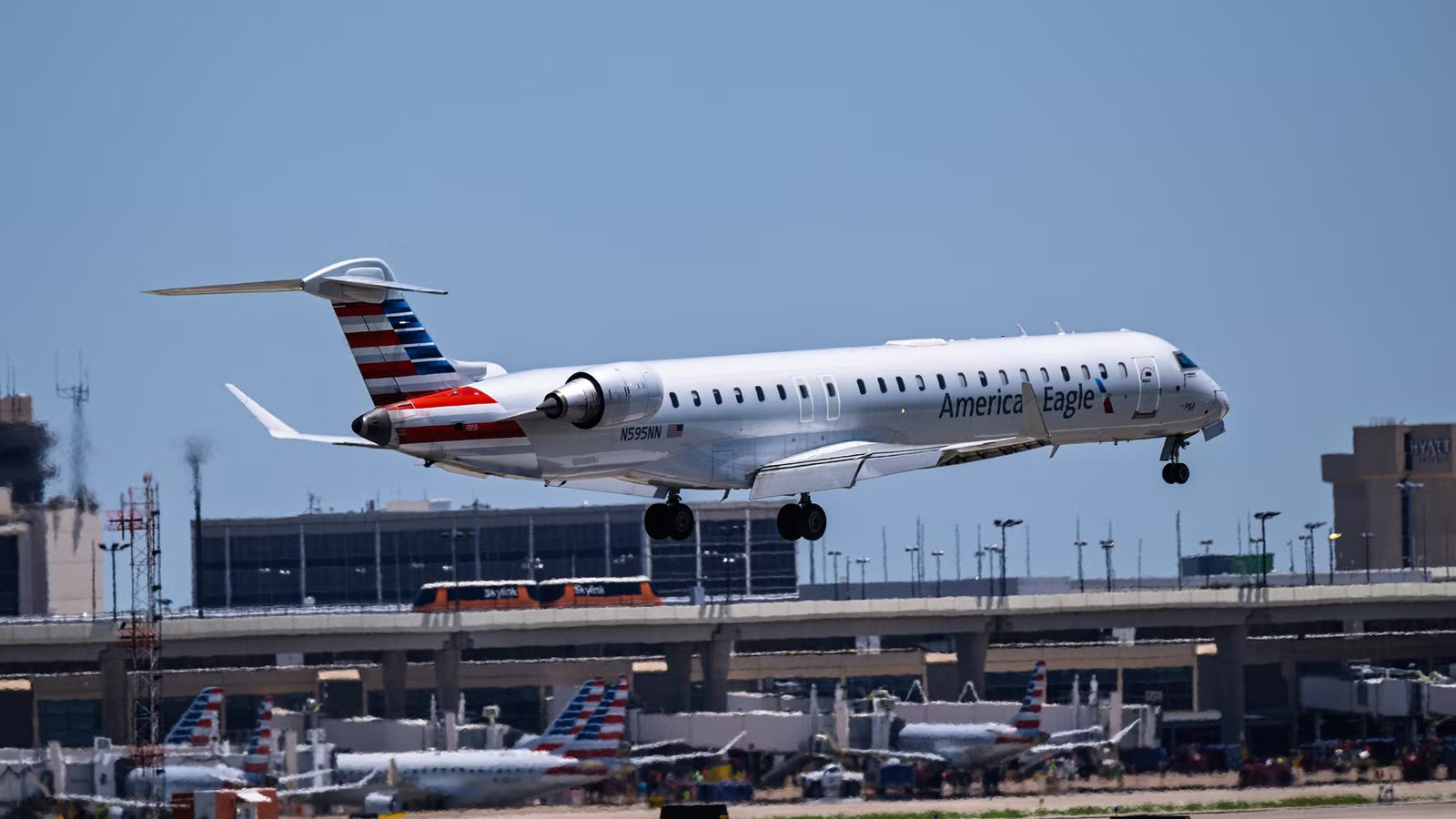
A regional airline is an airline contracted by a mainline carrier to operate small regional planes under their name. These include SkyWest Airlines, Republic Airways, Envoy Air, and Horizon Air in the US. Regional airlines typically carry passengers within the continental US, although they may also fly to some cities in Mexico and Canada. They also tend to fly to smaller, sometimes less populated cities to connect passengers to mainline hubs and other destinations.
A mainline carrier is one of the big airlines we’re mostly more familiar with, such as  American Airliness, Delta Air Lines, United Airlines, and
  Southwest Airlines. These airlines typically fly routes between their hubs in highly populated cities and to international destinations. Aircraft like the Boeing 737 and Airbus family operate short-haul routes, while aircraft like the Boeing 767, 777, and 787, and the Airbus A330 and A350, operate longer routes.
Mainline aircraft carry larger teams with more defined roles, such as the lead flight attendant, purser, and galley positions, which often accrue extra hourly pay. Regional jets usually seat between 50 and 75 passengers and have one or two flight attendants, and mainline aircraft have between three and ten-plus flight attendants depending on the size of the aircraft and number of passenger seats. Mainline aircraft have upward of 150+ seats. Many passengers don’t even realize that they have flown on a regional jet.
What Kind Of Schedule Do They Have?

The schedules are considerably different too. Regional flight attendants usually fly four or five short legs a day, which are short flights of 30 minutes up to two hours. This means duty days can be longer with more turnarounds and boarding, without boarding pay, which was recently introduced for most mainline flight attendants. There may be layovers in unusual destinations across the US that they don’t normally see.
Mainline crews typically fly no more than two or three sectors, and also include longer domestic routes and international trips, which regional crews generally don’t get. They will also fly to major cities and have extended trips and more time away from home. Their schedule will look much more exciting with worldwide trips than a regional schedule, but some flight attendants with families prefer to be home most nights.
The crew at regional airlines, including the pilots, tend to be young as they are gaining precious experience in order to move to major airlines. Working alone on a small aircraft can be quite lonely and stressful, with no colleagues to back you up during a busy service or if there is an emergency. However, some flight attendants prefer to work alone and enjoy being in charge of their own ship.
The Big Pay Question

Flight attendants working on regional jets earn significantly less than their mainline counterparts, and add-ons like boarding pay are almost non-existent. Mainline flight attendants earn almost double what regional attendants do and have stronger contract protections. Because pay is based on flight hours rather than total duty time, all those short legs add up to long days without much more pay. There is also a big gap in base pay. Some flight attendants say they prefer to work a ten-hour flight rather than four or five short flights.
The Association of Flight Attendants says regional flight attendants fly the same routes and do the same work as mainline crews, but often earn only half as much. According to Future Flight Attendant, some new hires barely clear $2,000 a month, while mainline senior flight attendants can make $10,000+ flying high-time trips.
The Association of Flight Attendants states: “The “regional” business model benefits executives and shareholders at Delta, United, American and Alaska by keeping pay and benefits for regional flight attendants horrifically low. Across our contract negotiations, we’re raising the standards for regional flight attendants by demanding boarding pay, work rule improvements, and double-digit pay increases to bring regional wages and workplace protections in line with those of mainline employees.“
The Pros And Cons Of Both

Regional jet bases are quite small and friendly, so they often have a close-knit, family-style crew base, whereas when working mainline, there are a larger number of flight attendants, and you may work with different crews every day. The all-important ‘seniority’ can be achieved faster at regional airlines, usually within one to three years, whereas at mainline airlines it takes much longer to achieve seniority. Also, less time will be spent on reserve at regional airlines. It is also easier to change bases.
The flight attendant job is notoriously hard to get as there is so much competition for roles. However, competition is lower at regional airlines, and the hiring process is thought to be slightly easier. The recruitment process for mainline crew is tougher, and more people want to work for the big airlines. Flight attendants at larger airlines are more likely to be furloughed than those at regional airlines.
For staff travel or non-revenue travel, mainline flight attendants have higher priority than regional flight attendants. They may be restricted to one airline, depending on the airlines’ agreements and code shares. Regional flight attendants may have multiple options for non-rev travel but may be restricted to destinations on their network.
The Bottom Line

Nearly one-third of scheduled passenger departures were operated by regional airlines in 2024, according to the Association of Flight Attendants. The hiring process for regional flight attendants is thought to be easier and less competitive than for mainline airlines, and most crew, including the pilots, are young. Pay is less than half of mainline flight attendants, although the Association of Flight Attendants is working to change this.
Mainline flight attendants earn more than regional flight attendants, work on larger aircraft on international routes, and have more layovers and longer trips. However, gaining seniority can take years, and the large airlines are more prone to furlough. They also spend longer on reserve early in their careers.
Many flight attendants view regional airlines as a faster entry point or stepping stone to gain experience before transitioning to higher-paying mainline carriers. Some may prefer working on regional jets because it means they are home most nights and can maintain a better family and home life. Ultimately, a flight attendant will choose the airline that works best for them, and it comes down to personal preference.
Catch what other trackers miss
Emergency squawks, holds, NOTAMs — live signals, no signup.
Open tracker
Catch what other trackers miss
Emergency squawks, holds, NOTAMs — live signals, no signup.
Open tracker