dailynewsnblog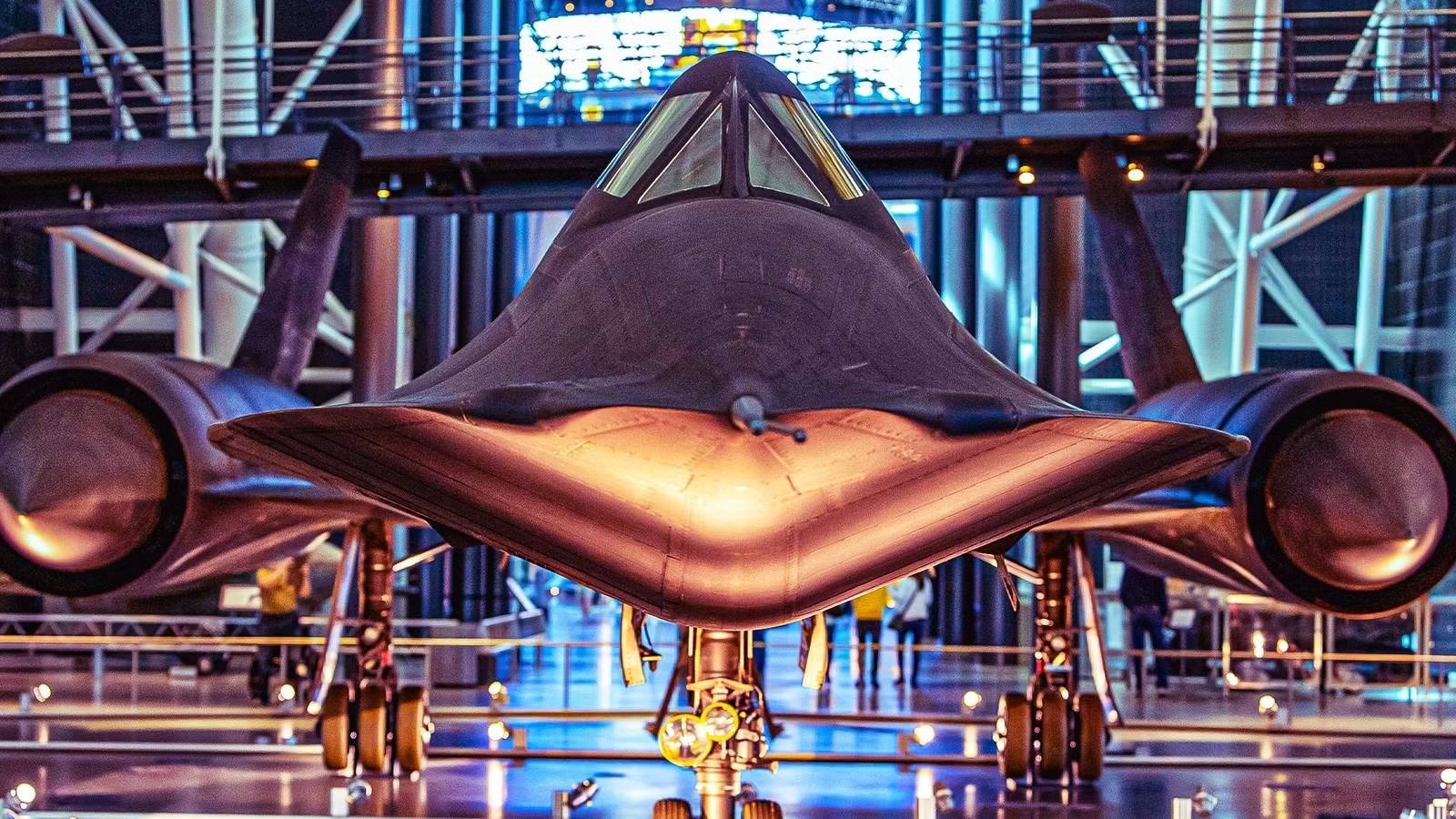
The Lockheed Blackbird family comprises 49 aircraft, including the A-12, M-21, YF-12A and SR-71 variants. Around a third (17–18) of them were lost to crashes from mishaps over the years. While thousands of Soviet and other missiles are reported by former SR-71 aircrews to have been fired at the Blackbird, no operational Blackbird was ever brought down by enemy action. As the SR-71 family was retired from use in the 1990s, they were demilitarized and donated to museums and set up as monuments.
Counting the precise number of aircraft on display is somewhat difficult. One preserved aircraft, the SR-71C, was assembled from the forward fuselage of one airframe and the rear fuselage of another following separate accidents, complicating any simple count of surviving aircraft. In addition, a handful of crash remnants are preserved as partial exhibits. Here is a guide to the dozens of Blackbird family aircraft that can still be visited across the continental United States, along with one surviving example in the United Kingdom.
The SR-71 Is Part Of A Larger Family

In total, some 32 SR-71s were built. These included 29 SR-71As, two SR-71Bs, and one SR-71C. The aircraft remained in service from 1968 until 1998, although it had been temporarily retired in 1989. By the time the aircraft were withdrawn from use, 12 of them had been lost to mishaps, and twenty remained. All of those twenty are preserved in museums around the United States (and the United Kingdom) today.
But even this is an incomplete story, as there were a number of pre-SR-71 Blackbird family aircraft, which are part of the larger SR-71 family. These include 15 A-12s, of which two were converted into M-21s, plus three YF-12A interceptor aircraft. The Lockheed YF-12 was developed from the A-12 as a high-speed interceptor for the US Air Force. Although the program was canceled after three aircraft were built, NASA later operated surviving examples for high-speed research.
The Lockheed A-12 looks similar to the SR-71 and was also a high-altitude, Mach 3+ reconnaissance aircraft. The Lockheed M-21 was a rare two-seat variant of the A-12 Blackbird family built as a “mothership” to carry and launch the supersonic D-21 reconnaissance drone. The Lockheed YF-12 was developed from the Lockheed A-12 as an interceptor aircraft for the Air Force and NASA. Three were built before it was canceled. This article covers every preserved member of the Blackbird family, including examples of each variant that can still be seen today.
The Original Lockheed A-12

The Lockheed A-12 was the first member of the Blackbird family and was developed for the CIA as a strategic reconnaissance aircraft. The CIA says, “CIA developed the highly secret A-12 OXCART as the U-2’s successor, intended to meet the nation’s need for a very fast, very high-flying reconnaissance aircraft that could avoid Soviet air defenses. CIA awarded the OXCART contract to Lockheed (builder of the U-2) in 1959.”
Lockheed built 15 A-12 airframes, two of which were converted into the M-21 drone-launch aircraft. Today, eight A-12s survive, along with one surviving M-21. One of these A-12s is on display outside the CIA Headquarters as a memorial. The spy agency says of this aircraft, “The A-12 on display at CIA Headquarters — number eight in production of the 15 A-12s built — was the first of the operational fleet to be certified for Mach 3. No piloted operational jet aircraft has ever flown faster or higher.”
The other surviving A-12s include Article 121 (60-6924) at Blackbird Airpark in Palmdale, California; Article 122 (60-6925) at the Intrepid Sea, Air & Space Museum in New York City; Article 124, the sole surviving two-seat A-12 trainer (60-6927), at the California Science Center in Los Angeles; Article 127 (60-6930) at the US Space & Rocket Center in Huntsville, Alabama; Article 130 (60-6933) at the San Diego Air & Space Museum; Article 131 (60-6937) at the Southern Museum of Flight in Birmingham, Alabama; and Article 132 (60-6938) at USS Alabama Battleship Memorial Park in Mobile, Alabama.
Surviving M-21 & YF-12 Variants

The M-21 is perhaps the most unusual member of the Blackbird family, being developed under the CIA’s Project TAGBOARD (canceled in 1966) to launch the Mach 3+ D-21 drone. Only two of these M-21 aircraft were built, of which only one, Article 134, survives (60-6941) at The Museum of Flight in Seattle. The other (60-6940) was lost in 1966.
The YF-12 (developed from the A-12) was one of the most capable interceptor prototypesever built. It served as the technological precursor to the Hughes AWG-9 radar and AIM-54 Phoenix missile system later fielded on the F-14 Tomcat. Only three examples were ever built, with the first flight taking place in 1963.
State with Blackbirds | SR-71A/B/C | A-12/M-21/YF-12A | State with Blackbirds | SR-71A/B/C | A-12/M-21/YF-12A |
|---|---|---|---|---|---|
Alabama | 3 (A-12) | Arizona | 1 | ||
California | 5 (not all open to the public) | 3 (A-12) | Florida | 1 | |
Georgia | 1 | Kansas | 1 | ||
Louisiana | 1 | Michigan | 1 (SR-71B) | ||
Nebraska | 1 | New York | 1 (A-12) | ||
Ohio | 1 | Oregon | 1 | ||
Texas | 1 | Utah | 1 | ||
Virginia | 2 | 1 (CIA HQ, not public) | Washington | 1 (M-21) | |
United Kingdom | 1 |
In 1971, Article 1003 (60-6936) was lost in an accident near California’s Edwards Air Force Base. The only surviving complete example is Article 1002 (60-6935) at the National Museum of the U.S. Air Force, Wright-Patterson AFB, Dayton, Ohio. Additionally, the third aircraft (60-6934) is partly on display at Hill Aerospace Museum in Utah. Its rear fuselage was later mated to the forward fuselage of a damaged SR-71 trainer to create the sole SR-71C.
SR-71As On Display On West Coast & Inland

Eighteen of the surviving SR-71 airframes are SR-71A variant aircraft. Starting with the West Coast, one is displayed in Oregon (61-7971) at the Evergreen Aviation & Space Museum, McMinnville. None are in Washington state, but several can be found in California. These include 61-7960 at Castle Air Museum, Atwater; 61-7973 at Blackbird Airpark, Palmdale; 61-7975 at March Field Air Museum, Riverside; and 61-7980 (NASA 844) at NASA Armstrong Flight Research Center at Edwards Air Force Base.
Catch what other flight trackers miss
Emergency squawks, holds, NOTAMs — live signals, no signup.
Open tracker
Catch what other flight trackers miss
Emergency squawks, holds, NOTAMs — live signals, no signup.
Open tracker
Additional examples exist in California at restricted locations such as Beale AFB and the Air Force Flight Test Museum at Edwards. Notably, in California’s Blackbird Airpark, it is possible to see the A-12, SR-71A, and the D-21 drone together. Going inland, Arizona has 61-7951 at Pima Air & Space Museum, Tucson. Texas’ Lackland AFB / Airman Heritage Museum in San Antonio has the Blackbird registered 61-7979.
Before crossing over to the South and Atlantic coasts, 61-7961 is on display at Cosmosphere, Hutchinson, Kansas, and 61-7964 can be found at the Strategic Air Command & Aerospace Museum, Ashland, Nebraska. Going to the real Midwest, Ohio’s National Museum of the United States Air Force in Dayton has 61-7976.
SR-71As On Display On Atlantic Coast & South

Virginia has two on display: 61-7968 at the Science Museum of Virginia in Richmond, and 61-7972 at the Steven F. Udvar-Hazy Center (Smithsonian) near Washington, D.C. The Smithsonian says of its SR-71, “On March 6, 1990, the service career of one Lockheed SR-71A Blackbird ended with a record-setting flight. This special airplane bore Air Force serial number 61-7972…
The Smithsonian adds, “The aircraft spent twenty-four years in active Air Force service and accrued a total of 2,801.1 hours of flight time.” In the Deep South, the only preserved SR-71A is 61-7967 at the Barksdale Global Power Museum, Barksdale AFB, Louisiana. As previously mentioned, other museums and memorials may exhibit parts of destroyed Blackbirds lost to mishaps.
The only preserved SR-71A found overseas is 61-7962 at the American Air Museum / Imperial War Museum, Duxford, Cambridgeshire, UK. That aircraft is famous for setting an absolute altitude record of 85,069 feet (25,929 meters) in 1976. It retired in 1990 after logging over 2,835 flight hours. The Blackbird was gifted to the United Kingdom in 2001 to honor past operations at RAF Mildenhall.
Preserved SR-71B & SR-71C Aircraft

Only two SR-71Bs were ever produced. Article 2007 (61-7956) survives at the Air Zoo in Kalamazoo, Michigan. This aircraft is notable as it served with NASA as 831 and was used for pilot training until the end of the Blackbird program. The second aircraft was Article 2008 (61-7957) and was destroyed in 1968 after a double generator failure and a dual engine flameout during approach to Beale Air Force Base (both crew members ejected safely).
After the loss of the SR-71B, Lockheed built the only SR-71C (61-7981). That aircraft was nicknamed ‘The Bastard’ and was unique as it was cobbled together from the rear fuselage of a crash-damaged YF-12A (60-6934) and the forward fuselage of the SR-71 static test airframe. The SR-71C is on display at Hill Aerospace Museum in Utah.
In all, the Blackbird family can be found around the country, although California has by far the most. California has a total of eight preserved Blackbirds (five SR-71As and three A-12s) at public museums like Castle, Blackbird Airpark, March Field, plus restricted-access examples at Edwards AFB / NASA Armstrong and Beale AFB.