dailynewsnblog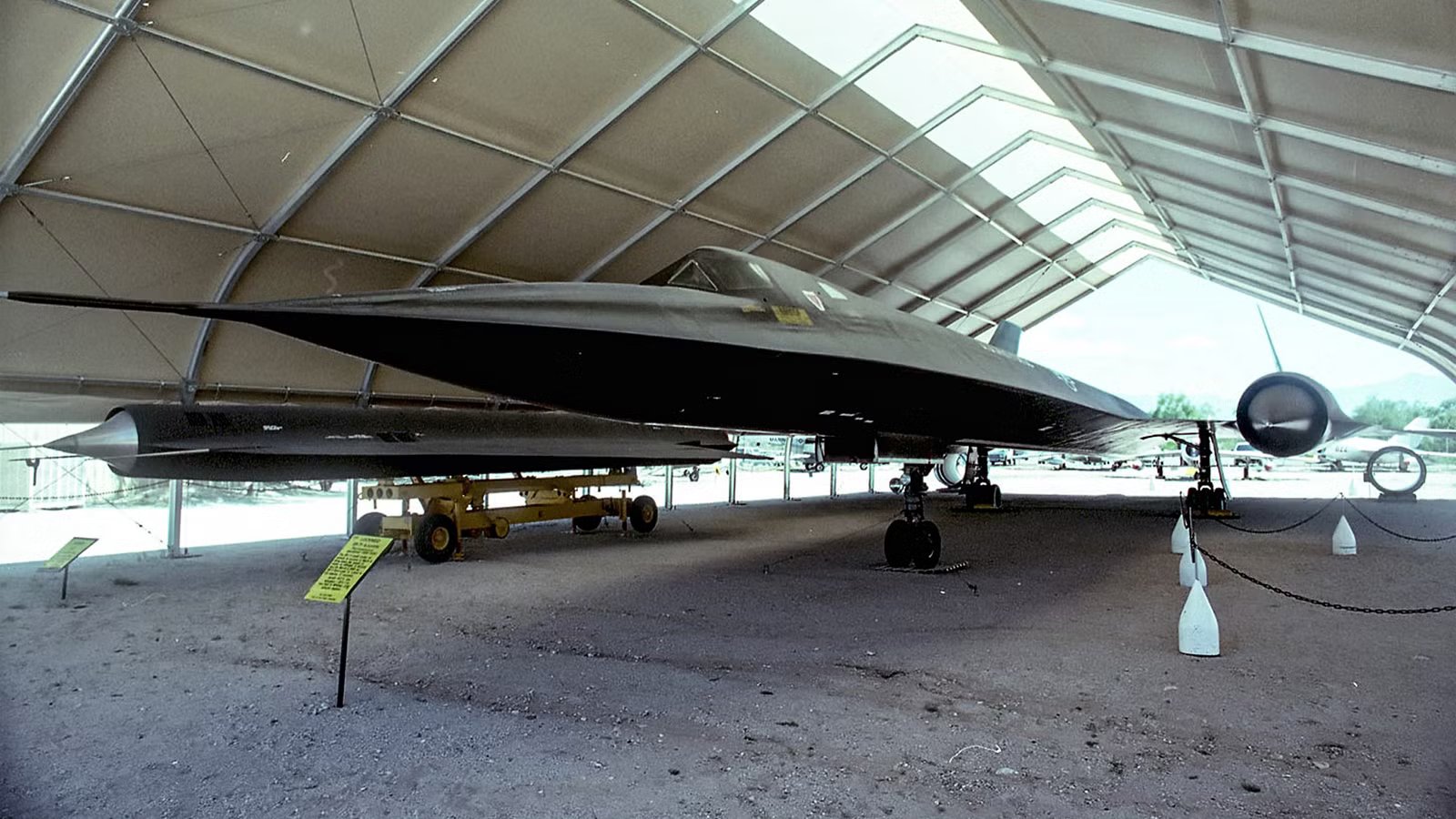
Lockheed A-12 Mothership

The Lockheed Skunk Works’ SR-71 Blackbird is one of the most famous spy planes ever built and was a marvel of Cold War engineering. It came with a service ceiling of 85,000 feet (26,000 meters) and at a maximum speed of Mach 3.3, enabling it to out-fly and out-run threats. It managed to succeed where other aircraft failed.
The North American XB-70 bomber failed in its strategic role as a high-altitude strategic bomber able to fly above (around 77,000 feet or 23,500 meters) and faster (Mach 3.1) than the anti-aircraft threats that existed when design work commenced. Soviet air defense was legacy flak-fire and jet fighters, but the development of surface-to-air air defense systems and the subsequent Lockheed U-2 Dragon Lady being downed in 1960 proved its vulnerability. Simultaneously, the development of ICBMs made it less imperative for the Air Force’s nuclear delivery.
But the SR-71 did not emerge in a vacuum. It was part of a larger family that included the predecessor Lockheed A-12 spy plane and the Lockheed D-21 reconnaissance drone. The A-10 included the M-21 two-seat variant that was designed to carry and launch the D-21 drone. It had a pylon on its back to mount the D-21. However, the M-21 program was canceled in 1966.
The Need For Lockheed D-21 Spy Drone

Before the Lockheed U-2 entered service, the US was almost completely in the dark about what was happening in the USSR. This was an age before satellites, and when sometimes the only strategic photos the US had of parts of the USSR were World War II photos taken by German reconnaissance flights.
The greater SR-71 program was the result of the USAF scrambling for a solution to conduct reconnaissance over the USSR following the shootdown of Gary Powers and his Lockheed U-2 in 1960. The US and CIA needed another solution to fly intelligence-gathering flights over particularly hostile territory. In the 1962 Cuban Missile Crisis, the U-2 highlighted both factors. It proved how valuable it was by being the asset that discovered the Soviets were moving nuclear missiles to Cuba and its vulnerability by being the only aircraft shot down during the standoff.
Lockheed built a total of 38 Lockheed D-21 high-altitude and high-speed spy drones for the CIA and US Air Force. The aircraft first flew in 1964 and was retired in 1971. As stated, it was a parasite autonomous aircraft designed to be carried on the back of an M-21 variant A-12 predecessor to the Blackbird.
Top 5 US Military Surveillance Aircraft That Made History
The legacy of the US military developing some of the world’s most iconic and successful surveillance aircraft looks set to continue into the future.
The Lockheed D-21’s Performance

The D-21 had a maximum speed of over Mach 3.3 and an operational altitude of 90,000 feet (27,000 meters). Some sources say it reached 95,000 feet (29,000 meters). The National Museum of the United States Air Force says, “The Lockheed D-21 was a highly-advanced, remotely piloted aircraft (RPA) designed to carry out high-speed, high-altitude strategic reconnaissance missions over hostile territory.” The D-21 was powered by the RJ43-MA20S-4 ramjet.
This was also a period before digitalization, and so the physical film had to be retrieved and developed. This was also a period before aircraft could be effectively remotely operated and landed like today’s MQ-9 Reaper drones. Consequently, the D-21’s route and mission were all pre-programmed. It would take photos with its high-resolution photographic camera over a pre-programmed path.
|
Lockheed D-21 reconnaissance drone (per USAF Museum) |
|
|---|---|
|
Number built |
38 |
|
Powerplant |
Marquardt RJ43 ramjet of 12,000 lbf |
|
Max speed |
Mach 3.3 |
|
Service ceiling |
Approx. 95,000 feet (28,956 meters) |
|
Retired |
1971 |
Once complete, it would release the camera module for retrieval, after which the drone itself would self-destruct. This made the drones expensive single-use aircraft, while the retrieval of the module with the film was often difficult. Manned aircraft, like the Lockheed U-2 and SR-71 Blackbird, were able to be flown by their pilots back to a US Air Force base. It wasn’t until the late 1980s or even early 1990s that the US was able to achieve practical digital/electro-optical (EO) image transmission from its spy aircraft, making the retrieval of physical films obsolete.
The Failure Of The D-21

The first successful in-flight launch came in March 1966 and was followed by two failed launches that year. The March Field Air Museum says that a hydraulic failure caused the loss of the drone on the second mission, and the failure of the electronics module failed to release during the third test. At first, the issues appeared to be minor deficiencies, and tests continued despite designer Kelly Johnson’s concerns over the risks of the complex system.
In July 1966, Johnson’s worries were validated when the D-21 engine failed immediately after separation during the fourth flight test. This caused the drone to veer to the right of the mothership. The result was catastrophic, breaking off the forward fuselage section of the M-21 mothership at a speed of Mach 3. Fortunately, both pilots were able to bail out, although only one survived, as LCO Ray Torick was severely injured during the bailout and drowned before rescue.
This was enough to force Lockheed to abandon the idea of launching the drone with an A-12 supersonic aircraft. Instead, they pivoted to launching it from a subsonic B-52H bomber. Since entering service, the B-52 has proven to be a popular aircraft for launching parasitic aircraft, like the North American X-15 rocket airplane.
How Many U-2 Spy Planes Were Built?
Around a third remain in operation today with the USAF and NASA.
The D-21B Launched From B-52s

Following the failure of the A-12 mothership concept, Lockheed modified the D-21 into the D-21B by adding a solid rocket booster under the drone to propel it over Mach 2 for initial engine start. The US military has a long history of developing parasitic aircraft to launch from motherships. One of the most remarkable (and forgotten) is when the US Navy built two massive Akron-class airships as flying aircraft carriers to launch F9C Sparrowhawk biplanes. Both crashed soon after entering service.
The D-21B was also modified to fit under the wing of a B-52 Stratofortress bomber. While it was safer, the program remained plagued with engineering problems. The United States Air Force Museum puts it this way: “D-21Bs were used on four flights over communist China under the code name Senior Bowl, but none of these missions fully succeeded. The U.S. Air Force canceled the program in 1971 and put the remaining D-21s in storage.”
All four operational missions took place under the name Senior Bowl and were part of the US’s efforts to spy on Communist China’s Lop Nor nuclear test site. These spy missions typically took off from the US’s Andersen Air Force Base on the island of Guam. Lop Nur is located in China’s remote far western Xinjiang region and was used for nuclear testing. China’s first nuclear bomb test took place in 1964 at this site, with the first hydrogen bomb test occurring in 1967.
The D-21B’s Four Operational Missions

The D-21D did enter operational service, but essentially failed as a functional information-gathering platform. Only four operational missions were flown. All four missions were over Communist China between 1969 and 1971. The first flight suffered from a D-21 guidance system malfunction that caused it to fly through China and crash into the Soviet Union. The KGB was able to recover the wreckage. The second flight went smoothly until the electronic module recovery system was damaged during ejection.
The museum says that the module fell and sank “to the bottom of the sea.” The third flight was comedic; the flight went flawlessly, but the US Navy ship that was dispatched to retrieve the module accidentally rammed it and sank it. The fourth and final D-21B operational flight malfunctioned and crashed somewhere in China’s Gobi Desert.
It is also worth noting that at this time, the US recognized the Republic of China (aka Taiwan) as the legitimate government of China. This only changed in 1979 when the US recognized the PRC government based in Beijing, which was actually in control of the vast majority of the country. Before that, the US, including the CIA, worked closely with authorities in Taiwan to conduct reconnaissance missions deep into the Mainland. A number of CIA Lockheed U-2s were flown and officially owned/operated by Taiwan (namely, its Black Cat Squadron, 35th Squadron), with several known to have been downed over China.