dailynewsnblog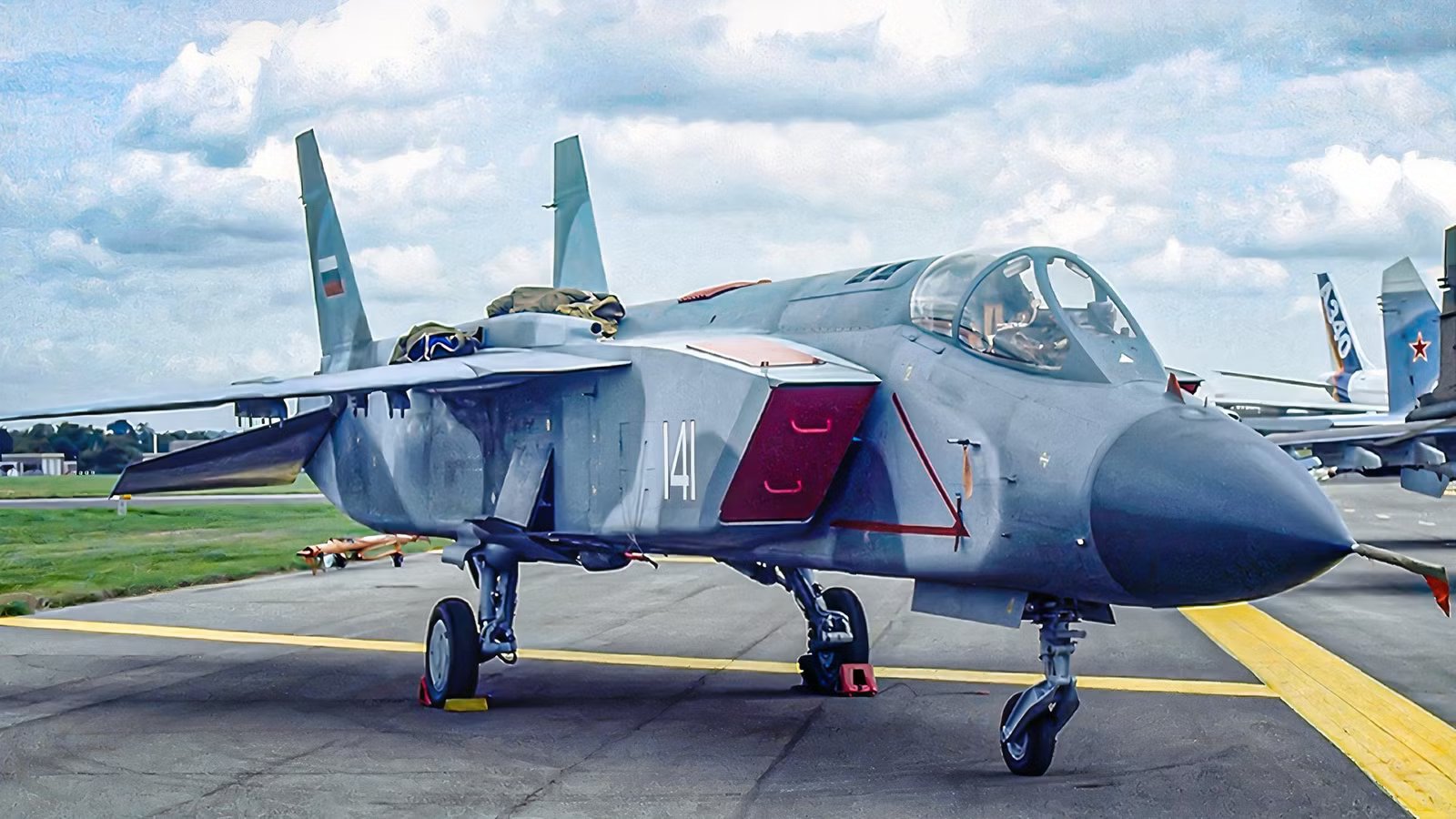
The Lockheed Martin F-35 Lightning II program represents a major leap in combat aviation, combining advanced sensors, software, and stealth capabilities into a single platform. The aircraft has proven itself in combat and has become a global success, with numerous allied nations participating in the program.
The F-35B short takeoff and vertical landing variant, operated by the United States Marine Corps (USMC), features a swiveling exhaust nozzle and a shaft-driven lift fan that enable short takeoffs and vertical landings (STOVL). This capability not only sets it apart from most other fighters, but also provides the Marines with organic air support from forward-deployed Marine Expeditionary Units (MEUs) operating from amphibious assault ships and austere shore bases.
While the aircraft represents a remarkable feat of aeronautical engineering, some have argued that the F-35B’s propulsion system is based on stolen Soviet plans or is simply a copy of the Yakovlev Yak-141. Although this is a compelling narrative, it oversimplifies the history and overlooks significant differences between the propulsion systems of the F-35B and the Yak-141. There is little dispute that Lockheed benefited from access to technical data generated during the Yak-141 program through its partnership with Yakovlev in the 1990s. However, the two aircraft remain fundamentally different in both propulsion design and overall capability.
The Ascendance Of Carrier Aviation And A Prelude To The Yak-141

During World War II in the Pacific theater, the aircraft carrier became the centerpiece of naval power projection, providing long-range patrol, air superiority, and ground attack capabilities from a single hull. So important was the carrier that shipyards in the United States (US) produced 24 Essex-class carriers between 1941 and 1945. These vessels had a full-load displacement of approximately 36,380 long tons (36,970 metric tons) and could accommodate around 90–100 planes. It was the capabilities of these carriers, together with their escorting vessels, that enabled the US Navy and Marine Corps to conduct their island-hopping campaign across the Pacific and wrest control of this vast ocean from the Imperial Japanese Navy.
The Soviet Union did not join the fixed-wing aircraft “carrier club” until 1975 with the introduction of the Kiev-class carriers, four of which eventually entered service. These ships could accommodate up to 12 STOVL-capable Yak-38 fighters, along with 12–20 helicopters. Its primary intended missions included fleet defense, reconnaissance, and strike operations against enemy ships.
While the Yak-38 could operate from a short-deck carrier and land vertically, its limited capabilities significantly constrained its combat potential. The most glaring issue was its lack of an onboard radar. This drastically limited its ability to function as an effective fleet defense fighter, particularly in poor visibility or beyond-visual-range engagements. In air-to-air combat, its armament was primarily limited to R-60 heat-seeking missiles, which were short-range, within-visual-range weapons rather than long-range interceptors.
For ground attack missions, the Yak-38 featured four underwing hardpoints that could carry bombs and unguided rockets. Its maximum bomb load ranged from approximately 1,000 to 2,000 pounds (450–900 kilograms), depending on the mission configuration, and was generally lower than that of later Western STOVL strike aircraft such as the Harrier, particularly when accounting for fuel and range requirements.
The Yak-38 was withdrawn from active service between 1992 and 1993, and a total of 231 airframes had been manufactured by the time production ended in 1988. The Yak-38’s shortcomings heavily influenced the design modifications in its intended successor, the Yak-141, which was conceived to provide the Soviet Navy with a far more capable fleet defense fighter.
The Rise And Fall Of A Potential Game Changer For The Soviet Fleet: The Ill-Fated Yak-141

The Yak-38 certainly had serious limitations, and it was fortunate that a Soviet naval task force was never tested against a capable adversary. Had it faced a modern carrier air wing, the Yak-38 would likely have proved a poor fleet defense fighter, leaving the task group’s protection largely dependent on its surface-to-air missile defenses. It was for this reason that the Yak-141, while not a direct replacement for the Yak-38, formed part of a broader Soviet push during the 1970s and 1980s to explore the next generation of naval aviation concepts.
The Soviet leadership officially initiated development of a new fleet defense fighter on June 26, 1974. By late December 1989, the Yak-141 prototype made its first hovering test. The following June, the aircraft accomplished a full transition from vertical to horizontal supersonic flight, an unprecedented feat for a jet in its class. During continued flight testing, the Yak-141 set 12 world records, and on September 26, 1991, it completed its first successful landing aboard the aircraft carrier Admiral Gorshkov.
While the Yak-141 was making remarkable progress and demonstrating the engineering prowess of the Soviet Union, on October 5, 1991, one of the prototypes suffered a hard landing on the same carrier, ruptured a fuel tank, and was engulfed in flames. This accident, coupled with the political instability, economic collapse, and military turmoil engulfing the Soviet Union, conspired against the Yak-141. With military funding effectively evaporating, the aircraft—and with it the potential future of Russian naval aviation—was put on ice permanently in October 1991.
Some Say The Spirit Of The Yak-141 Lives On In The F-35B

With the dissolution of the Soviet Union, Yakovlev was struggling to keep its Yak-141 program afloat. It was at that time, as relations between Russia and the West thawed and security restrictions eased, that Lockheed entered the picture. As Yakovlev floundered—reportedly unable to afford fuel for its prototype—Lockheed reportedly provided between $300 and $400 million (~£238- £318 million) to support continued testing and development of the aircraft. While Lockheed had little interest in seeing the Yak-141 enter serial production, it was certainly interested in the program’s technical data.
In return, Yakovlev received much-needed funding, while Lockheed gained access to years of flight-test results and engineering experience, likely saving the company years of costly trial-and-error on its own STOVL program, which ultimately became the F-35B. One area of particular interest was the Yak-141’s thrust-vectoring nozzle. The aircraft’s main engine featured a three-bearing swivel nozzle made up of three rotating sections that turned in opposite directions, allowing the exhaust to be vectored downward by up to 95 degrees in just a few seconds.
Some commentators have suggested that Lockheed simply copied the design, implying that the F-35B is powered by a “Russian engine.” This is both misleading and an oversimplification. The Yak-141 is powered by one primary engine and two dedicated lift engines, whereas the F-35B Lightning II uses a Rolls-Royce shaft-driven lift fan—an architecture with no direct Soviet equivalent.
Although the F-35B’s three-bearing swivel module (3BSM) also vectors the engine’s exhaust, it operates in conjunction with the forward lift fan and wing-mounted roll-control nozzles. The entire propulsion system is also coordinated by a highly sophisticated digital flight-control system.
The Necessity Of Short Takeoff Vertical Landing Aircraft For Expeditionary Operations

The USMC, affectionately called Uncle Sam’s Misguided Children, has always been an expeditionary force by nature. To rapidly respond to crises around the globe, the President of the United States can rely on the Marine Corps’ multifunctional MEUs. These are self-contained, mission-ready operational groups composed of roughly 2,200 Marines. A single MEU consists of command, ground combat, aviation, and logistics elements. An MEU is typically transported aboard three amphibious assault ships, which together form an Amphibious Ready Group (ARG).
The USMC maintains seven MEUs: three based on each coast of the United States, while the 31st Marine Expeditionary Unit is home-ported in Okinawa, Japan. At any given time, several MEUs are in training or conducting a “work-up” in preparation for deployment, while others are forward deployed and ready to respond to crises at short notice. Typical missions undertaken by an MEU include:
- Amphibious assault operations
- Amphibious raids
- Air assault and vertical envelopment operations
- Noncombatant evacuation operations
- Humanitarian assistance and disaster relief
- Crisis response and contingency operations
- Maritime security operations, including counter-piracy and maritime interdiction
When called upon to conduct these missions, the ground combat element of an MEU can rely on organic close air support from a uniquely designed amphibious assault ship that functions as a miniature aircraft carrier. Designated a Landing Helicopter Assault ship, it operates a mix of helicopters, tiltrotor aircraft, and typically around seven F-35Bs. When deployed with an MEU, these fighters can rapidly establish local air superiority, provide electronic warfare capabilities, and deliver devastating firepower in support of Marines operating ashore.
F-35B: General Specifications | Related Data |
|---|---|
Length | 51.2 ft / 15.6 m |
Speed | Mach 1.6 |
Wingspan | 35 ft / 10.7 m |
Wing Area | 460 ft² / 42.7 m² |
Combat Radius (Internal Fuel) | >450 nautical miles / 833 km |
Range (Internal Fuel) | >900 nautical miles / 1,667 km |
Internal Fuel Capacity | 13,100 lb / 5,942 kg |
Max G-Rating | 7.0 |
Weapons Payload | 15,000 lb / 6,800 kg |
Propulsion | 1x Pratt & Whitney F135-PW-600 Engine |
Thrust* | 38,000 lb max / 26,000 lb mil / 40,500 lb vertical * Maximum Power (Max) = With Afterburner Military Power (Mil) = Without Afterburner |
Unlike traditional aircraft, which are required to operate from large air bases and may need aerial refueling for round-trip flights to and from a combat zone, the vertical lift capability of the F-35B enables strikes and support to be conducted much closer to the engagement zone. The ability to operate from damaged runways, austere forward locations, and amphibious assault ships reduces the need for aerial refueling and has the potential to significantly increase sortie generation.
The F-35B’s combat utility was first demonstrated on September 27, 2018, during operations in Afghanistan in support of Operation Freedom’s Sentinel. In this mission, F-35Bs from Marine Fighter Attack Squadron 211 (VMFA-211), operating from the amphibious assault ship USS Essex, conducted close air support and strike missions against Taliban targets in support of ground forces. This marked the first combat employment of the F-35B.
The F-35B Is A Core Capability That Will Remain With The USMC For Years To Come

The F-35B and the Yak-141 bear a striking resemblance in their vertical lift capability. However, that is where the resemblance ends; the two planes differ significantly in the functionality of their propulsion systems and their overall technological advancement. The F-35B is a unique and advanced combat aircraft whose propulsion architecture and much of its engineering originated independently within the Lockheed Martin program.
The F-35B has been so successful in supporting the mission of the USMC that, according to the 2025 Marine Corps Aviation Plan, the Corps intends to procure a total of 280 F-35Bs. Further, the Marines intend to operate 205 F-35B and 56 F-35C airframes by the end of 2026. The addition of the F-35C provides the Corps with greater range, increased payload capacity, and more dispersed operational options, thereby reducing risk. With its unique capabilities and versatility, the F-35B is expected to remain a core element of USMC combat air support in the coming years.