dailynewsnblog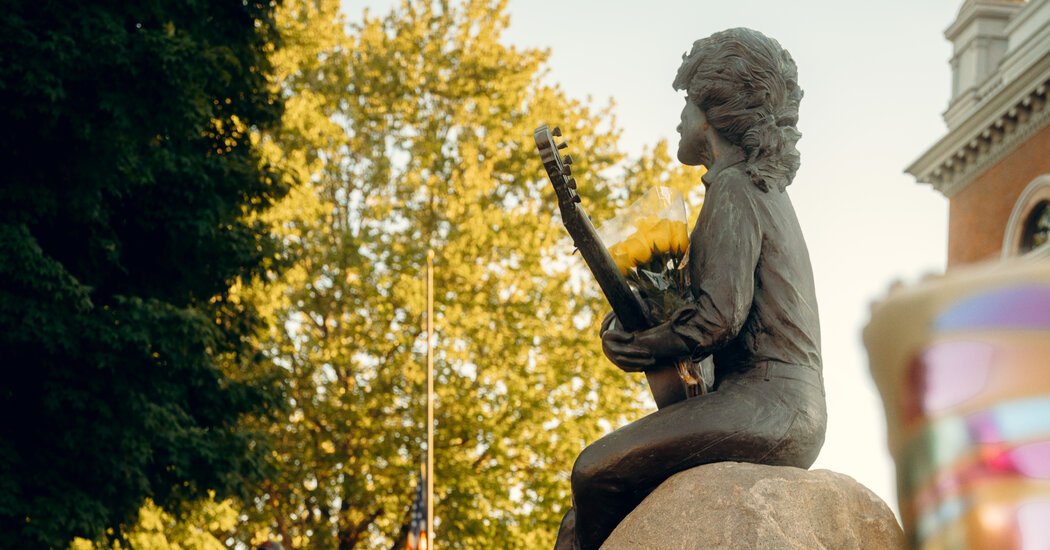
The unmistakable likeness of Dolly Parton — with bright eyes and hair reaching for heaven — has been immortalized on murals in Nashville. She has been emblazoned on official state license plates on minivans cruising toward Knoxville. And she has been sculpted in bronze outside the courthouse in Sevierville, the little Tennessee town in the Smokies where the legend began.
She inspired drag brunches in Atlanta and a Mardi Gras club in New Orleans, where crowds would put on wigs and boas and sequins in an effort to be just a little more like her.
In the South, where she was born and raised and steeped in long traditions of storytelling and self-deprecating humor that she harnessed into a singular career, Ms. Parton ascended from successful singer and actress into a figure larger than life.
Since her death on Tuesday at age 80, many of her fellow Southerners said they were not simply mourning an icon. They were mourning one of their own.
“She loved this area and she was proud of it, and we saw ourselves differently because of her,” said Regina Murray, who lives in Knoxville, Tenn., and grew up near the Sevier County line. “I think it gave each of us a sense of, we’re good enough, we’re OK.”
Beyond the South, in a country and culture splintered into countless silos organized by race, partisan affiliation, class, religion, generation, sexual orientation and gender identity, Ms. Parton has been recognized as a rare individual who engendered affection and respect across many of those lines.
She could sometimes test the limits of that bond, taking stances that many in the South might object to. Yet it still endured.
“She would challenge you to not love her,” said Scott Borchetta, the president and chief executive of Big Machine Label Group, which helped distribute her recent rock album. “There was no way that you were not going to love Dolly Parton.”
Ms. Parton’s fans in the South idolized her for all the ways she was exceptional — the musical talent, the charisma, the altruism. Yet so much of the love was also grounded in a sense that she wasn’t all that different from them either.
She shared an accent and a sense of humor. Like many Southerners, she embraced her faith, which for her was a form of Christianity anchored in love. She appreciated a pork roast, especially the fatty part.
And even as her gifts and her work ethic opened a broader world to her, she always came home.
“Dolly was our royalty in the South, and Dolly was the person that I think everyone aspired to be, who everyone respected and everyone understood,” said David Steele Ewing, a historian and tour guide in Nashville. “A lot of Dolly was the hair and the makeup and the rhinestones. But the real Dolly was the voice, the generosity and the kindness to everybody, no matter who they were.”
Some believed that finding wider success as a Southerner often required a devil’s bargain: “You can either be Southern or you can be smart and successful,” said Landon Bryant, a devoted fan of Ms. Parton’s who lives in Laurel, Miss., and has built a career as a social media influencer, performer and author with his interpretation of Southern culture and customs.
Other celebrities softened their accents or took on a more polished look, while some surrendered to the caricature. She carved another path.
“With everything she did,” Mr. Bryant said, “she was just like, ‘This is who I am, and I’m going to be as big as I can be,’ and was so unapologetic about it, while at the same time loving on everybody.”
She took a firm hand in the mythmaking, mindful of everything stamped with her name and associated with her reputation. She also walled off much of her personal life from the public, particularly her long marriage with her husband, Carl Dean, who died last year at 82.
Her death has prompted a sprawling endeavor to assess the vast reach of her legacy, which encompasses dozens of albums, classic Southern films like “Steel Magnolias,” and inspirational fare informed by her faith, her theme park, frozen foods and beauty products. The enduring appeal of films like “9 to 5,” Beyoncé’s cover of Ms. Parton’s song “Jolene” and collaborations with newer artists ingratiated Ms. Parton with younger audiences.
She has been lauded for her abilities as a songwriter: She was not only wildly prolific, but she also knew how to tell a story, capturing the character and the struggles of the world she grew up in.
She was a philanthropist, with projects like the Imagination Library, using the lesson of her father’s illiteracy to help thousands of students improve their reading. She donated millions of dollars for disaster relief and vaccine research at Vanderbilt University.
She was also a one-woman economic engine. By attracting tourists to the hills of Eastern Tennessee with ventures like Dollywood, her theme park, she brought opportunity to a place that had been starved of it.
“Our livelihoods are the way they are because of her,” said Hannah Sanderson, who owns a scrapbook store in Sevierville and whose husband has a second job at Dolly Parton’s Stampede, a dinner theater in nearby Pigeon Forge.
Still, the sum of Ms. Parton’s accomplishments does not quite account for the scale of the adulation or the magnitude of the loss many are just now starting to reckon with.
“I don’t know how to say it — I’m still in shock,” said Darlene Williams, who was visiting Dollywood on Tuesday from Inglewood, Ill., and wearing a T-shirt with a collage of images from across Ms. Parton’s career. “I’ve loved Dolly since I was itty bitty. I feel like I know her, even though I know that sounds silly, because I don’t.”
Ms. Williams expressed a common sentiment — a feeling that the love was mutual.
That was especially true for people who said that their relationship with home had been complicated by the ingrained biases and animosities that tested the limits of Southern hospitality.
When the Mardi Gras social organization called the Krewe of Dolly was formed in New Orleans in 2020, one of the first parades it participated in was a gay pride event. Some in the krewe remembered people in the crowd approaching them in tears.
“There was that much joy,” said Annie Wentz, a science writer and editor who is one of the group’s founding leaders. “It’s because of Dolly, it’s not us. We were just emulating her.”
Ms. Parton navigated political and social fault lines largely by hovering above them. She turned down offers of the Presidential Medal of Freedom from President Trump and from Joseph R. Biden Jr. She would swat away the suggestion that she was political.
Still, in her own way, she was.
As the gay community made strides toward acceptance, she joked that if she had not been born a woman, she would have been a drag queen — a cherished nod of recognition. She voiced support for L.G.B.T.Q. rights and discouraged others from using their Christian faith as a justification for condemning that community.
“She helped me feel that being gay was OK, that I wasn’t going to hell,” said Jacob Stanberry, a high school color guard instructor and massage therapist in Knoxville. “It’s not just the style and the wigs and the glamour.”
As racial justice protests erupted in 2020, she acknowledged demonstrators’ frustrations and their desire to be seen and heard. “And of course Black lives matter,” she told Billboard magazine.
And some Christian conservatives saw her message of loving thy neighbor as extending to them, too, even as they felt like they had been ostracized by secular culture because of their beliefs.
She did not emerge from cultural conflicts entirely unscathed.
Some conservatives said she had distorted Christian teachings by referring to her faith in embracing the L.G.B.T.Q. community. Some also accused her of submitting to cancel culture when she renamed the Dixie Stampede in 2018; she said it made sense to avoid offending people.
Conversely, others sometimes questioned if she had not gone far enough in using her platform to make more explicit political stands.
But some of her fans argued that her deliberate approach had given her more influence, meaning even a measured statement could have a rare and far-reaching resonance.
“I think we all agreed on Dolly,” said Catherine McTamaney, a Vanderbilt University professor.
Ms. Parton’s representatives have said her funeral will be small and private. But in a region with a proud and elaborate culture of celebrating life, some have been pondering and planning how to memorialize Ms. Parton on their own.
Performers at the Grand Ole Opry and other music venues are organizing tributes. The Krewe of Dolly is putting together a second line, a defiantly jubilant funeral tradition in New Orleans, for Sept. 5, or 9/5 — a nod to her song and film “9 to 5.”
There are many, though, who still cannot quite conceive of a South without her living and working in it.
“She still had so much to do in her life,” Mr. Ewing, the historian, said.
She will undoubtedly endure through her body of work, her fans say. But some believed she had left them with an assignment, as another way for her to carry on: Try to be like her.
As Mr. Bryant, who had met her a few times in recent years, saw it, work hard like she did, he said. Lead with kindness, like her. And take pride in places that can sometimes be difficult to be proud of.