dailynewsnblog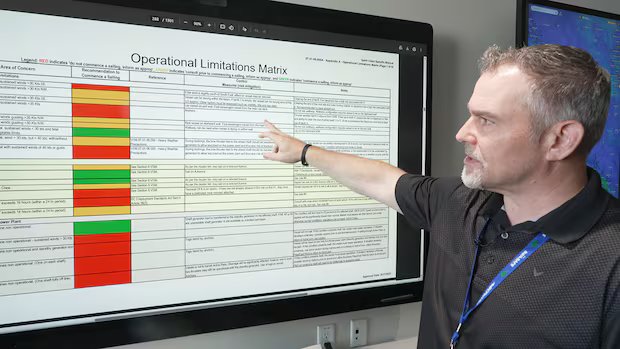
It’s the notification that every ferry traveller dreads: sailing cancelled due to weather conditions.
To a stranded commuter, this message can ruin a whole weekend or worse. For many people living on the coast, ferries are a vital lifeline.
The process behind cancelling sailings due to weather is a high-stakes calculation that involves a high-tech nerve centre, a 28-year navy veteran and a strict mathematical matrix designed to survive the volatile waters of the Salish Sea.
It all happens in the B.C. Ferries Operations and Security Centre, which is run by Jason Boyd. He’s not your average transit manager. He spent 28 years in the Royal Canadian Navy commanding a warship and running a military base before taking the helm of the command centre.
The dimly-lit room in Victoria operates 24 hours a day, 365 days a year, and is lined with massive monitors displaying real-time radar, wave-height charts and live vessel tracking.

“I found that the transition was pretty natural,” Boyd said. “You walk into work every day, you never know what’s going to happen. Things can go from zero to 100 in one phone call here. My mariner background is very translatable. Life at sea is life at sea, and the challenges at sea are the same for people on frigates or ferries.”
Operations limitation matrix
His team’s mission is total situational awareness. Under the Canada Shipping Act, the final say always belongs to the ship’s captain, who can override a corporate green light based on what they see in front of them.
But they don’t work alone. When a Pacific storm approaches, the operations centre bridges the gap between raw weather data and the vessels on the water.
Often, they work with Environment and Climate Change Canada to figure out the forecast on specific routes.
“We’ve got them on speed dial,” Boyd said. “They know when there’s a system coming up, we’re going to be calling.”
B.C. Ferries uses a strict, colour-coded framework tailored to each vessel’s individual limits to translate those forecasts: the operations limitation matrix.

Green: The weather poses no risk; the vessel sails.
Red: Docking is unsafe or stability is at risk; the ship stays tied up.
Orange: Weather conditions are right on the edge of a safe call. This is where real-time observations and human experience come into play.
Sea versus the docks
Making that call requires balancing ship design, sea conditions and the physical limits of concrete docks.
“Tsawwassen is a really good example. It’s probably one of our more exposed terminals,” Boyd said.
“In the winter we often get pretty strong southeasterly winds there. Depending on the direction of the tide as well, if it’s running with the tide, that amplifies things. If it’s bucking against the tide, that introduces different challenges.”

The Salish Sea is one of the most unpredictable marine environments on the planet, yet the ‘go, no-go’ decision for a B.C. Ferries route often feels like a black hole to the public. It turns out the process behind the call is a high-stakes calculation involving a 24/7 nerve centre, a strict mathematical matrix and decades of human seafaring experience. CBC’s Johanna Wagstaffe pulls back the curtain.
Different hulls react to those forces uniquely. A massive Spirit Class vessel has a completely different power configuration and handles differently than a Coastal Class vessel, which has less “sail area” exposed to the wind.
This creates a paradox that can frustrate passengers —conditions can be calm at the terminal, but the open transit across the Strait of Georgia is raging or the open ocean crossing is completely safe, but the surge at an exposed dock makes docking too dangerous.
“We’re always trying to find that balance,” Boyd said.
Human experience
B.C.’s coast is notoriously complex—a dynamic collision of ocean, mountains and rivers that creates funneling winds, trapped fog and dramatic temperature drops over very short distances. Because high-confidence, long-range forecasts are rare in this region, B.C. Ferries relies on local knowledge when technology hits its limit.
“Sometimes the forecast is wrong,” Boyd said. “The models will say one thing, the senior marine forecaster will say the same thing, and then our captains will observe something completely different when they’re out there. So, it is a science, but it’s not an exact science.”

He said it’s the centre’s job to support ferry captains when they make a decision and communicate with customers.
“We don’t like to cancel if we don’t have to.”
But a changing climate is bringing more frequent, violent wind events to the coast, pushing an aging fleet to its limit. According to the Intergovernmental Panel on Climate Change, large-scale climate change is expected to interact with regional topography and land-water contrasts to create shifts in atmospheric “circulation patterns” in the Pacific Northwest.
B.C. Ferries president and CEO Nicolas Jimenez said more modern ships may help.
“In theory, these ships are going to run not just more efficient from a fuel economy perspective, but they’re also going to have higher tolerances in terms of what they can withstand when it comes to the combination of wind and waves and tides,” he said.
The sea gets the final say
Back in the operations centre, Boyd watches the screens as low-lying marine clouds threaten to move in. He hopes the public understands the immense, calculated effort that goes into every single cancellation.
“It’s not as easy as just looking out the windows,” Boyd said. “We’re very rarely surprised by things, even though it may seem like we’re making decisions at the last minute, because our hope is to try and continue the service as much as possible.”
Forecasts will sharpen and new ship designs will improve resilience against the elements. But on this rugged coast, sometimes the sea has the final say — and the crew in the operations centre is entirely OK knowing that to be true.