dailynewsnblog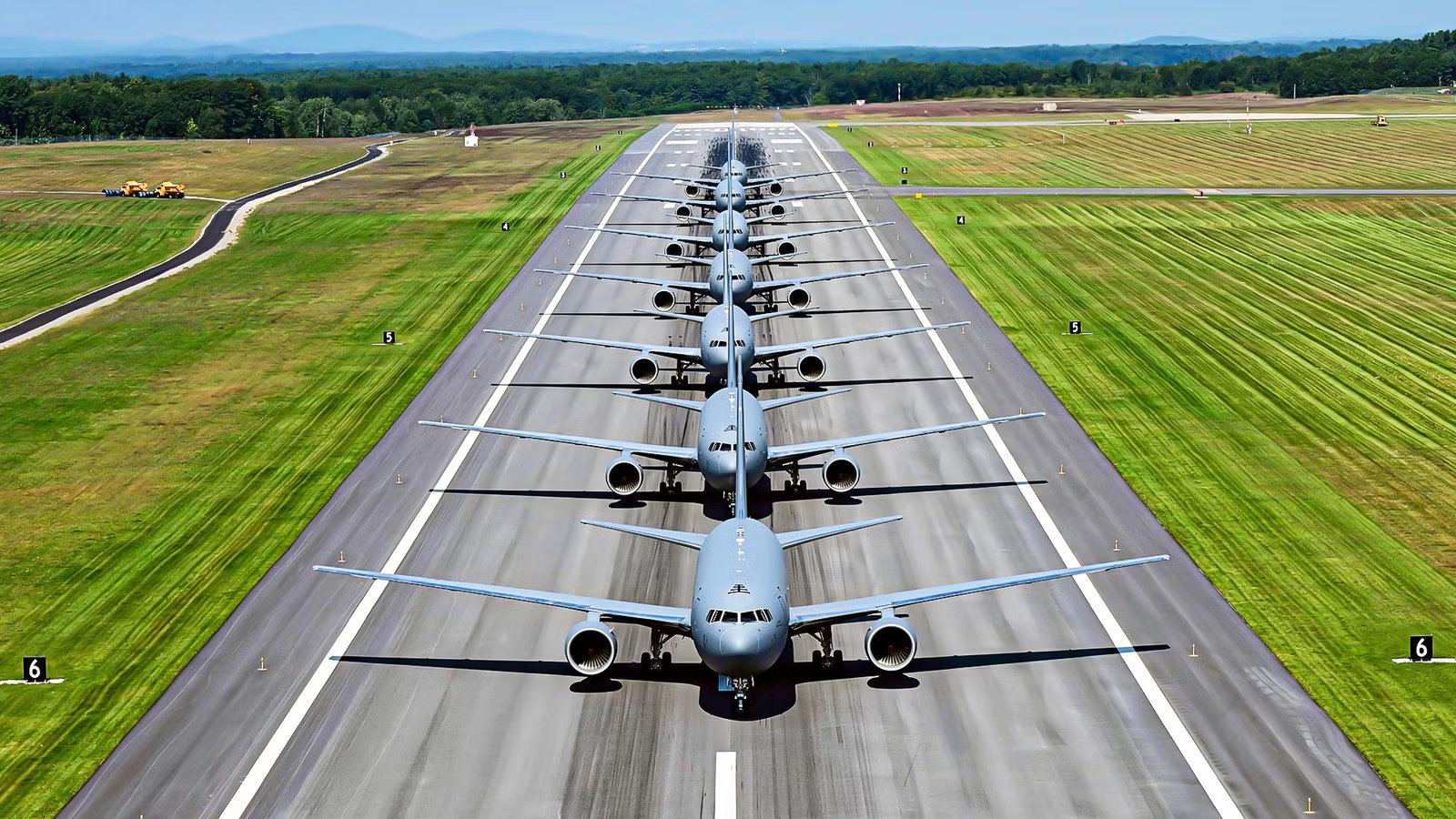
Many of the US Air Force’s refueling wings are still flying the KC-135 Stratotanker, which was made in the Eisenhower era and is rapidly approaching an average age of 70. Recent midair mishaps and structural wear have made the KC-135 increasingly dangerous to operate. Yet its replacement, the  Boeing KC-46 Pegasus, is highly controversial because it has suffered from severe design flaws, multi-billion-dollar cost overruns, and critical safety hazards.
No military in human history has ever forced a mainline frontline aircraft to fly for seven decades. The fleet is physically rotting away, suffering catastrophic structural failures, and entirely defenseless in a modern war. While the KC-46 has fought severe technical glitches like its Remote Vision System, it is fundamentally a modern, safe, factory-new airframe derived from the Boeing 767. Even though the Pegasus has high-profile flaws, the Air Force has run out of time.
An Aging Fleet On The Brink of Collapse

While the KC-135 was primarily built to move fuel, the KC-46 was engineered as a multi-mission airframe. It has many more features, plus it is hardened for the future contested battlefield’s contested airspace with better defensive sensors, electronic warfare systems, and electromagnetic shielding. The Pegasus was designed to radically expand the Air Force’s refueling mission from a Cold War flying gas station model to a truly flexible support platform.
According to Boeing, the KC-46A can be refitted for cargo hauling, passenger transport, or aeromedical evacuation with a ground service of less than two hours. The oversized cargo door and pallet rollers enable quick cargo loading, and it is compatible with all existing USAF loaders. Compared to the KC-135, it has 30% greater medevac capacity, carries double the passengers, and triple the pallets, which is equal to the Boeing C-17 Globemaster III.
The KC-135 was intentionally made to be much tougher than the baseline mission required because it was intended to survive the ‘Doomsday’ scenario of a nuclear conflict and continue fighting alongside other US and Allied aircraft even as nuclear weapons detonated around the world. The KC-46, on the other hand, is designed for efficiency and flexibility more than ruggedness or survivability.
At the same time, the KC-135 has zero modern electronic warfare jamming equipment, radar-evading capabilities, or advanced defensive countermeasures. In a potential 21st-Century conflict in the Indo-Pacific, Chinese long-range air-to-air missiles are explicitly designed to bypass US fighter escorts and shoot down support planes. A KC-135 cannot survive anywhere near a modern combat zone. This renders its massive fuel capacity useless when the USAF needs it most.
Hardened For The Future Contested Battlefield

The KC-46 was designed to provide the Air Force, Navy, Marine Corps, and partner nations with aerial refueling support from a modern, modular platform. It is more capable than the KC-135 in terms of refueling, cargo, and aeromedical evacuation thanks to its cargo deck and multi-mission architecture. The first step in the long-awaited recapitalization of the aging tanker fleet was the introduction of the KC-46.
The KC-46 has the first remotely operated, fly-by-wire fuel boom for multipoint, simultaneous aerial refueling using a drogue system of hoses. The aircraft may carry a combination of freight, passengers, and evacuees while still providing aerial refueling. It already features self-protection, defense, and communication systems to increase its chances of surviving in hostile areas, which the USAF plans to bolster.
Although the Pegasus promise is far more capable than the Stratotanker once the boom is fixed, it is currently a losing investment for both the Air Force and its maker. Boeing disclosed a $565 million loss on the KC-46 program in its fourth-quarter 2025 earnings. Boeing is currently developing a Boom Telescope Actuator Redesign. This replaces the rigid internal hardware with a more sensitive actuator that allows the boom to retract with less force, making it safe for the entire Air Force fleet, from light fighters to heavy bombers.
The High Cost Of Modular Innovation

The Next Generation Air-refueling System was envisioned as a platform with “some degree” of stealth to allow it to accompany the steadily growing fleet of fifth- and sixth-generation aircraft flown by the US Air Force, US Navy, and US Marines, as well as partner nations around the world. The capability of aerial refueling of the upcoming Northrop Grumman B-21 Raider stealth bomber or Boeing F-47 stealth fighter inside contested airspace would be a game changer at the strategic level.
In 2024, Air Force Secretary Frank Kendall publicly expressed his concern that the force lacks sufficient resources to field a clean-sheet NGAS. Given the makeup of the US and allied air forces, the requirement for a stealth tanker is justified, but the program would be very expensive because nothing like it has ever been produced.
The leadership of Air Mobility Command voiced intense dissatisfaction with the programming budget. The Air Force made a rounding error in military procurement by requesting a pitiful $12.9 million for NGAS concept refinement in the 2026 federal budget. Retired General Mike Minihan, who served as the commander of Air Mobility Command until late 2024, gave this remark to National Defense magazine:
“To be clear, we’re spending more on Air Force bands than we’re spending to invest in the next generation of aerial refueling or even the current generation when it comes to connectivity. That’s a big fat insult to the mobility community.”
The US Air Force dropped the specific NGAS funding item in their most recent budget request for fiscal year 2027. Instead of investing billions to design a new stealth aircraft from the ground up, the Air Force seems to be reallocating funds to current survivability modifications on operational KC-46s. To speed up production, the service asked for about $3.9 billion in FY2027.
Fighting Category One Deficiencies On The Flight Line

There have been multiple occasions when a Lockheed Martin F-16 Fighting Falcon or Boeing F-15 Eagle was damaged during combat missions, as Manufacturing Dive wrote. According to NBC News, there were two recorded cases in 2022 and a third in 2024. The boom of vintage tankers, such as the KC-135, has enough flex for light aircraft to push it forward and keep a connection. The Fairchild Republic A-10 Thunderbolt II and F-16 are examples of lighter or slower aircraft because the KC-46 boom requires a lot more force to collapse.
In 2025, researchers discovered that this rigidity, coupled with operator input, can result in ‘nozzle binding,’ in which the boom becomes physically trapped in the reception aircraft’s receptacle. Nonetheless, the Air Force accepted its 100th KC-46A in December 2025, and the fleet is on schedule to reach 179 total aircraft by 2026. In high-profile incidents, this binding led the boom to ‘whip’ upwards and strike the tanker’s own tail, causing millions of dollars in damage.
Jack Flynt, a retired USAF KC-135 pilot, was interviewed by Boeing on how the Pegasus has improved the AR mission. He showed strong support for the plane despite its troubled debut, saying:
“We’re making leaps and bounds with the KC-46A… The tanker enables so many of the other missions to do their job. There is no other airframe out there where you get to affect so many lives at once.”
The number of category 1 deficiencies suffered by the small Pegasus fleet has troubled lawmakers and senior officials so much that they paused the retirement of the Boeing KC-135 Stratotankers it is replacing until there is a full resolution implemented.
Overcoming The Hurdles Of Next-Gen Aerial Refueling

Over the course of the upcoming year, the USAF will implement several improvements to improve the remote vision system’s functionality. The KC-46 can also refuel planes in complete darkness thanks to infrared sensors. In theory, this provides stealth missions with a significant tactical edge. RVS will be a vital system to maintain the USAF two steps ahead of even the most sophisticated enemies, given the expanding fleet of next-gen fighters, bombers, and unmanned drones.
Although the idea is groundbreaking, the initial iteration had a number of Category 1 flaws that Boeing and the Air Force are now addressing with RVS 2.0 enhancements. Strong sunlight deteriorated video quality, and in certain situations, depth perception was warped. The 2.0 update includes 4K Ultra-HD video feeds with sophisticated geometric calculations that detect distance using LiDAR lasers.
Despite the lengthy list of difficulties, the Air Force intends to purchase many more KC-46s. The originally projected 179-unit maximum has risen to 188, then 259, with 75 extra aircraft announced in 2025. As of May 2021, the Air Force plans to purchase a total of 263 KC-46As, according to Air & Space Forces Magazine. The military has been waiting years for Boeing to deliver the revised RVS 2.0 system, and Boeing is claimed to have taken nearly $8 billion in penalties and write-offs, making it one of the greatest financial disasters in defense procurement history.
Congressional Intervention Reshapes The Air Force Recapitalization Plan

Restrictions on airframe retirements will be enforced by Congress on the USAF to maintain the mandatory fleet minimum of KC-135s if the KC-46s are not available by next year. Lawmakers may be slowing down plans for additional Pegasus tankers, but at the same time, Congress wants to increase the total tanker fleet capacity. The draft 2026 National Defense Authorization Act bill would expand the statutorily required USAF tanker fleet from 466 aircraft to 504 by 2027, according to a report by Flight Global.
In July 2025, the USAF opted to skip a competition for new tanker models and reduce its investment in the stealthy Next-Generation Air Refueling System in favor of buying as many as 75 more KC-46s. Air and Space Forces Magazine reported that the KC-46A Production Extension would help recapitalize the existing KC-135 fleet and improve the new KC-46s as the last three-engine KC-10 Extenders and its oldest KC-135s are retired.
Based on its unaddressed deficiencies with the Pegasus, Congress has enacted a provision limiting KC-46A acquisitions to 183 jets. The oversight committee is making additional procurement a condition of a fully developed plan of corrective actions and milestones to resolve all major deficiencies in the KC-46.