dailynewsnblog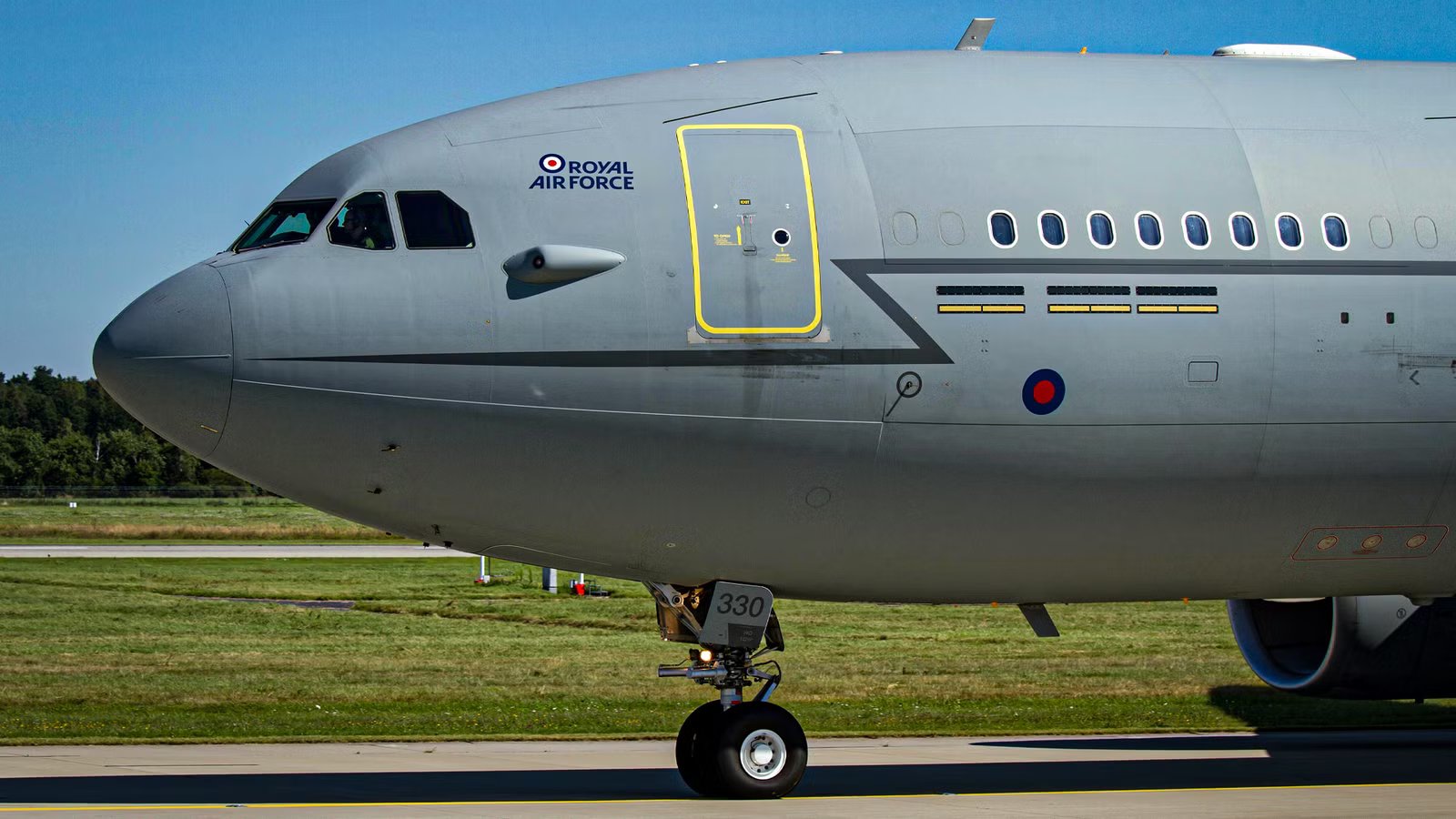
Aerial refueling is a hallmark of persistent, effective and, if need be, lethal airpower. The ability of a military to provide fuel to its aircraft midair allows its combat aircraft to remain on station to provide vital close air support. Additionally, this capability lets a nation rapidly project power across vast distances, since its transport aircraft do not have to stop and can carry soldiers, equipment, and supplies directly to an area of operations.
For the Royal Air Force (RAF), this service is provided by its fleet of Voyager tankers, which it has operated for over a decade. These operational enablers deliver fuel through a hose-and-drogue system, which the RAF has used for decades. While this method of fuel delivery is effective, the British Air Force has, over time, been accumulating aircraft that require the flying-boom refueling method, which the RAF is not yet equipped with.
The boom issue is the proverbial can that has been kicked down the road, and now it must be addressed, and quickly. This is particularly true not only because of its growing boom-only fleet, but also, and possibly most importantly, the Global Combat Air System (GCAP) fighter will require a boom for refueling.
The RAF’s Voyager Fleet and Their Capabilities

In order to carry out refueling operations for the majority of its fleet, the Royal Air Force relies on its capable fleet of Voyager tankers. These aircraft are derivatives of the widely used and proven Airbus A330-200. Regarding fleet size, the RAF maintains 14 Voyagers (AirTanker consortium), which is composed of a nine-unit core fleet; of this number, eight are military-registered airframes, with one civilian-registered model.
The remainder, five A330-200s, primarily function as commercial aircraft, but they can be ushered into military service when required. According to the RAF, these platforms are capable of transporting up to 109 tons (98.8 tonnes of fuel), stored in the wings and center-section tanks. During refueling operations, the fleet has two distinct models: the KC Mk2 with two refueling points and the KC Mk3 with an additional centerline hose for refueling larger aircraft.
In terms of personnel transport, the cabin can accommodate up to 291 passengers, and the cavernous cargo hold can handle a maximum payload of roughly 94,800 pounds (43,000 kilograms) of cargo, including up to 32 463L cargo pallets. In an emergency, such as the need to transport the spearhead of a large military force or urgently respond to a large-scale humanitarian disaster, the RAF’s nine active-duty Voyagers could quickly deploy 2,619 fully equipped soldiers in a single lift.
The Voyagers began to arrive for service with the RAF in April 2012 and began air-to-air refueling operations in 2013. The final tanker deliveries were completed in 2016. The fleet is the product of a 27-year Private Finance Initiative (PFI) and was originally valued at $17.7 billion (about £13 billion); however, the projected outturn value was later revised down to about $14.1 billion (£10.5 billion).
The RAF’s Growing Need For Sovereign Boom Capabilities

The RAF has historically preferred refueling aircraft equipped with a compact hose-and-drogue system, despite the fact that this method of delivering fuel is not as efficient as the flying boom long operated by the United States Air Force (USAF). The main reason is that hose-and-drogue-equipped refuelers can service more than one receiving aircraft at a time. Additionally, this system is standard not only across the RAF’s fleet but also across NATO for fighters such as the Typhoon and the F-35B.
Hose-and-drogue refueling is performed when a retractable hose with a basket-shaped drogue is extended toward the waiting aircraft, where it connects to a refueling probe. Conversely, the flying boom deploys downward from an externally mounted, rigid, telescoping boom arm, which is operated by an operator who can oversee the entire operation.
While hose-and-drogue refueling has served the RAF very well for decades, Britain’s air service has had an ever-growing need for, and urgency to develop, sovereign boom-refueling capabilities. Having this option would allow its fleet of  Boeing RC-135 Rivet Joint intelligence-gathering platforms, the C-17 Globemaster III transporters, the P-8 Poseidon maritime patrol aircraft, and the future E-7 Wedgetail early warning aircraft to receive fuel without the need for partner assistance.
The issue of not being able to refuel its entire fleet will become more pronounced if London proceeds with the purchase of a small contingent of Lockheed Martin F-35As. If planning proceeds, the island nation will be the operator of 12 conventional takeoff and landing fighters. This will only heighten the need and pressure to purchase boom-equipped tankers, considering that the RAF is dependent upon allied assistance to refuel all the aforementioned aircraft from partners such as the US and France.
Driving home this glaring issue, just last August, a French Air and Space Force A330 MRTT was needed to refuel a British RC-135 over France. Promptly addressing the need for boom-equipped tankers, on September 2, Luke Pollard MP, Minister of State for Defence Readiness and Industry, stated, “The Royal Air Force currently operates a probe and drogue air-to-air refuelling system and will complement this with the development of a boom system. This will ensure we have a sovereign air-to-air refuelling capability for the future Royal Air Force fleet that enhances interoperability with NATO Allies and partners.”
GCAP May Have Forced The Boom Issue

The sense of urgency is real; the sixth-generation GCAP fighter, being developed jointly by the United Kingdom, Italy, and Japan, is expected to achieve initial operating capability by 2035, the same year that the PFI contract is set to expire. By then, the oldest Voyagers will be over 20 years old, making them ideal candidates for replacement.
The options are stark: either extend the Voyager contract and pursue the expensive path of equipping this aging fleet with extendable booms, or look at purchasing new tankers. The latter appears to be the best route; the RAF would receive new refueling aircraft that would be less prone to mishaps. Further, it could acquire a new fleet of boom-equipped A330 MRTTs, which also have hose-and-drogue systems that allow multiple refueling operations.
Per Airbus, the new A330 MRTTs provide up to “…4,500 litres per minute, and 1,500 litres with hose and drogue…The tanker aircraft is capable of refuelling 25 different receiver aircraft and providing global coverage for air forces with a range of up to 16,000km.” Among other issues it would settle, this new aircraft would solve the sovereign boom issue for London and the RAF, which is particularly essential given their need for a fleet of GCAP fighters.
The sixth-generation fighter is expected to have a larger fuselage than the Eurofighter Typhoon; as such, it would have increased internal fuel capacity, weapons storage and range. These prospective characteristics would make the faster fuel transfer offered via boom highly logical. Additionally, GCAP partners Italy and Japan also operate boom-capable tankers; for the RAF to purchase a similar capability would lead to greater interoperability. Thus, London must make a choice quickly, or it will have to continue to rely on allied partners to refuel its growing boom-only fleet, in addition to its soon-to-be fleet of sixth-generation fighters.
The RAF Must Address Its Boom Refueling Gap

The RAF has successfully operated the Voyager fleet for more than a decade, providing the service with a dependable hose-and-drogue aerial refueling capability. However, the changing composition of Britain’s air forces means this capability is no longer sufficient on its own. With more boom-dependent aircraft entering service and GCAP fighters expected to become operational from 2035, the RAF’s lack of a sovereign boom capability is becoming increasingly difficult to overlook.
With the Voyager PFI contract approaching its 2035 expiration, the UK has an opportunity to address this capability gap while also determining the future of its tanker fleet. Whether London modifies existing Voyagers or procures new A330 MRTTs, acquiring a boom capability would provide greater flexibility and interoperability with its allies. For an island nation increasingly reliant on long-range airpower, ensuring its aircraft can be refueled without depending on foreign tankers will be an increasingly important requirement.