dailynewsnblog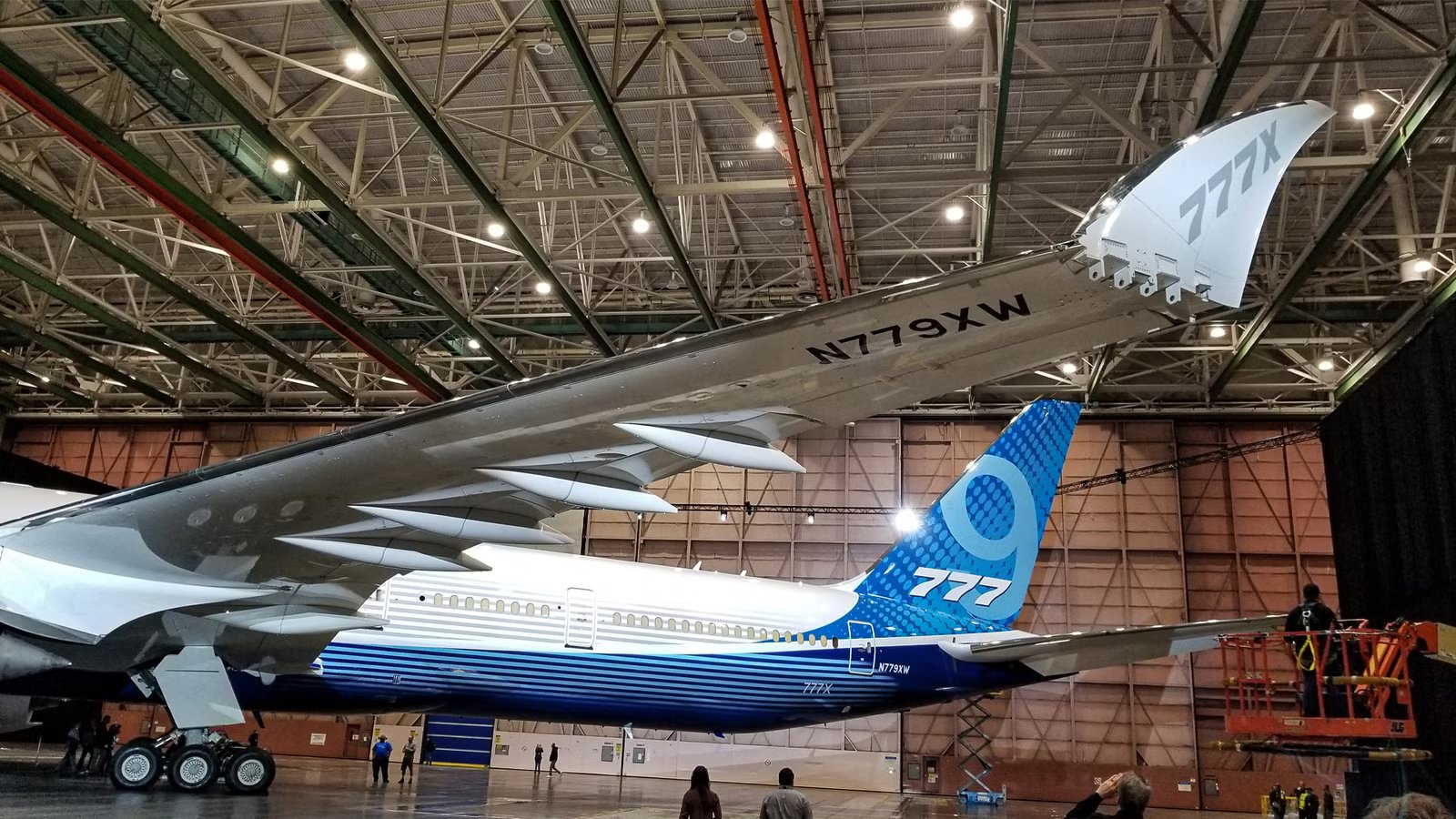
The Boeing 777-9 was supposed to enter airline service in 2020. Instead,  Boeing now expects the first delivery in 2027. Among other program problems, the manufacturer currently has roughly 30 completed 777-9 airframes that had been built years before the aircraft reaches its final certified configuration. Those airframes are not simply waiting for engines, interiors, and customer acceptance. Boeing must systematically bring them up to the configuration required for delivery, a process the company calls “change incorporation.”
The issue emerged from the unusually long gap between early production and certification. Boeing continued assembling 777-9s while the program moved through design changes, flight testing, and a more demanding FAA certification process following the Boeing 737 MAX accidents. The result is a fleet of aircraft built at different stages of the program, with older examples requiring more extensive work. Boeing has created a dedicated team for the task, but CEO Kelly Ortberg said the process will take several years.
Boeing Built The Aircraft Before The Final Design Was Frozen

The Boeing 777X program was launched in 2013, with the 777-9 originally scheduled to enter service in 2020. Boeing began assembling early production aircraft well before that target, using them to gain manufacturing experience, develop production processes, and prepare for the expected transition into airline deliveries. The first 777-9 rolled out in 2019, but certification delays soon made the original schedule unattainable.
That approach is not inherently unusual. Aircraft manufacturers routinely build early examples before certification is complete because waiting for every regulatory question to be resolved before starting production would delay industrial learning and make the eventual production ramp much slower. The difficulty arises when certification takes years longer than planned. Every additional year gives engineers more time to identify changes, regulators more time to request modifications, and production teams more time to improve the manufacturing process. Aircraft already sitting on the ground do not automatically receive those changes.
Boeing therefore ended up with an unusual inventory problem. Instead of having a short transition between early production and customer deliveries, it accumulated a sizable population of aircraft spanning several generations of the design. Ortberg acknowledged in 2026 that the older aircraft will require more extensive work, particularly structural modifications, while newer examples should require less. Boeing’s plan is to bring the stored aircraft to a common configuration before completing the necessary modifications.
Certification Changes Became A Physical Rework Problem

Wikimedia Commons, Simple Flying
The phrase “change incorporation” can make the process sound like a software update. Boeing’s description indicates something much broader. The work encompasses changes arising from certification, production improvements, and process developments made after individual aircraft were assembled. Reporting on the early 777-9s indicates that the affected systems include flight-control software, engine-control software, and wiring routing. Some aircraft also require structural work, with the scope depending heavily on when each airframe was built. The older the aircraft, the greater the accumulated difference between its configuration and the final version Boeing intends to certify.
This creates a logistical problem because an airplane is not an isolated collection of interchangeable modules. Changes in one system can affect interfaces with others. Wiring may have to be accessed before components can be replaced, software changes may require associated hardware configurations, and structural modifications can require additional inspections and testing.
Boeing has therefore established a dedicated organization within Boeing Commercial Airplanes to handle the stored aircraft rather than relying solely on the normal production line. Ortberg said each aircraft has its own work scope, with the company currently defining what needs to be done before bringing the fleet to a common configuration. The practical consequence is that the aircraft are not merely delayed deliveries. They have become individual engineering projects.
WH007 Showed Why Rework Can Stop Making Economic Sense

The most striking example is WH007, the seventh 777-9 built. The aircraft, line number 1611, rolled out of Boeing’s Everett facility in July 2019 with  Emirates colors and the intended registration A6-EZT. It never flew and never received engines. Instead, Boeing moved the aircraft around Paine Field for years as other 777X test and production aircraft occupied the available space.
WH007 was eventually dismantled in late summer 2025. The Air Current reported that the decision reflected the economics of modifying such an early airframe rather than an indication that the 777-9 itself was being abandoned. By the time Boeing had a clearer path toward certification, the aircraft was so far removed from the expected production configuration that returning it to a deliverable condition was not economically attractive.
The example illustrates why the inventory cannot simply be counted as 30 completed aircraft waiting for customers. A stored jet has value only if the cost and effort required to bring it to an acceptable standard remain below the value a customer assigns to it. For Boeing, that calculation becomes especially difficult when an aircraft is several years old before entering service. The company must spend money on modifications, inspections, testing, preservation, and potentially customer-specific work while receiving no corresponding delivery revenue. WH007 was therefore an early warning of the larger challenge. It demonstrated that some airframes could cross an economic threshold where dismantling them made more sense than completing them.
Emirates Has Rejected The Earliest Aircraft

The customer response makes the situation more complicated. Emirates is the largest 777X customer, with 270 aircraft on order, and has been among Boeing’s most important supporters of the program. Yet President Tim Clark said at the 2026 Farnborough Airshow that Emirates would not accept the first 10 aircraft from its order because of the extent of the modifications required.
Clark’s comments underline the difference between an aircraft being technically recoverable and being commercially acceptable. Emirates has spent years waiting for the 777-9 and can reasonably expect an aircraft built to the latest production standard. Accepting an early example that requires extensive modification could introduce additional uncertainty into maintenance, reliability, configuration management, and future resale. Clark said the airline had decided against taking that initial batch and suggested Boeing would have to determine what to do with the aircraft. His widely reported reference to Heinz and baked bean cans illustrated just how little appeal those early airframes have to at least one major customer.
The implications extend beyond Emirates. Boeing must determine whether other customers will accept early-build aircraft, whether it must absorb more of the modification expense, and whether some airframes will need to find alternative buyers or leasing arrangements. That leaves Boeing with a commercial problem layered on top of the engineering one. Even if the company can technically make every aircraft compliant, it cannot force customers to value all completed airframes equally.
The Cost Has Become A Program-Level Problem

The financial impact of the 777X delay is already substantial. In October 2025, Boeing recorded a $4.9 billion pretax charge on the program after moving the expected first delivery to 2027. Boeing said the charge reflected the updated certification timeline and associated costs. The new charge pushed cumulative 777X charges above $15 billion.
The stored aircraft add another layer because Boeing must fund their preservation and eventual rework while the program remains pre-delivery. Analysts have estimated that billions of dollars of working capital are tied up in aircraft that cannot yet generate delivery revenue, although the precise amount associated specifically with stored 777-9s remains an estimate rather than a Boeing disclosure. At the same time, the company is trying to move from development into a sustainable production system. Boeing reported that 777-9 certification flight testing had entered the Type Inspection Authorization phase in late 2025, while the company continued targeting first delivery in 2027. Boeing said in May 2026 that the 777-9 test program had accumulated more than 4,700 flight-test hours across the fleet.
The stored aircraft therefore create a bridge between two phases of the program. Boeing needs to complete certification, establish the final configuration, rework earlier aircraft, and simultaneously ensure that new production does not recreate the same divergence. That last requirement may ultimately be the most consequential. Once deliveries begin, the company needs the production line and certification baseline to remain closely synchronized.
The 777X Is Now Paying For Its Early Start

The 777-9’s stored-aircraft problem is ultimately a consequence of a program that started production learning long before certification was complete, followed by a delay long enough for the aircraft to accumulate years of design evolution. Boeing’s efforts are closing that gap, but it cannot erase the economic consequences of building aircraft too early. The fate of WH007 shows the extreme outcome. Some early airframes may be worth less as aircraft than as sources of recoverable components. Others could still become useful airline jets if Boeing can complete the necessary work at an acceptable cost and customers agree to take them.
Looking ahead, the real test will be whether Boeing can turn this difficult inventory into a controlled transition rather than a recurring production problem. The company has said the 777X modifications are part of its operating plan, and that newer aircraft should require less extensive work. If Boeing can establish a stable certified configuration and keep future production aligned with it, the stored fleet will eventually become a finite cleanup exercise. If changes continue to accumulate faster than aircraft can move through certification and delivery, the company risks recreating the same problem with later production batches. For the 777X, therefore, certification is not simply the gateway to delivery, but the point at which Boeing must finally make its production system, engineering baseline, and customer expectations converge.