dailynewsnblog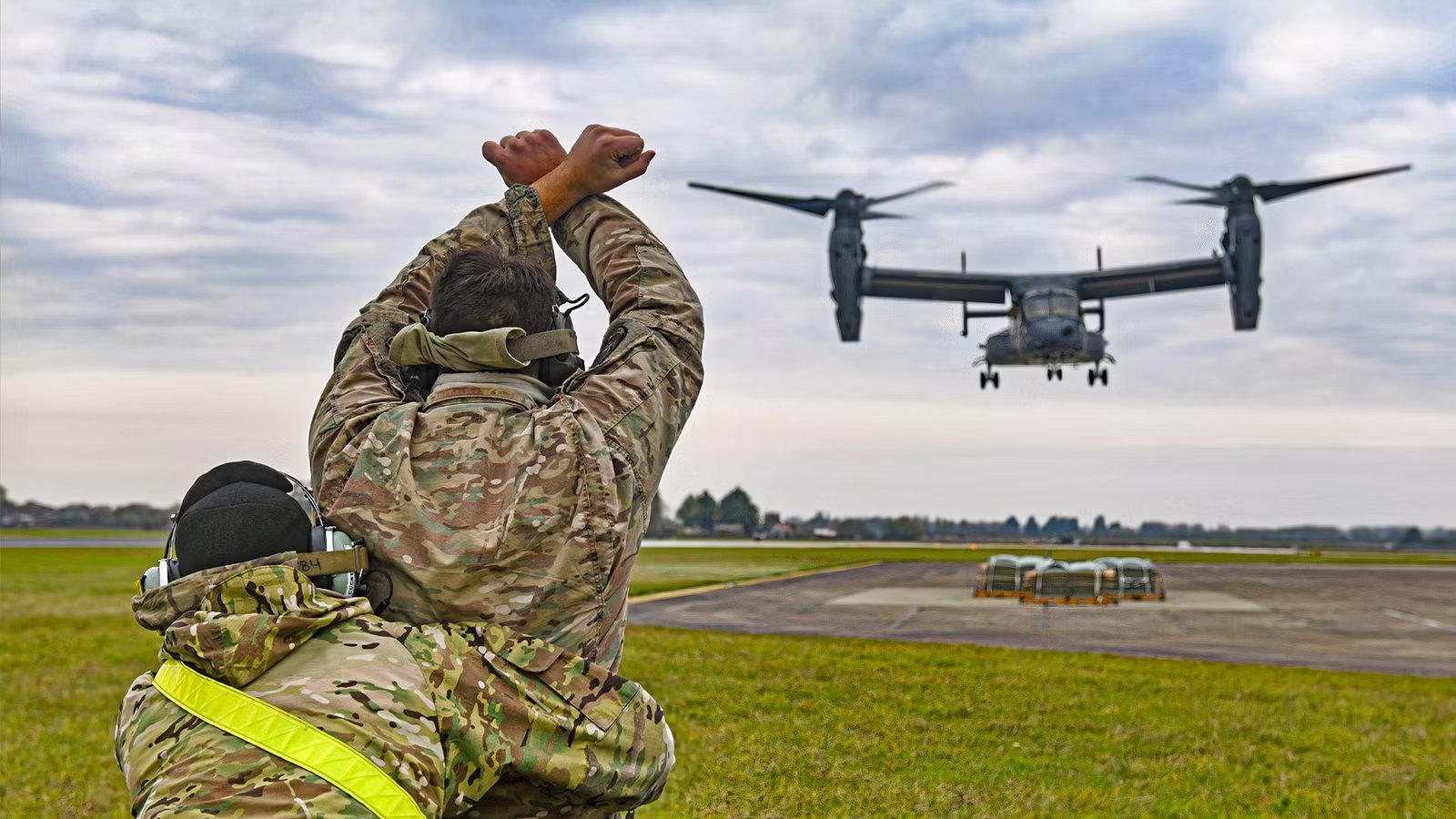
The Pentagon wants every Bell/Boeing V-22 Osprey to receive a new gearbox by 2027; however, at a production rate of 12 units per month, the math quietly raises questions about whether that goal is achievable. The issue is significant because the Osprey has transformed military aviation by combining the vertical takeoff and landing capabilities of a helicopter with the speed and range of a conventional turboprop aircraft. At the heart of this capability is its highly complex drive system and massive proprotor gearbox.
Weighing around 2,600 pounds, the gearbox transfers power from the engines to the Osprey’s proprotors while reducing rotational speed and increasing torque. However, years of failures have made it one of the aircraft’s most significant reliability concerns.
The Osprey & Why Its Gearbox Is Crucial To Its Transformative Capabilities

The V-22, which reached initial operating capability in 2007, is an aircraft with the unique ability to take off, land, and fly vertically like a helicopter or fly like a conventional prop-driven airplane. This ability to transition seamlessly between these two modes of flight comes from its highly complex transmission. Each Osprey’s entire drive system weighs about 3,780 pounds (1,715 kg), and the gearbox is central to the aircraft’s ability to transition between vertical and conventional flight, according to The Air Current.
Of the nearly 4,000 pounds mentioned earlier, the gearbox weighs 2,600 pounds, or 70% of the total weight, plus tilt-axis and mid-wing gearboxes. This system also includes tilt-axis and mid-wing gearboxes and an interconnecting shafting system. This complex design is necessary in order to transfer power from the engine to its massive proprotors.
The proprotor gearboxes transfer power from the Rolls-Royce AE 1107C engines while reducing the engines’ high rotational speed and increasing torque to a level suitable for driving the proprotors. This process relies on multiple gear assemblies, including high- and low-speed planetary assemblies containing numerous pinion gears.
The system’s complexity is particularly relevant given the V-22’s gearbox reliability issues. The high-speed planetary assembly contains five pinion gears, while the low-speed assembly contains six, providing some redundancy. Testing and previous inflight failures show the gearbox can continue operating with a cracked pinion, provided the damage does not cause additional failures.

According to The Stratos Brief the US military has approximately 403–420 V-22s in service across the services, with 323 MV-22Bs flying with the Marines, 29-41 CMV-22Bs with the Navy, and 51-56 CV-22s deployed with the Air Force’s Special Operations Command. While the aircraft has made its way across the US military in just four short years, 20 service members have lost their lives, and four aircraft have been destroyed in 12 V-22 Class A mishaps, according to The Aviationist. The latter represents the most severe class of mishap and includes incidents resulting in a fatality, permanent disability, property damage exceeding $2.5 million, or the complete destruction of an aircraft.
The most serious incident occurred on November 29, 2023, near Yakushima Island, Japan, which resulted in the loss of eight Airmen after the Osprey plunged into the water. The tragic crash led to a three-month safety stand-down of about 400 V-22s, according to The Aviationist. The subsequent Aircraft Accident Investigation Board determined that the proprotor gearbox suffered a catastrophic failure. Investigators speculated that the failure may have resulted from an inclusion—a foreign substance within the steel components that creates a weak point.
Regarding gearbox-specific issues, a Navy review identified two primary problems, according to Air & Space Forces Magazine.The first is hard clutch engagements, which occur when the clutch slips and reengages and cause immense torque swings that can make the aircraft difficult to control. The second, and a persistent issue, is the X-53 steel alloy used in most gearbox gears, which make up a significant portion of the aircraft’s weight.
Bell/Boeing V-22 Osprey (USAF Variant) | General Characteristics |
|---|---|
Deployment date | 2006 |
Propulsion | Two Rolls-Royce Liberty AE1107C engines |
Thrust | More than 6,200 shaft horsepower per engine (More than 4,623 kW per engine) |
Length | 57 feet, 4 inches (17.48 meters) |
Height | 22’ 1” (6.73 meters) |
Wingspan | 83’ 10” (25.55 meters) |
Weight | Maximum gross 60,500 pounds (27,442 kg) (self-deployment); 57,000 pounds (25,855 kg) (STOL); 52,600 pounds (23,859 kg) (VTOL) |
Range | Combat radius of 500 nautical miles (926 km) with one internal auxiliary fuel tank |
Crew | 2 Pilots, 2 Special Mission Aviators |
Rotor diameter | 38 feet (11.58 meters) |
Armament | One .50-caliber (12.7 mm) machine gun on ramp |
Payload | 24 personnel (seated), 32 personnel (floor loaded) or 10,000 (4,536 kg) pounds of cargo |
Unit cost | $90 million |
The alloy contains material impurities or inclusions that lead to part failures; the Navy review found that since 2006, there have been 22 instances of gear failures due to cracking caused by inclusions. In most cases studied in the review, investigators noted that failed gears made from X-53 alloy produced metal chips that caused further operational issues.
Regarding the notable mishaps with the Osprey fleet, the Government Accountability Office (GAO) found that serious accident rates for the Air Force and Marine Corps — the largest operator of the aircraft — increased during fiscal years 2023 and 2024. This was compared to their averages over the preceding eight years; the GAO also found that, depending on the service, the incident rate increased from 36 to 88%.
These incidents also affect readiness, since after any malfunction or failure, the associated V-22 must be pulled off the flight line, inspected, repaired, and recertified. Naval Air Systems Command stated that the Osprey had “a low average readiness and availability level in the 2020-2024 timeframe at 50% for the U.S. Navy and AFSOC, and 60%,” according to The Aviationist.
The Fix Is In

The Osprey has become a cornerstone of tactical mobility within the fleet, Marine assault operations, and Air Force special operations. The services need to rely on the aircraft to perform, whether in combat or in any other situation in which it may be called upon. And the 2023 incident near Yakushima Island was surely a tipping point, and fortunately, the gearbox issue is now being remedied.
Brigadier General David C. Walsh (USMC) is the Program Executive Officer for Air Anti-Submarine Warfare, Assault & Special Mission Programs. That office is within Naval Air Systems Command and directly manages the V-22 program.
According to Defense.Info, General Walsh confirmed that the new gearboxes are currently being manufactured at a rate of 12 per month, and they are being distributed to all three services.
Regarding the Navy and Air Force, the retrofit will be complete within the next couple of years, with the latter intending to allocate $213 million (£157.3 million) for the 2027 CV-22 modernization initiatives, and the Marine Corps will follow a similar timeline. This represents a fully funded, systematic upgrade across the entire V-22 fleet.
However, at a production rate of 12 new gearboxes per month, the program would produce 144 gearboxes per year. With 469 V-22s currently in service and each aircraft requiring two proprotor gearboxes, replacing both across the fleet would require 938 units. Even allowing for aircraft that have already received the new gearbox and production that began before 2027, the numbers show why reaching the entire fleet on that timeline could conflict with the program’s expected goals.
The new gearboxes, manufactured from X-53 triple-melt steel, initially began entering repair bays in January 2026. The new steel alloy will provide significantly enhanced resistance to the impurities that have plagued the Osprey’s gearboxes, made from double-melt alloy, for the last two decades.
“Our analysis shows that going from the double-melt gears to the triple-melt gears will reduce the probability of this happening by an order of magnitude,” Admiral John E. Dougherty IV (USN), Commander, Naval Air Systems Command, said, according to Defense.Info. “It will actually take this risk from a serious risk down to a medium risk.”
Echoing this, Colonel Robert Hurst (USMC), head of the V-22 Joint Program Office, said the new alloy is expected to reduce inclusions in the material by roughly 90%, according to The Aviationist.
The Osprey’s Gearbox Overhaul Is A Major Step Forward

The V-22’s gearbox has become a critical focus for the services after years of failures and readiness concerns. The 2023 Yakushima Island crash, which claimed eight Airmen, underscored the consequences of a catastrophic gearbox failure and helped drive efforts to address the problems with the X-53 alloy. According to Air & Space Forces Magazine, a 2024 CV-22 mishap further illustrated the issue, with investigators finding an inclusion measuring just 0.055 inches long by 0.011 inches wide in the failed gear.
The new triple-melt steel gearboxes offer a major improvement, with NAVAIR estimating an order-of-magnitude reduction in the probability of inclusion-related failures. However, with production running at 12 gearboxes per month, questions remain about how quickly the fleet can receive the upgraded components. The program’s success will depend on whether the new gearboxes improve both safety and V-22 readiness.