dailynewsnblog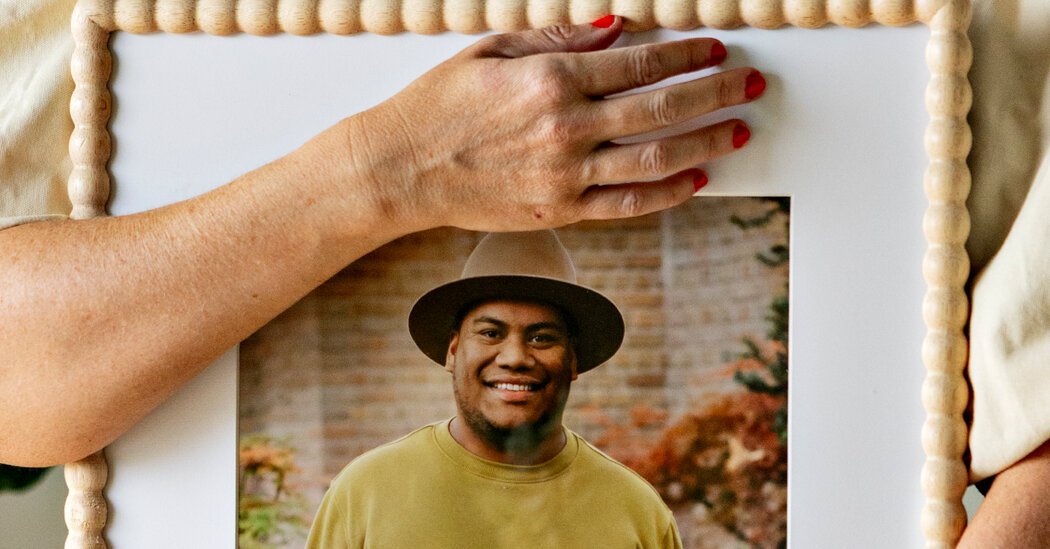
Afa Ah Loo was filming the crowd at a No Kings march in downtown Salt Lake City. About 10,000 people had come, part of a national movement protesting the Trump presidency. It was one of the largest demonstrations the city had seen.
A woman dressed as Lady Liberty entered the frame of his cellphone video. Michelle Van Tassell, one of the protesters, had made the costume in her sewing room: a foam crown, a green robe, a torch shaped from household items.
It was the evening of June 14, 2025. Walking near the middle of State Street, Mr. Ah Loo panned across the marchers, the wide brim of his tan hat low against the evening sun. In his other hand he carried a sign: white cardboard, four words in large black letters. “The world is watching.”
Gunfire split the air. Three shots. Pop. Pop. Pop.
The crowd broke. Ms. Van Tassell walked toward the man on the ground, Mr. Ah Loo. A tan hat lay near him on the asphalt. She came close enough to see the bullet wound in his temple. She raised her torch and said, to no one in particular, “This is not who we are.”
The shooter, a contractor named Matthew Alder, had volunteered to help keep the marchers safe. He would later say he had shot at an armed man he believed was about to open fire on the crowd. Mr. Alder said he had no intention of hitting Mr. Ah Loo.
More than 1,500 demonstrations took place across the country that day, the largest single day of protest in the United States in years. Nearly all were peaceful. Salt Lake City was the exception. A year on, Mr. Alder faces a charge of manslaughter and a civil suit filed by Mr. Ah Loo’s widow.
The criminal case turns on one question. Can a person who fires believing it is self-defense, or the defense of others, be held to account when the bullet kills a bystander?
Since 2020, researchers who track political violence have counted a dozen American protests where a bystander — someone with no part in the fight — was hit by a stray round. Self-defense is a matter of state law, and a Salt Lake County jury will bind no court beyond Utah. But the question is not Utah’s alone.
Joseph Blocher, a law professor at Duke University who studies the Second Amendment, said the case sat at the meeting point of some of the hardest questions in American law. He said he could not have invented a set of facts that tested them more sharply.
“This illustrates, as powerfully as I can imagine, the intersection of some of the most fraught areas of law — self-defense, the Second Amendment, the First,” he said. “It’s the kind of case I can imagine driving conversations in courtrooms and law schools for years to come.”
“The only thing that separates that feeling of fear from a homicide is five pounds of pressure on a trigger,” he added. “That’s a very hard thing for a law to deal with.”
Mr. Ah Loo, 39, was supposed to be working that day. A friend texted their group chat to say he was leaving for the protest.
“Let’s cancel the meeting,” Mr. Ah Loo told him. “I’ll come with you.”
He was born and raised in Samoa, the youngest of five, in a world of hard work and ceremony. When he was a boy, his grandfather made him learn a Tokelau dance, from the island next door, not his own. He hated it. “But when my grandfather would make him get up and do it,” his sister, Ofeira Asuao, said, “he would do it with so much gusto that people would think he was from that other island.”
He learned to sew from the women in his family. The skill carried him further than he could have imagined. He represented Samoa at a fashion showcase inside Buckingham Palace, and appeared on the television series “Project Runway.”
He came to Utah on a Latter-day Saints mission at 21, and met his future wife, Laura Ah Loo, on a later visit.
He made clothes for all sizes and genders, and became a known ally to the local trans community. Native Hawaiians and Pacific Islanders make up only a small share of Salt Lake City’s population. In that group, Mr. Ah Loo was a figure of consequence.
And then there was the hat. A tan hat with a wide, flat brim. His friends knew the shape of him in that hat from a block away. “Afa was not a big person — about 5-foot-9,” his business partner Benjamin Powell said. “He had a very simple dress code, but he always wore his hat. He was an island boy in a hat.”
On Sept. 17, 2024, Mr. Ah Loo raised his right hand in a courthouse and became a U.S. citizen. That November he voted for the first time. After that, his friends say, politics became personal.
“Once he got his citizenship, I noticed he started becoming more vocal,” Mr. Powell said. “He felt like he could speak up, like every American. He told me, ‘I see what the agenda is now. I’m scared for my kids.’”
When he was wrapping up at the studio that last afternoon, Ms. Ah Loo and their young son and daughter showed up by surprise. He came down to the lobby. He kissed Ms. Ah Loo and the kids.
Then he walked out to join the march.
Protests where guns appear are far more likely to turn violent, researchers have found. Among the men carrying guns at the Salt Lake City protest were two who had not come together.
Arturo Gamboa, 24, was a Venezuelan American progressive activist born and raised in Salt Lake City. Tall and lanky, with roots that split between his mother’s Mormon Church and the local punk scene, he read Frantz Fanon, Huey Newton and Malcolm X. “True revolutionaries,” he said. He had been openly carrying at local protests since 2020.
The Second Amendment, he said, is not reserved for one political ideology. “If they can do it,” he said of right-wing counterprotesters, “if they can show up with intimidation on their minds, open carrying, well, so can we.”
That day, Mr. Gamboa was dressed in black, with a hood up and a mask on. He carried a disassembled AR-15-style rifle, a Venezuelan flag in his backpack, a knife, and three loaded magazines tucked into his cargo pants. To him, the mask and hood — what activists call “black bloc” — were a defense against surveillance.
Mr. Alder, 43, who would fire the shots that night, was a stocky, broad-shouldered Army veteran and home contractor. He had grown up in Utah and lived modestly. He had served about a year as a combat engineer in the Army Reserve, his lawyer said, and had trained as a weapons instructor. He wore a thick reddish-brown beard and a body camera strapped to his chest. The camera’s battery died early in the march.
Had he not volunteered for the safety team, said his lawyer, Neal Hamilton, Mr. Alder would have attended as a protester.
A friend had asked him, the day before the march, to serve on the volunteer safety team. Its members wore yellow vests and carried radios and first aid kits. They also watched for the kind of threat that had become familiar at protests in the Trump years. No training was required to join. Organizers had told them there had been credible threats against the protest, Mr. Hamilton said.
Mr. Hamilton agreed that, under other circumstances, the three men — Mr. Alder, Mr. Gamboa, Mr. Ah Loo — might have stood together. They had come to the same protest. They were sympathetic to the same cause. They had never met.
Just before 8 p.m., the sun was dropping toward the Oquirrh Mountains. A second safety team volunteer stood under a carport at the side of a building on State Street, a few blocks south of the State Capitol. Court papers refer to him as A.F.
A.F. had been watching Mr. Gamboa for several minutes. He saw him duck behind a column, pull part of a rifle from his backpack and struggle to put it together.
Mr. Gamboa later said he had stepped aside to assemble the weapon so marchers would not be alarmed. Utah allows open carry.
To A.F., this looked different. He pressed the radio at his shoulder: “Gun, gun, gun.”
Mr. Alder came running. He and A.F. yelled commands at Mr. Gamboa to drop the gun and get on the ground.
Mr. Alder later told investigators what he believed he saw: a man hunched against a wall, the rifle held low, the hand sliding up. He said he had seen a man “psyching himself up,” about to “mag dump into a crowd of people to kill as many people as he could.” To Mr. Alder, the man had not merely put the rifle together. “He saw him load it,” Mr. Hamilton said.
Mr. Gamboa said it had not been that way. He had slung the rifle over his shoulder, he said, the barrel pointed down. The magazine was in his pack. He was straining to catch the rhythm of the chants so he could join in, he said.
Video from a nearby balcony, aired on local television, appears to show the barrel pointed down. It shows him moving along a walkway beside the next building, about 30 feet from the volunteers, past a wall and glass doors, toward the corner where the walkway bends to the street.
A.F. had his gun drawn. He did not fire.
“There’s no way I can shoot him when he’s running toward a crowd,” he told investigators. “I’m accountable for every bullet that comes out of my gun.”
Mr. Alder, beside him, drew his Smith & Wesson 9-millimeter. He fired.
Three shots. One entered the left side of Mr. Gamboa’s torso. One hit the rifle. About one second passed between each.
Of the commands to drop his gun and get on the ground, Mr. Gamboa struggles with the memory. He never heard anyone say “police,” he said, and he would not have taken orders from two volunteers in safety vests. “Who deputized them to make me do something like that?” he said.
By the third shot, the prosecution’s official charging affidavit says, Mr. Gamboa had rounded the corner of the building. The document cites a photograph taken at the moment of that last shot and notes there were three people in Mr. Alder’s line of sight. One standing. Two seated. None of the three were Mr. Ah Loo, who stood farther up the block.
Mr. Alder’s lawyer disputed that account, saying his client never fired with anyone in his line.
The third bullet traveled roughly 160 feet, the affidavit says, before it hit Mr. Ah Loo. He was standing near a parked car.
When Mr. Ah Loo fell, his phone fell with him. The camera turned through color and light and came to rest on the asphalt, its lens pointed at the sky.
A man stepped into the frame — an emergency room doctor from the crowd.
“Someone call 911! Tell them we have a gunshot wound to the head! Now!”
“OK, I’m starting compressions. Stay with me. Stay with me, buddy.”
Sirens rose in the distance.
“Keep fighting. Just keep fighting.”
At home, Ms. Ah Loo was lying on her daughter’s bed, laughing with the children, when a friend called. Afa had been shot. Go to the hospital.
She left the kids with a neighbor and drove. She and her sister-in-law, Ms. Asuao, reached the emergency room around 10 p.m.
The hours passed. Midnight. One. Two. Ms. Ah Loo did not sit. Scrolling her phone in the waiting room, she saw it — a local news alert, a photograph: her husband’s tan hat on the ground.
Then a social worker came and told them.
“My ears were ringing,” Ms. Asuao said. “I couldn’t hear anything after that.”
When the first bullet entered his side, Mr. Gamboa had thought he was going to die. He looked down at his shirt. He saw blood. “In my mind, I was saying my goodbyes,” he said. “I was praying to God because I thought they were going to kill me.”
He ran into a parking garage. He put the rifle back in his backpack and tried to disappear into the crowd. A marcher recognized the rifle’s shape through the bag and took it.
A detective came to his hospital room and told him he was being held on a murder booking. “Who did I kill?” Mr. Gamboa recalled thinking.
At the county jail, a chain ran from his hands to his waist, another from his waist to his ankles. Guards fed a chain through a porthole in the cell door before moving him. When he called his mother, he had to bend himself over a phone bolted low to the wall — a grown man folded in half to say hello.
Six days later, a judge ordered Mr. Gamboa’s release. The state determined he had done nothing illegal and would not bring charges against him.
For six months, the office of Sim Gill, the Salt Lake County district attorney, worked through the legal architecture.
In Utah, as in most states, a person may use deadly force against a danger they reasonably believe is real, even when the belief is mistaken. But the Utah law had nothing to say about a bystander killed the way Mr. Ah Loo was killed.
Mr. Gill kept looking, past Utah’s own books, until he found his footing far from home: a recent Massachusetts ruling. A claim of self-defense, the court had held, does not shield a shooter whose force is reckless. An assailant assumes the risk of being shot, Mr. Gill said. An innocent bystander does not.
He would focus on the third shot alone. The first two, fired at Mr. Gamboa, might have been justified. The third, sent down a crowded street after the threat had seemingly moved away, was not. Each shot, he would argue, was its own decision.
A.F. made what to the prosecution was the right choice. He saw the crowd behind the target. He held his fire.
Mr. Gill came back to the bystander.
“Being in the wrong place at the wrong time is a tragedy for the victim,” Mr. Gill said. “It is not a legal defense for the person pulling the trigger.”
In December, Mr. Gill charged Mr. Alder with manslaughter, a second-degree felony that carries up to 15 years.
Ms. Ah Loo’s lawsuit, filed in March, names Mr. Alder and the protest’s organizers. It contends that planning failures — armed volunteers in the crowd, little oversight — led to her husband’s death.
Either case may end before a jury ever hears it. The criminal charge could be dismissed at a special justification hearing — a Utah legal maneuver that forces prosecutors to prove early on that the case warrants a trial. It could also dissolve into a plea for a lesser count, just as the civil suit could end in a settlement. But the question that began on State Street would remain: What should happen when an effort to protect people kills someone who posed no threat?
“We have created laws,” Mr. Gill said, “where the average person can pay that price with their life for those misunderstandings.”
A year on, Mr. Alder has not moved beyond that night. He has not granted interview requests. His lawyer, Mr. Hamilton, spoke on his behalf.
Mr. Alder sees himself as someone who was trying to help, who acted to stop what he believed was a mass shooting, Mr. Hamilton said.
“Believing that there were threats, having been told he was a threat — that was his state of mind,” Mr. Hamilton said.
Mr. Gamboa lost his job at a grocery store. He found other work, on a shift that starts near midnight. The bullet that went through his side left him with a $20,000 medical bill.
“That day I will carry with me the rest of my life,” he said.
He lifted his black T-shirt to show the bullet scars. Entry and exit.
The night of the shooting, Ms. Van Tassell, dressed as Lady Liberty, and her husband wondered how far from Mr. Ah Loo they had been when the bullet was fired. They went back to State Street the next day to measure the distance. Twenty yards.
They have a policy now. Before large public events, they plan what to do if they hear a gunshot. They establish where the exits are and map out where they will meet if they get separated.
“We don’t stand up for democracy,” Ms. Van Tassell said. “We take cover. And that is disgusting.”
After the shooting, 50501, the national umbrella organization for No Kings marches, cut ties with its Utah chapter for violating its no-weapons policy. When marches resumed with different leaders, no one was allowed to carry firearms — not the safety volunteers, not anyone in the crowd.
Ms. Ah Loo is moving. The four-bedroom house in a working-class suburb north of Salt Lake City is being packed up. She and the children are heading to a town closer to friends.
She plays Samoan music from a playlist Mr. Ah Loo made. The children sing with an accent the elders praise.
A few months after he died, their daughter danced to a song he loved. Ms. Ah Loo cannot hear it without crying. He had translated it: a father telling his child to go forth across the deep water, to be brave, that he would be there on every path.
The children sing it now. They know the words. They no longer have him to say what the words mean.