
 dailynewsnblog
It is said that the art of glassmaking originated in Mesopotamia and Egypt and dates as far back as 3000 BC. It wasn’t until about four millennia later when glassmaking techniques reached Venice via Mediterranean trade and local artisans began producing objects and mosaics. The role of the fiolario, or glassmaker, was first recorded in the 10th century, and since then that rich cultural heritage has been a heavily guarded Venetian patrimony.
But with the increasingly global popularization of heritage brands like Barovier&Toso and Venini, the Venetian island of Murano is under the international spotlight like never before. Its guarded workshops and ateliers have opened their doors to new, fresh ideas and an international wave of designers.
Norman Foster and Hydra

Norman Foster poses with his reinterpretation of the Venetian chandelier.
Courtesy Photo
With Italian firm Salviati and glass maestro Franco Zane, English architect and urbanist Norman Foster and the Norman Foster Foundation reinterpreted the Venetian chandelier with Hydra: a site-specific glass installation that creates a dialogue between Venice’s historical heritage and a contemporary design vision. Composed of a structure of organic arms culminating in blown-glass light elements, the work explored glass as both a structural and expressive material. With Hydra, Foster imbued his urban vision into ancient craft, highlighting the design innovation and the expertise of Murano’s master glassmakers.
Michela Cattai’s Organic Expressions

Michela Cattai Studio’s sculpture, a part of the exhibit “Frequenza della Forma.”
Italian artist Michela Cattai, who divides her time between her Milan gallery and a Venice furnace, is known for her sculptural expressions of tension, balance, light and movement. Her approach often embraces the ancient process of using botanical forms and organic plants as the blueprint for new design. At Venice Glass Week her exhibit “Frequent della Forma” (Italian for the frequency of shape) introduced new biological expressions of art.
Marco Zito for Agape

Marco Zito for Agape.
Courtesy of Agape
Venice-born architect and industrial designer Marco Zito is bringing the art of glassmaking mainstream with Massicci, a basin he envisaged for high-end bath design firm Agape.
The new sink is made from cast glass and shaped through fire revealing the expressive depth of a material pushed to its limits. Each basin is formed by pouring molten glass into a mold, creating a monolithic volume with a subtly faceted surface — a natural imprint of the cooling process.
Prices start at 2,330 euros on Mohd.
6:AM’s Modern Spin

6:AM
Delfino Sisto Legnani
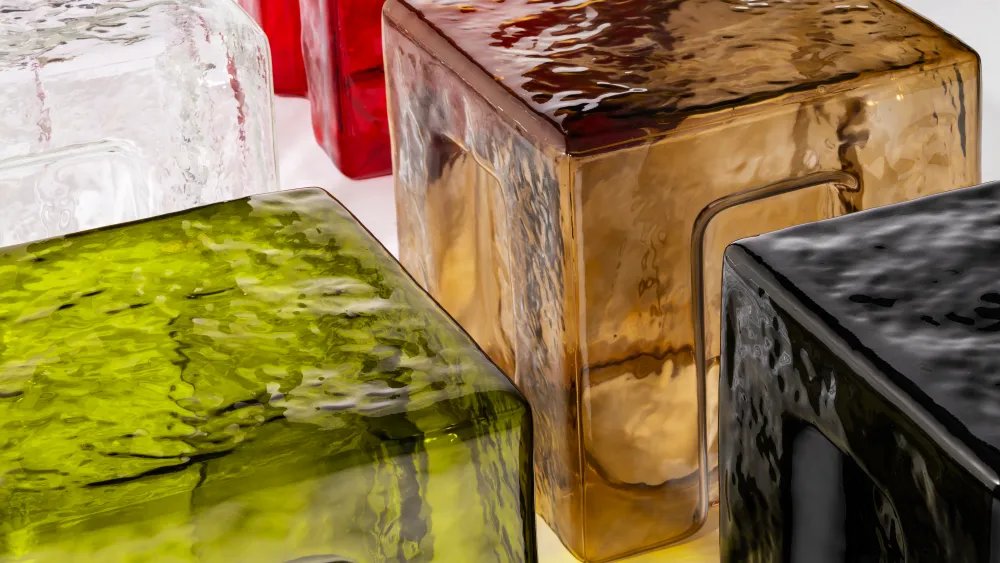
When Edoardo Pandolfo and Francesco Palù founded Milan-based design brand 6:AM in 2018, they were intent on turning Murano glassmaking into a new and experimental expression.
Since then, they have enchanted both the worlds of fashion and design with their hand-blown glass objects, lighting and furniture. Earlier this year, they unveiled Batch, a collection of functional cube forms. Each piece is made using a cast-iron mold engraved with CNC technology, creating a subtractive geometry inspired by the rough-hewn stages of marble carving.
Prices for Batch start at 4,900 euros on the 6:AM website.
Micheluzzi Glass’ New Classics

Micheluzzi’s ghiaccio glasses.
Elena and Margherita Micheluzzi, the daughters of artist Massimo Micheluzzi, are rising stars on the Venetian glass scene. As a family-run business, they also strive to interpret Murano glass through a contemporary lens while consistently capturing the majestic spirit of Venice and her islands. Their latest — Ghiaccio (Italian for ice) features frosted glasses made by applying granzioli, small fragments of glass resembling crushed ice, to the face while still incandescent.
Barovier&Toso Looks to the Future

Barovier&Toso designs by Swedish design studio Claesson Koivisto Rune.
Courtesy of Barovier&Toso
While Venice has felt the pulse of international trade since the days of Marco Polo, the 13th-century glass house Barovier&Toso has only just now amped up its international roster of designers. Under the pioneering spirit of art director Luca Nichetto, a global roster of names are refreshing this ages-old company’s profile, among them Swedish design studio Claesson Koivisto Rune. The Swedish architectural partnership composed of Mårten Claesson, Eero Koivisto and Ola Rune designed Podio, a family of vases. The vases are mouth-blown and crafted using the corteccia technique, the same employed in the lighting diffusers, which generates lenses and dynamic reflections.
Prices upon request at Barovier&Toso.