dailynewsnblog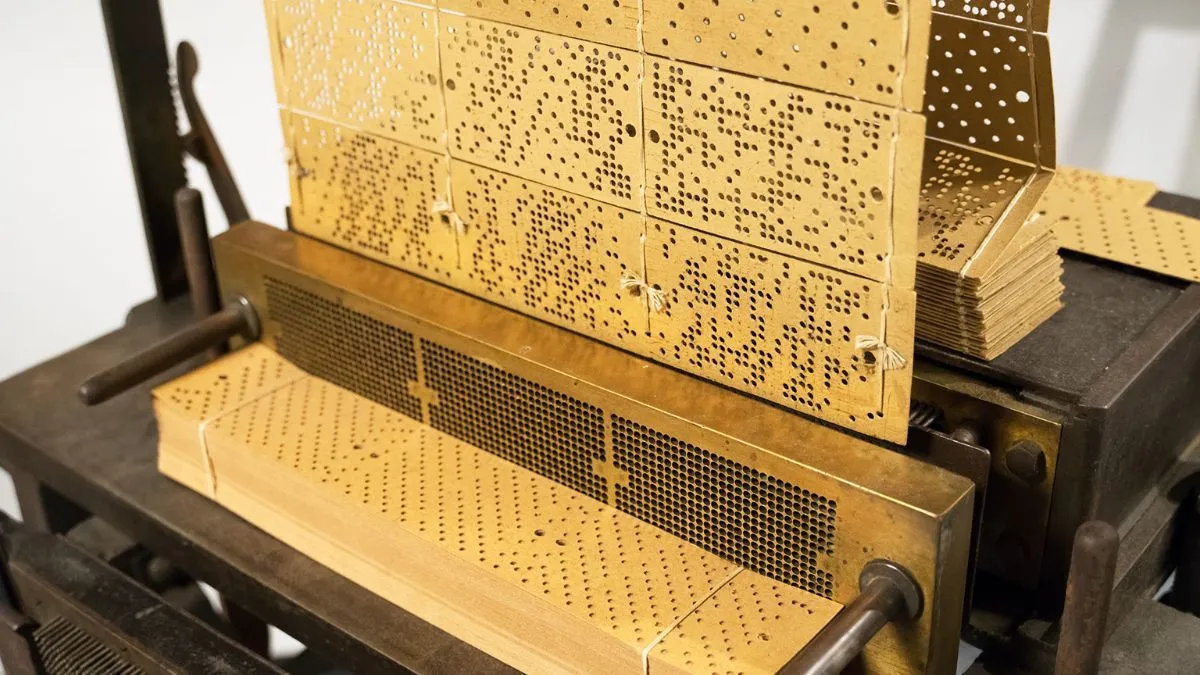
Everyone knows the Luddites smashed looms. What is less appreciated is that the loom was the first serious programmable device — the direct ancestor of the computer. Thus, the Luddites weren’t just the first to resist automation. They were the first to attack AI.

The Jacquard loom, introduced in France circa 1805, used a chain of punched cards to control which threads were raised for each pass of the shuttle. The ability to change the pattern of the loom’s weave by simply changing cards was an important conceptual precursor to computer programming. Babbage borrowed the idea directly for the Analytical Engine in the 1830s.
The Luddites lost–they were violently suppressed by the UK military–but more generally they lost because programmable looms brought patterned clothes to the masses.
Prior to its invention, the creation of complex patterns required skilled and labour-intensive manual labour, often involving large teams of weavers. With the Jacquard loom, a single operator could control the machine and produce intricate designs with relative ease.
This innovation greatly increased the speed and efficiency of textile production. It also opened up new possibilities for creativity and design, as the loom enabled the production of intricate patterns that were previously unattainable. The Jacquard loom contributed to the democratization of textile manufacturing, making intricate fabrics accessible to a wider audience
By the time Jacquard died in 1834, thousands of his looms were operating in Manchester, an epi-center of the Luddites riots. Moreover, just over 100 years later, Manchester birthed the Manchester Baby and the Manchester Mark 1, the first electronic stored-program computer. And who was hired to program the latter? None other than Alan Turing.
Ada Lovelace had foretold it all beautifully: “the Analytical Engine weaves algebraical patterns just as the Jacquard-loom weaves flowers and leaves.”
Addendum: I thank Claude for assistance on this post.