dailynewsnblog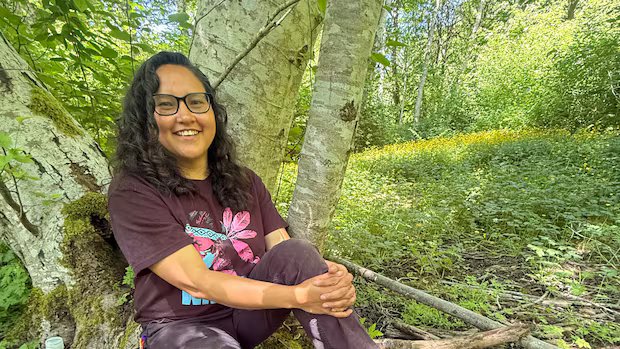

Listen to this article
Estimated 4 minutes
The audio version of this article is generated by AI-based technology. Mispronunciations can occur. We are working with our partners to continually review and improve the results.
Burn scars can still be seen on the oldest of Douglas fir trees on southern Vancouver Island, according to Tiffany Joseph, leader of the XAXE TEṈEW̱ Sacred Land Society’s Indigenous land restoration and stewardship program.
That is evidence that the W̱SÁNEĆ peoples have been conducting forest burns for generations, she said.
“Our ancestors, with their great observation skills that spanned over thousands of years, recognized that when a naturally occurring burn happened, the foods and the medicines were more abundant and of better quality.”
Joseph said that when her peoples’ ancestors realized that fire is a natural tool of the land, they began using it as a tool themselves.
“They took these places that were existing meadows and over thousands of years burned those meadows.”
But since 1904 —when the Vancouver Portland Cement Company opened a plant on the Tod Inlet and mined lime quarries in the area — the land hasn’t been properly cared for, she said.
“Our people do need to return because the land misses us.”
Joseph said the most important thing is that elders are consulted for her team’s burning practices. This year, she brought in Joe Gilchrist, a wildland firefighter for over 30 years from Skeetchestn, to teach them about cultural burning, prescribed burning and controlled burning to proactively prevent wildfires.
“A properly managed forest will have well spaced trees. Low limbs would be cut so that they’re not touching the ground,” Joseph said.

There are efforts to revive Indigenous firekeeping across B.C. These ecosystems depend on fire, according to William Nikolakis, an associate professor at University of British Columbia’s faculty of forestry and environmental stewardship.
Nikolakis works with the Gathering Voices Society and Yunesit’in of the Tŝilhqot’in Nation. His work supports and analyzes the effects of Indigenous stewardship on landscapes.
“We’re working with severely degraded landscapes that have been really thrashed,” he said.
“It’s about stewarding landscapes in ways that generate outcomes that are good for people, but as well as for the ecosystems.”
His work with First Nations fire stewards began in 2019, and he said knowledge pertaining to the needs of the land from Indigenous communities is invaluable. Now, it’s about “learning by doing.”
“You don’t want soils heating up through fire. You don’t want to kill saplings … we like to burn when there’s frozen ground or when we’re expecting snow or very cold nights,” he said.
Modelling suggests fire moves more slowly and at a lower intensity through areas that have seen cultural burnings, he added.
Nikolakis said preliminary evidence from his research — which has yet to be peer-reviewed — shows plants that have been burned through low-intensity fire are producing five times the berries, and have far more nutrients than at sites that were unburned.

“We’re seeing natural regrowth happening. And the community is seeing more deer on the landscape, elk coming back.”
He added the research backs that up, with 74 cameras across the landscape tracking vegetation and wildlife.
“Indigenous fire stewardship is about that connection that people have with that place so they can learn and understand when fire is needed on that landscape.”
Nikolakis sees that as a key part of restoring B.C.’s landscapes to being healthy.
Joseph is among many Indigenous land stewards who are reviving cultural practices and passing that knowledge on to the next generation.
“By looking after the forest, we are preventing wildfire … we’re also making sure that when our people feel safe to come back, that they have something beautiful to come back to,” she said.